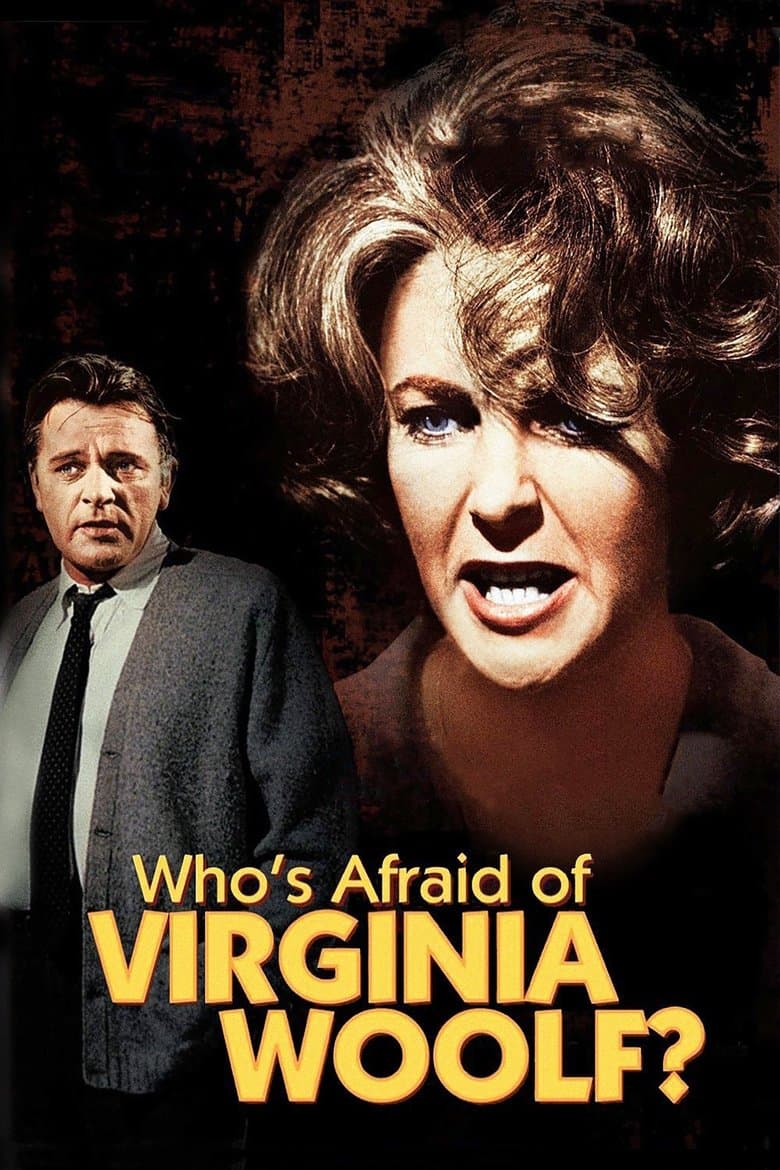
Who's Afraid of Virginia Woolf?
Vibe
Adapted from Edward Albee’s acclaimed stage play, this searing drama unfolds over the course of a long, alcohol-soaked night between middle-aged couple George and Martha and their younger guests, Nick and Honey. What begins as awkward post-party small talk gradually spirals into a brutal contest of humiliation, seduction, confession, and emotional warfare. Elizabeth Taylor and Richard Burton deliver ferocious performances as a couple whose marriage runs on cruelty, dependency, and painful intimacy, while Mike Nichols’s film debut uses close-ups, framing, and pacing to intensify the play’s psychological claustrophobia. Who’s Afraid of Virginia Woolf? remains one of American cinema’s most devastating portraits of marriage, illusion, and emotional truth.
Watch for
- Elizabeth Taylor and Richard Burton’s performances, especially the way affection, contempt, dependence, and theatricality keep shifting within the same exchange.
- Mike Nichols’s use of close-ups and confined interiors, which turns the house into a pressure chamber where every glance and pause feels dangerous.
- How the younger couple functions as both audience and mirror, gradually revealing their own vulnerabilities as George and Martha’s games intensify.
- The rhythm of the dialogue, where jokes, stories, and insults constantly blur together until performance itself becomes part of the film’s central question about truth and illusion.
Production notes
Who's Afraid of Virginia Woolf? was Mike Nichols's directorial debut — his adaptation of Edward Albee's 1962 Pulitzer Prize-winning stage play (an award the prize board ultimately withdrew due to the play's controversial content). The screenplay by Ernest Lehman preserved substantial material from Albee's original three-act stage play, with relatively limited cinematic restructuring. The film starred Elizabeth Taylor as Martha — the aging college president's daughter married to George, the disappointed history professor — and Richard Burton as George. Taylor and Burton were married at the time and would remain so for approximately fourteen years; the on-screen marital cruelty of their characters drew on the actors' substantial emotional intimacy. The cast included George Segal as the young biology professor Nick and Sandy Dennis as his wife Honey. The film's substantial Production Code controversy — the explicit sexual content and profanity of Albee's source play were substantially preserved in the film adaptation — was substantially shaped by the contemporary Production Code Administration's negotiated restraint, and the film was central to the eventual 1968 abolishment of the Production Code in favor of the MPAA ratings system. Cinematographer Haskell Wexler shot the film in black-and-white. Production cost approximately $7.5 million.
Trivia
- Mike Nichols's directorial debut on Who's Afraid of Virginia Woolf? was substantial — Nichols had been working in comedy with his partner Elaine May before transitioning to directing, and Virginia Woolf was his first major credit before his subsequent decade of major work including The Graduate (1967), Catch-22 (1970), Carnal Knowledge (1971), and Working Girl (1988).
- Elizabeth Taylor and Richard Burton were married at the time of production and would remain so for approximately fourteen years (with a brief 1974 divorce and 1975 remarriage); the on-screen marital cruelty of their characters drew substantially on the actors' real emotional intimacy, and the substantial chemistry has been continuously cited as one of the great on-screen pairings of the 1960s.
- Elizabeth Taylor reportedly gained approximately 30 pounds for the role of Martha — substantially against type from her established glamorous leading-lady image — and her commitment to the role's substantial physical and emotional demands won her the Academy Award for Best Actress, her second after Butterfield 8 (1960).
- The film's substantial Production Code controversy was substantially shaped by the contemporary Production Code Administration's negotiated restraint; the film was central to the eventual 1968 abolishment of the Production Code in favor of the MPAA ratings system that has continued since.
- Who's Afraid of Virginia Woolf? received thirteen Academy Award nominations and won five — Best Actress (Taylor), Best Supporting Actress (Sandy Dennis), Best Cinematography (Wexler), Best Art Direction, and Best Costume Design; it lost Best Picture to A Man for All Seasons in one of the more contested mid-1960s Oscar contests.
Legacy
Who's Afraid of Virginia Woolf? received thirteen Academy Award nominations — the second-most for any single 1966 release — and won five including Best Actress for Elizabeth Taylor (her second Oscar). It was selected for the National Film Registry in 2013. The film was central to the eventual 1968 abolishment of the Production Code Administration in favor of the MPAA ratings system; the substantial Production Code controversy around the film's preserved adult content demonstrated the impossibility of continuing the established Code structure in the face of contemporary adult-themed work. Mike Nichols's directorial debut launched his subsequent four-decade career as one of the most thoroughly respected American directors of his generation. The on-screen Taylor-Burton chemistry has been continuously cited as one of the great pairings of the 1960s, and the film stands as the most thoroughly serious treatment of their substantial real-life marital intimacy. Edward Albee's source play has been continuously revived in subsequent stage productions, with substantial productions starring Uta Hagen (the original Broadway Martha), Glenda Jackson, Diana Rigg, Kathleen Turner, Tracy Letts and Amy Morton, and other major theatrical performers.