The Searchers
Vibe
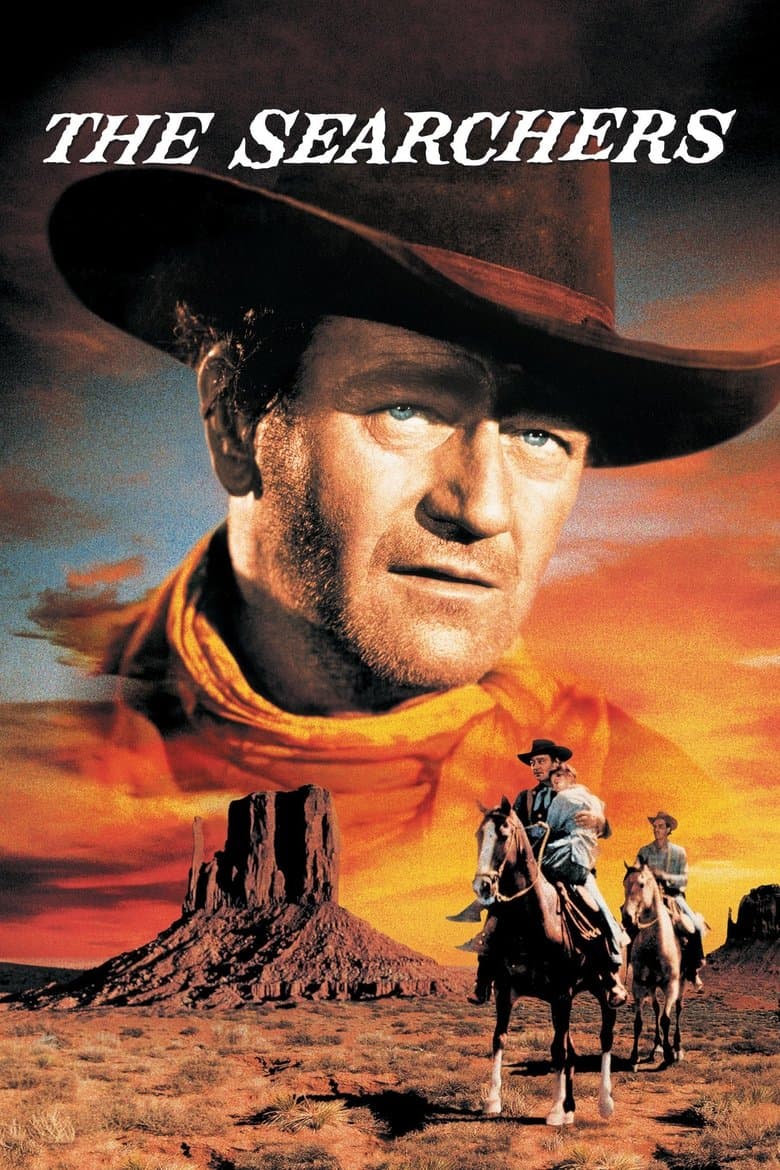
John Ford’s landmark Western follows Ethan Edwards, a hardened Civil War veteran who returns to his family’s Texas homestead only to set out on a years-long search after a Comanche raid shatters their lives. Joined by his adopted nephew Martin, Ethan pursues the missing Debbie across vast frontier landscapes, but the journey becomes as much about obsession, hatred, and identity as rescue. John Wayne gives one of his most complex performances, turning Ethan into a figure of power, prejudice, and deep emotional isolation. With its monumental use of Monument Valley and its haunting moral ambiguity, The Searchers remains one of the most influential Westerns ever made.
Watch for
- Ford’s use of doorways, horizons, and Monument Valley landscapes, which frame the frontier as both majestic and emotionally forbidding.
- John Wayne’s performance as Ethan, especially the way menace, grief, and obsessive purpose flicker beneath his outward authority.
- The evolving contrast between Ethan and Martin, whose different values turn the search into a conflict over what rescue, family, and justice really mean.
- How the film balances sweeping adventure with unsettling moral tension, gradually revealing that the greatest threat may come from within the search party itself.
Production notes
The Searchers was John Ford's adaptation of Alan Le May's 1954 novel, with the screenplay by Frank S. Nugent. The film is widely regarded as one of John Ford's masterworks and as one of the canonical American westerns. John Wayne played Ethan Edwards, a Confederate veteran returning to his brother's Texas frontier homestead in 1868; when his brother's family is killed in a Comanche raid and his niece Debbie is taken captive, Ethan begins a multi-year obsessive search to find her. The cast included Jeffrey Hunter as Martin Pawley (Ethan's adopted nephew), Vera Miles as Laurie Jorgensen, Ward Bond as Reverend Samuel Johnson Clayton, Natalie Wood as the older Debbie, Lana Wood as the younger Debbie, and Henry Brandon as Chief Scar. Ford shot the film extensively in Monument Valley — his signature location across nearly two decades of work — with the actual geological monoliths providing the visual atmosphere that has become permanent shorthand for the American western. Cinematographer Winton C. Hoch shot the film in VistaVision. Composer Max Steiner contributed the score. Production cost approximately $3.7 million.
Trivia
- The Searchers received no Academy Award nominations on its 1956 release — an outcome that has been continuously cited as one of the most thorough Oscar snubs in cinema history; the film's contemporary critical reception was mixed, and its substantial reputation as one of the canonical American westerns came primarily through subsequent decades of critical reassessment.
- John Wayne's Ethan Edwards has been continuously cited as one of the most morally complex characters in any American western; the role's depiction of a Confederate veteran whose racism and revenge-obsession drive a years-long search for his Comanche-captive niece was substantially ahead of its time for 1956 American cinema.
- The famous closing image — John Wayne framed in the doorway of the Jorgensen homestead, then turning to walk back into the wilderness alone — has been continuously celebrated as one of the most thoroughly resonant closing shots in any American cinema; the image has been directly referenced and parodied across decades of subsequent media.
- The Searchers is widely regarded as one of the most-influential American films of the postwar period — particularly on subsequent generations of American filmmakers; Martin Scorsese, Steven Spielberg, George Lucas, Paul Schrader, and many others have explicitly cited The Searchers as a foundational influence on their work, with Schrader's screenplay for Taxi Driver (1976) substantially shaped by the film.
- The film's depiction of racial conflict between American settlers and the Comanche has been the subject of substantial subsequent critical reassessment; the film's 1950s perspective on the conflict has aged in complex ways, with the substantial moral complexity of Ethan Edwards's character offering both a substantial critique of frontier racism and a substantial preserved center of American mythologization.
Legacy
The Searchers received no Academy Award nominations on its 1956 release — an outcome that has been continuously cited as one of the most thorough Oscar snubs in cinema history; the film's substantial reputation as one of the canonical American westerns came primarily through subsequent decades of critical reassessment. It was selected for the National Film Registry in 1989. Sight & Sound's decennial critics' polls have consistently placed The Searchers among the greatest films ever made. The film has been widely cited as one of the most-influential American films of the postwar period — particularly on subsequent generations of American filmmakers; Martin Scorsese, Steven Spielberg, George Lucas, Paul Schrader, and many others have explicitly cited The Searchers as a foundational influence on their work. The famous closing image — John Wayne framed in the doorway then turning to walk back into the wilderness — has been continuously celebrated as one of the most resonant closing shots in any American cinema. Among John Ford's films, The Searchers sits alongside Stagecoach (1939) and The Man Who Shot Liberty Valance (1962) as the canonical achievements of his western career.