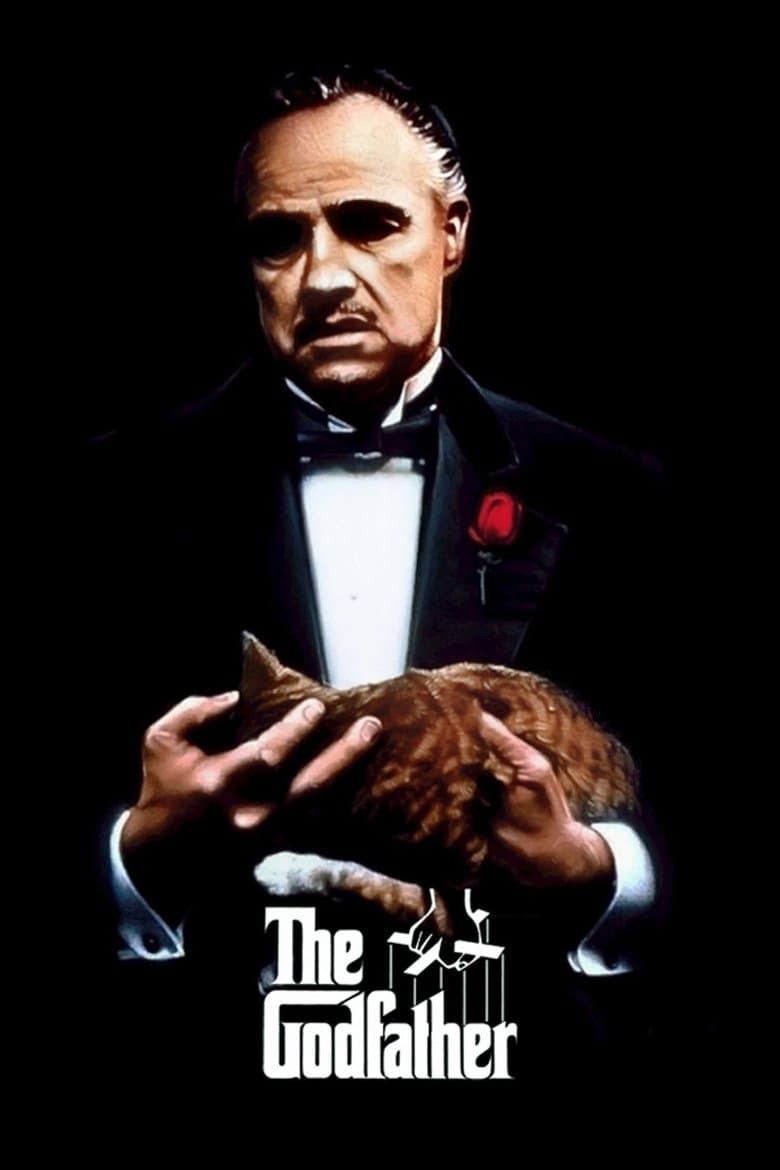
The Godfather
Vibe
Francis Ford Coppola’s sweeping crime epic follows the powerful Corleone family as aging patriarch Vito Corleone struggles to maintain control of his Mafia empire in postwar America. When a rival gang attempts to assassinate Vito, the family is thrust into a violent power struggle that draws his youngest son, Michael, into the criminal world he once rejected. Over time, Michael transforms from decorated war hero into a cold and calculating leader determined to protect the family at any cost. With haunting cinematography by Gordon Willis, an unforgettable score by Nino Rota, and iconic performances from Marlon Brando and Al Pacino, The Godfather elevated the gangster genre into Shakespearean tragedy. Its exploration of family loyalty, power, corruption, and the American dream has made it one of the most revered films ever produced.
Watch for
- Gordon Willis’s shadowy cinematography, which uses darkness and warm amber tones to give the Corleone world a powerful, almost mythic atmosphere.
- Michael Corleone’s gradual transformation from outsider to ruthless leader, revealed through subtle shifts in performance and framing.
- The famous baptism sequence, where parallel editing contrasts sacred ritual with calculated violence.
- How the film balances intimate family moments with large-scale power struggles, reinforcing the theme that in the Corleone world, family and business are inseparable.
Production notes
The Godfather was Paramount's adaptation of Mario Puzo's 1969 bestselling novel, with Puzo and director Francis Ford Coppola sharing screenplay credit. Coppola was hired as a relatively unproven director — at 32 he was the youngest major Hollywood director on a project of this scale — and the studio's preference for Marlon Brando as Vito Corleone was not initially shared by Paramount executives, who pushed for other stars. Brando's audition tape, in which he stuffed his cheeks with tissue paper to suggest the character's jowls, secured the role on the condition that he take only a modest fee with profit participation. Al Pacino was cast as Michael over the studio's strenuous objections. The cast included James Caan as Sonny, Robert Duvall as Tom Hagen, Diane Keaton as Kay, Talia Shire as Connie, and John Cazale as Fredo. Cinematographer Gordon Willis's signature dark, amber-toned interiors became one of the most influential visual approaches in American cinema. Composer Nino Rota's main theme is one of the most recognizable in all of film. Production cost approximately $6 million.
Trivia
- Paramount executives wanted Robert Redford or Ryan O'Neal as Michael Corleone instead of Al Pacino, and pressured Coppola throughout production to recast; Coppola's refusal — backed by Brando's quiet support — preserved one of the defining performances in American cinema.
- The horse's head in the producer Jack Woltz's bed was real — obtained from a slaughterhouse — and the actor John Marley's reaction in the scene reportedly contained genuine shock, as he had not been told the head would be present.
- Marlon Brando's gravelly, congested voice for Vito Corleone was achieved partly through dental prosthetics built by makeup artist Dick Smith — appliances that pushed Brando's lower jaw forward — and partly through deliberate vocal performance.
- Composer Nino Rota's main theme had been previously used in his score for the 1958 Italian film Fortunella; this earlier use disqualified Rota from a Best Original Score Academy Award, and his Godfather score lost the nomination on technical grounds.
- The Godfather grossed approximately $250 million worldwide on a $6 million budget — a return on investment comparable to any major studio release in history — and held the title of highest-grossing film of all time briefly until The Exorcist surpassed it in late 1973.
Legacy
The Godfather is one of the most influential films ever made, with a cultural and critical reach that extends across nearly every aspect of subsequent American cinema. It won three Academy Awards including Best Picture, Best Actor for Brando (which Brando declined, sending Sacheen Littlefeather in his place to protest Hollywood's treatment of Native Americans), and Best Adapted Screenplay. Sight & Sound, the American Film Institute, the Directors Guild of America, and most major critics' polls regularly rank it among the greatest films ever made; the National Film Registry inducted it in 1990. The 1974 sequel The Godfather Part II, also directed by Coppola, won six Academy Awards including Best Picture — making the Godfather films the only sequence in which both an original and its sequel won Best Picture. Together they established the template for American crime cinema, shaping the work of Martin Scorsese, Brian De Palma, and the entire subsequent prestige-mob tradition. The film's vision of family, loyalty, and the corruption of legitimacy by violence has become permanent vocabulary for American storytelling.