Swing Time
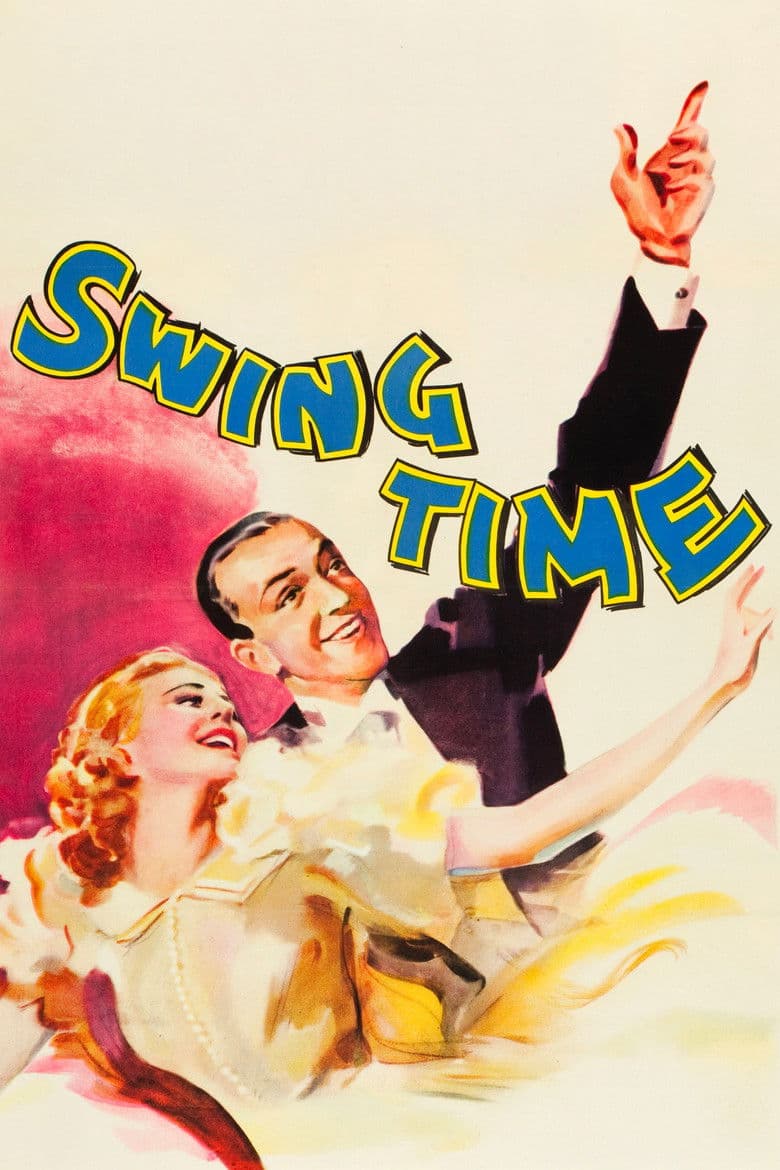
Vibe
Fred Astaire and Ginger Rogers deliver one of their most beloved screen pairings in this elegant musical romance. Astaire plays Lucky Garnett, a carefree gambler and gifted dancer who travels to New York to earn enough money to marry his fiancée, only to fall for dance instructor Penny Carroll. What follows is a light, witty courtship shaped as much by misunderstanding and timing as by attraction. Directed by George Stevens, the film pairs sparkling comic rhythm with some of the duo’s most celebrated dance numbers, including the sublime “Never Gonna Dance.” Swing Time remains one of the high points of the classic Hollywood musical and one of Astaire and Rogers’s finest collaborations.
Watch for
- The chemistry between Astaire and Rogers, whose contrasting energies—his effortless smoothness and her grounded warmth—create both comic sparkle and romantic depth.
- How the dance sequences reveal changing emotions, especially in “Pick Yourself Up” and “Never Gonna Dance,” where flirtation, longing, and heartbreak are carried through movement.
- George Stevens’s unobtrusive direction, which gives the performers room to shine while keeping the film’s tone light, fluid, and emotionally precise.
- Jerome Kern and Dorothy Fields’s songs, which help shape the film’s mood and make the romance feel buoyant even when the plot turns toward separation and regret.
Production notes
Swing Time was George Stevens's musical comedy — the sixth of the ten Fred Astaire-Ginger Rogers RKO Radio Pictures musical pairings, and widely considered the most thoroughly realized of the partnership. The screenplay was credited to Howard Lindsay and Allan Scott. Fred Astaire played the song-and-dance gambler John 'Lucky' Garnett, with Ginger Rogers as the dance instructor Penny Carroll. The cast included Victor Moore as Lucky's gambling partner Pop Cardetti, Helen Broderick as Penny's friend Mabel Anderson, Eric Blore as Mr. Gordon (the head of the Gordon Dance Academy), and Betty Furness as Margaret Watson (Lucky's fiancée from his hometown). The film's substantial choreographic ambition was central — the Jerome Kern and Dorothy Fields songs included 'A Fine Romance,' 'Pick Yourself Up,' 'The Way You Look Tonight' (which won the Academy Award for Best Original Song), and 'Bojangles of Harlem' (a substantial blackface dance tribute to Bill 'Bojangles' Robinson that has become substantially controversial in subsequent reception). The famous 'Never Gonna Dance' final dance sequence required approximately 47 takes — substantially more than any other Astaire-Rogers dance sequence — and Ginger Rogers reportedly danced in bloodied feet for the final takes. Cinematographer David Abel shot the film. Composer Jerome Kern's songs (with lyrics by Dorothy Fields) provided the music.
Trivia
- The famous 'Never Gonna Dance' final dance sequence required approximately 47 takes — substantially more than any other Astaire-Rogers dance sequence — and Ginger Rogers reportedly danced in bloodied feet for the final takes; the substantial physical commitment to perfect-take perfectionism was characteristic of Fred Astaire's substantial dance-rehearsal approach.
- The film's 'Bojangles of Harlem' sequence — a Fred Astaire dance tribute to Bill 'Bojangles' Robinson — was performed in blackface, which has become substantially controversial in subsequent reception; the sequence reflects the substantial racial conventions of 1936 American cinema, and contemporary screenings often involve substantial framing discussions around the sequence's content.
- Jerome Kern and Dorothy Fields wrote the songs for Swing Time, with 'The Way You Look Tonight' winning the Academy Award for Best Original Song; 'The Way You Look Tonight' has become one of the most-performed standards in American popular music, recorded across countless artists from Frank Sinatra to Tony Bennett to substantially modern performers.
- Swing Time was the sixth of the ten Fred Astaire-Ginger Rogers RKO Radio Pictures musical pairings — Flying Down to Rio (1933), The Gay Divorcee (1934), Roberta (1935), Top Hat (1935), Follow the Fleet (1936), Swing Time (1936), Shall We Dance (1937), Carefree (1938), and The Story of Vernon and Irene Castle (1939) — and widely considered the most thoroughly realized of the partnership.
- George Stevens directed Swing Time relatively early in his career — before his subsequent transition to substantial epic-prestige directing on Shane (1953), Giant (1956), and other major films; Stevens's substantial visual-comedic ambition on Swing Time would inform his subsequent work, though the substantial choreographic-musical mode was unique to this period of his career.
Legacy
Swing Time won the Academy Award for Best Original Song ('The Way You Look Tonight') and received one additional nomination. It was selected for the National Film Registry in 2004. Swing Time is widely regarded as the most thoroughly realized of the ten Fred Astaire-Ginger Rogers RKO Radio Pictures musical pairings — Top Hat (1935) is the substantial alternative claim for that designation, with the two films constituting the canonical achievements of the partnership. The Jerome Kern and Dorothy Fields songs — particularly 'The Way You Look Tonight' — have become some of the most-performed standards in American popular music. The film's 'Bojangles of Harlem' sequence — a Fred Astaire dance tribute to Bill 'Bojangles' Robinson performed in blackface — has become substantially controversial in subsequent reception, reflecting the substantial racial conventions of 1936 American cinema. Among Astaire-Rogers musicals, Swing Time sits alongside Top Hat (1935) and Shall We Dance (1937) as the canonical achievements, with the substantial choreographic ambition of the 'Never Gonna Dance' final sequence widely cited as the high-water mark of the Astaire-Rogers partnership.