Sunset Blvd.
Vibe
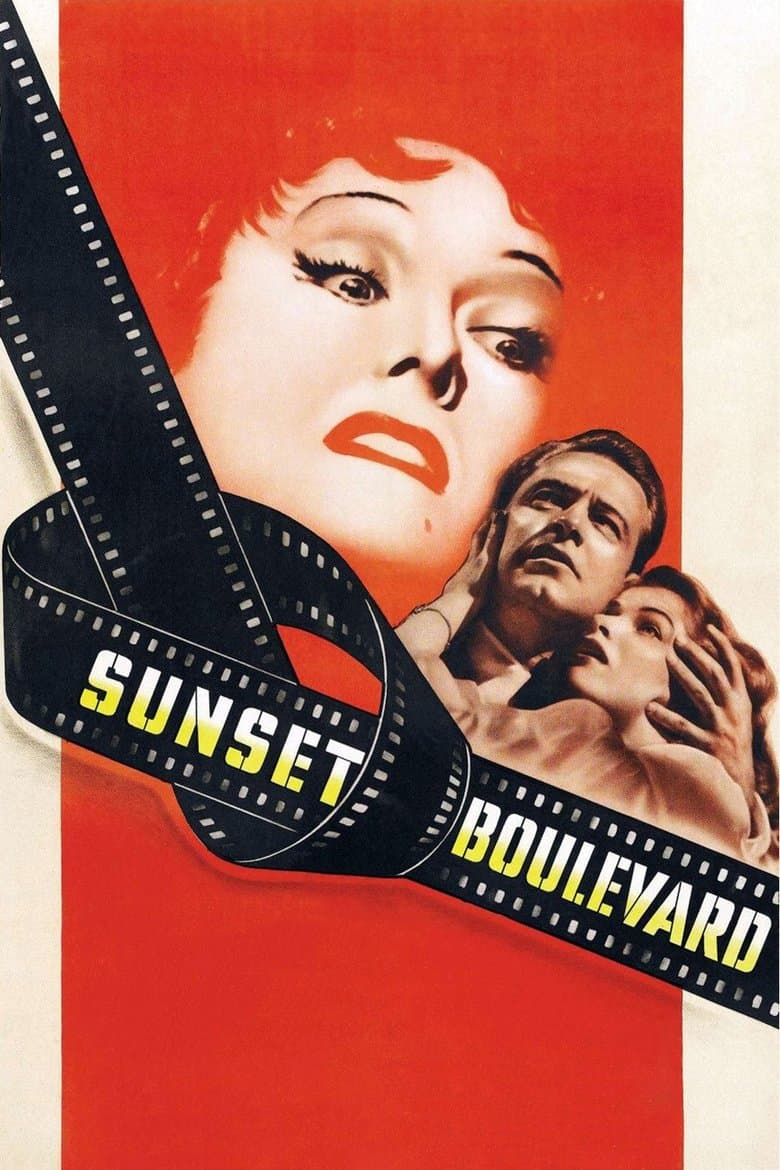
Billy Wilder’s dark Hollywood satire follows struggling screenwriter Joe Gillis, who becomes entangled with Norma Desmond, a reclusive silent-film star clinging to fantasies of a triumphant comeback. After Joe hides out at her decaying mansion on Sunset Boulevard, he is drawn into her world of wealth, delusion, and fading glamour, helping revise a screenplay meant to restore her stardom. What begins as a convenient arrangement gradually becomes a dangerous emotional trap. Gloria Swanson delivers a haunting performance as Norma, embodying both tragic vulnerability and grandiose self-delusion. Narrated from beyond the grave, the film blends film noir style with razor-sharp commentary on Hollywood’s obsession with youth, fame, and reinvention.
Watch for
- The famous opening narration delivered by a dead man, which immediately establishes the film’s cynical tone.
- Gloria Swanson’s theatrical performance style, reflecting both Norma’s silent-film past and her unstable emotional world.
- The eerie atmosphere of Norma’s decaying mansion, symbolizing Hollywood’s forgotten past.
- Billy Wilder’s biting dialogue and visual irony, especially in scenes where Hollywood dreams collide with harsh reality.
Production notes
Sunset Boulevard was Billy Wilder's noir-tinged Hollywood-on-Hollywood drama, made for Paramount with co-screenwriters Charles Brackett (their final collaboration after 13 years together) and D.M. Marshman Jr. The film stars Gloria Swanson — herself a major silent-era star whose actual career decline mirrored the role of Norma Desmond — opposite William Holden as the failed screenwriter Joe Gillis. The cast included Erich von Stroheim (also a real fallen silent-era director, playing Norma's former director) as Max von Mayerling, Nancy Olson as Betty Schaefer, and a remarkable supporting cast that included Buster Keaton, H.B. Warner, and Anna Q. Nilsson playing themselves at Norma's bridge game ('the waxworks'). Cecil B. DeMille appeared as himself. Cinematographer John Seitz shot the film. Composer Franz Waxman won the Academy Award for the score. The famous opening sequence — the dead Joe narrating the film from the bottom of Norma's swimming pool — has become one of the most influential framing devices in American cinema. Production cost approximately $1.75 million.
Trivia
- Gloria Swanson's role as Norma Desmond was casting against type but with extraordinary autobiographical resonance — Swanson had been one of the highest-paid silent stars of the 1920s, and her career had genuinely collapsed in the sound era as the film's narrative depicts.
- Erich von Stroheim, who plays Norma's former director Max, had himself been a major silent-film director (Greed, The Wedding March) whose actual career had been destroyed by Hollywood's commercial decisions — making the casting one of the most pointed self-references in American cinema.
- The original first scene set Joe Gillis's narration in a morgue, with the corpses of recently-dead screenwriters introducing themselves to him; Wilder cut the morgue scene after preview audiences laughed inappropriately, replacing it with the now-famous swimming-pool opening.
- Gloria Swanson, despite the role's autobiographical resonance, was not the first choice for Norma Desmond; Wilder had pursued Mary Pickford and Pola Negri before Swanson agreed.
- The film received eleven Academy Award nominations and won three (Best Original Screenplay, Best Art Direction, Best Original Score), but lost Best Picture and Best Director to All About Eve — a contest considered one of the closest in Oscar history.
Legacy
Sunset Boulevard is widely considered one of the great films about Hollywood — a noir-tinged self-portrait of the industry that has remained unmatched in its bitterness, its precision, and its literary register. It received eleven Academy Award nominations (winning three) and was selected for the inaugural class of the National Film Registry in 1989. Norma Desmond's lines — particularly 'I am big. It's the pictures that got small' and 'All right, Mr. DeMille, I'm ready for my close-up' — have become permanent shorthand for the toxic relationship between Hollywood and its aging performers. Andrew Lloyd Webber's 1993 stage musical adaptation, starring Glenn Close and later Patti LuPone, brought the story to a new generation. The film's literary qualities — its bitter dialogue, its nested narrative structure, its central images of decay — have made it one of the most-cited American films in academic film criticism. Among Wilder's films, Sunset Boulevard sits alongside Some Like It Hot and The Apartment as the high-water marks of his career, and is regularly named the greatest film about Hollywood ever made.