Sunrise
Vibe
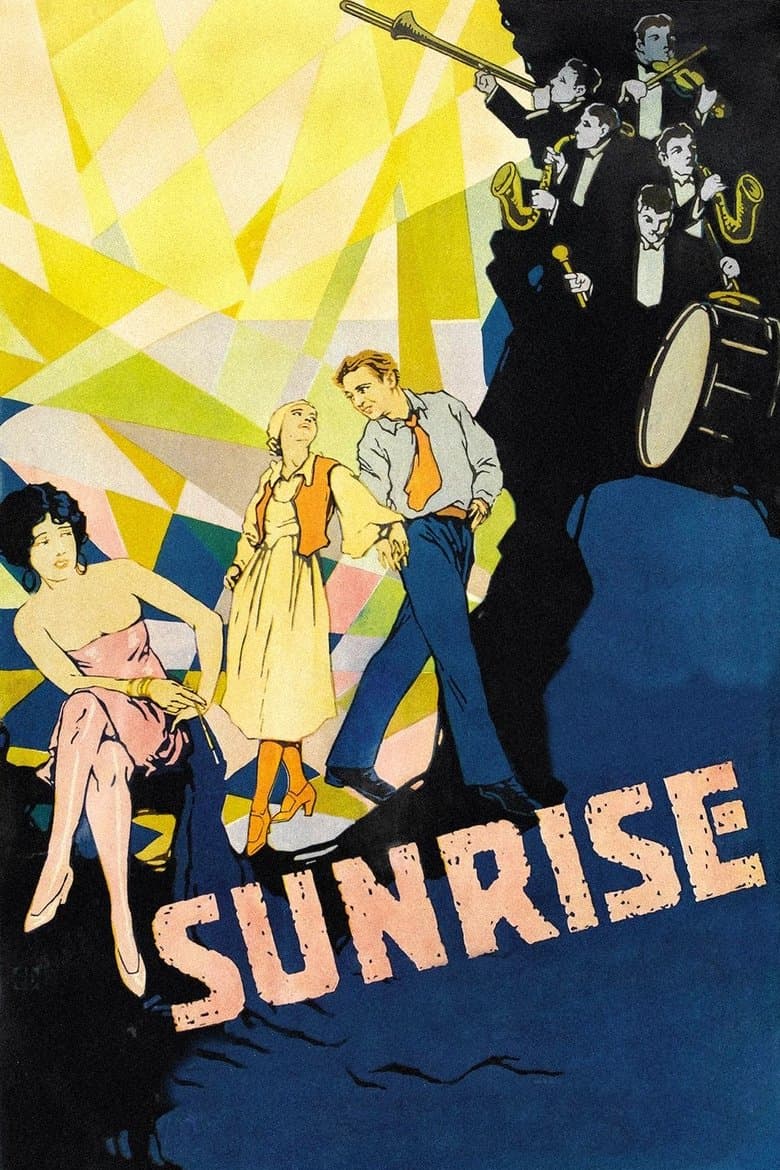
F.W. Murnau’s silent masterpiece begins with a farmer drawn into a murderous temptation by a seductive woman from the city, who urges him to kill his devoted wife and start a new life with her. But when he brings his wife across the lake with the crime in mind, guilt overwhelms him, and the day becomes an emotional odyssey through betrayal, terror, reconciliation, and renewal. Murnau transforms this simple story into something visually extraordinary through fluid camera movement, superimposition, expressive lighting, and a dreamlike command of mood. Sunrise remains one of the great achievements of silent cinema and one of the purest demonstrations of film as visual emotion.
Watch for
- Murnau’s camera movement, especially the way tracking shots and shifting compositions make emotion feel physically embodied in space.
- The contrast between the rural world, the city, and the lakeside journey, each rendered with a distinct visual atmosphere that mirrors the couple’s emotional state.
- How expressionistic techniques—superimpositions, lighting, and stylized sets—turn inner feeling into visible cinematic form.
- The gradual transformation in the husband and wife’s body language, where fear, remorse, tenderness, and rediscovered intimacy unfold through gesture as much as through plot.
Production notes
Sunrise: A Song of Two Humans was F.W. Murnau's first Hollywood film — produced after Fox Film Corporation had recruited the substantial German Expressionist director away from Germany. The screenplay by Carl Mayer (based on Hermann Sudermann's 1917 short story 'Die Reise nach Tilsit') tells the story of a country farmer who plans to murder his wife at the urging of a city seductress, then experiences a substantial moral transformation. The film was Fox's substantial production-resource commitment to the prestige-feature form — Murnau was given substantial creative freedom and budget, and the resulting production was extraordinarily ambitious for any 1927 film. George O'Brien played the unnamed husband, Janet Gaynor played his unnamed wife (a performance that won Gaynor the inaugural Academy Award for Best Actress, a recognition shared across her work in three films), and Margaret Livingston played the unnamed city woman. The film was released with Movietone synchronized sound — making it one of the earliest synchronized-sound features released by a major Hollywood studio, though dialogue remained in intertitles rather than synchronized speech. Cinematographers Charles Rosher and Karl Struss shot the film. Composer Hugo Riesenfeld arranged the score. Production cost approximately $1 million.
Trivia
- Janet Gaynor won the inaugural Academy Award for Best Actress for her performances across three films — Sunrise, 7th Heaven (1927), and Street Angel (1928) — making her the first Best Actress winner and the only winner ever to receive the award for multiple films simultaneously; the Academy subsequently restricted the award to single-performance nominations beginning the following year.
- Sunrise won the inaugural Academy Award for 'Unique and Artistic Production' — a category that existed only at the first Academy Awards ceremony in 1929 and was distinct from Best Picture; the category was retired after the first ceremony, making Sunrise the only film to win it.
- F.W. Murnau had been recruited away from Germany by Fox Film Corporation after his substantial international success with Nosferatu (1922) and The Last Laugh (1924); Murnau's Hollywood career would be tragically brief — he died in a car accident in Santa Barbara, California in March 1931, only four years after Sunrise's release.
- The film was released with Movietone synchronized sound — making it one of the earliest synchronized-sound features released by a major Hollywood studio, though dialogue remained in intertitles rather than synchronized speech; The Jazz Singer (1927) would be released approximately one month after Sunrise and would substantially overshadow Sunrise's technological achievement.
- Sunrise was a substantial commercial disappointment on its 1927 release — losing money for Fox Film Corporation despite the substantial critical praise — and its substantial subsequent reputation came primarily through decades of critical reassessment, with Sight & Sound's decennial critics' poll consistently placing the film among the greatest films ever made.
Legacy
Sunrise: A Song of Two Humans won three Academy Awards at the inaugural Academy Awards ceremony in 1929 — Best Actress (Janet Gaynor, for her work across three films including Sunrise), Best Cinematography (Charles Rosher and Karl Struss), and Best 'Unique and Artistic Production' (a category that existed only at the first ceremony). It was selected for the inaugural class of the National Film Registry in 1989. Sight & Sound's decennial critics' polls have consistently placed Sunrise among the greatest films ever made — the 2012 poll ranked it #5 overall. The film's substantial visual ambition — the integration of German Expressionist visual techniques with American Hollywood production values — established a template that influenced subsequent generations of filmmakers, with direct lineage to John Ford's American films of the 1930s and 1940s and the entire subsequent tradition of expressionist-influenced American cinema. Among silent-to-sound transition films, Sunrise stands as one of the most thoroughly ambitious achievements — its substantial subsequent reputation as one of cinema's masterpieces has substantially exceeded its modest 1927 commercial reception, in one of the most thorough critical reassessments in any cinema.