Sullivan's Travels
Vibe
Preston Sturges’s witty comedy follows successful Hollywood director John L. Sullivan, who grows dissatisfied with lightweight entertainments and sets out to make a serious film about poverty. Convinced that he must experience hardship firsthand, he disguises himself as a drifter and heads out on the road, only to discover that suffering is harder to understand—and easier to romanticize—than he imagined. Sturges blends screwball energy with sharp social observation, turning the film into both a satire of Hollywood self-importance and a sincere reflection on what movies can offer people in difficult times. Sullivan’s Travels remains one of the smartest and most influential comedies of the studio era.
Watch for
- How Sturges shifts the tone from manic Hollywood satire to road-movie hardship and then to something unexpectedly moving, without ever fully abandoning comedy.
- Joel McCrea’s performance, which makes Sullivan both sincere and faintly ridiculous, allowing the film to critique him without losing sympathy.
- The scenes that expose the gap between privilege and lived suffering, especially when Sullivan’s ideas about poverty collide with actual danger and humiliation.
- The church screening sequence, where the shared response to comedy becomes the emotional and philosophical heart of the film.
Production notes
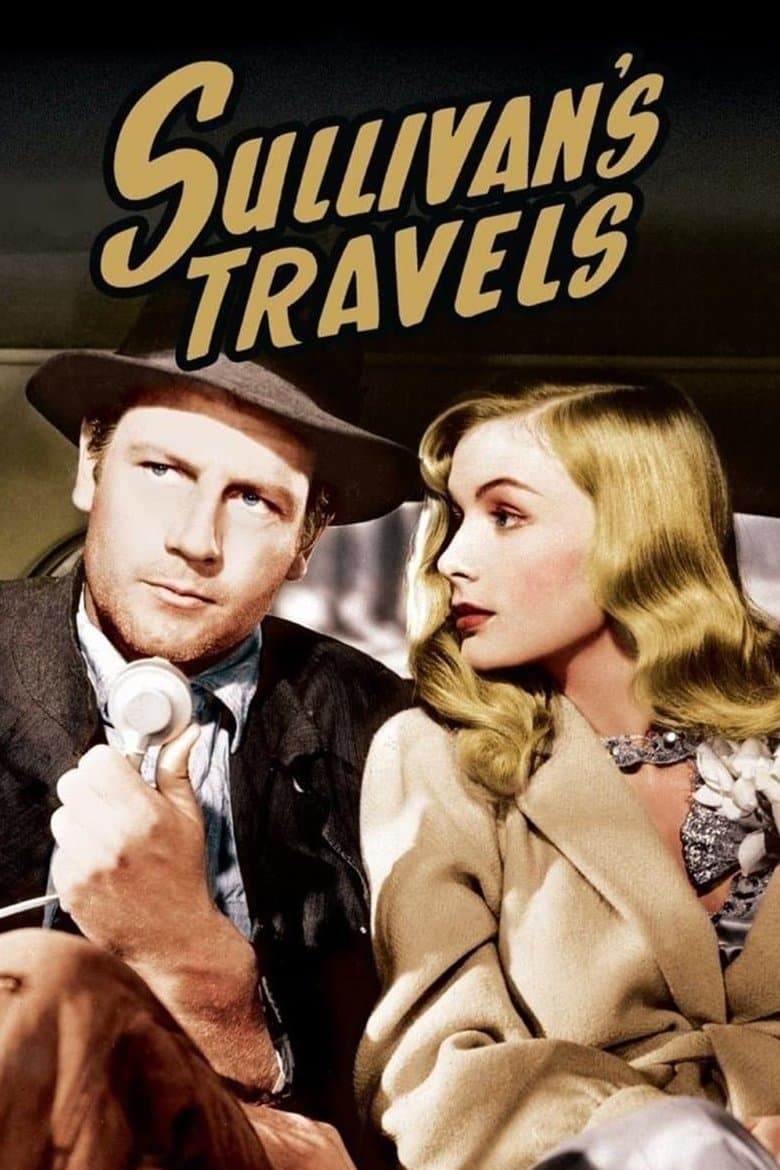
Sullivan's Travels was Preston Sturges's comedy-drama about a successful Hollywood comedy director who decides to make a serious social-message film about poverty — and goes on the road as a hobo to research the actual American underclass before returning to making comedies. The screenplay was Sturges's own (in his characteristic mode as both writer and director). The film was Paramount Pictures's substantial commitment to Sturges's distinctive writer-director model — Sturges had been one of the highest-paid screenwriters in Hollywood before transitioning to directing with The Great McGinty (1940), and Sullivan's Travels was his third feature as director. Joel McCrea played John L. Sullivan, the Hollywood comedy director, with Veronica Lake as 'The Girl' (the unnamed actress and Sullivan's traveling companion). The cast included William Demarest as the Sullivan production company's manager Jones, Robert Warwick as LeBrand, Porter Hall as Hadrian, and Franklin Pangborn as Casalsis. Cinematographer John F. Seitz shot the film. Composer Leo Shuken contributed the score. Production cost approximately $689,000.
Trivia
- Sullivan's Travels is the first major Hollywood film to substantially engage with the question of whether comedy or serious social-message filmmaking has greater cultural value; the film's substantial conclusion — that comedy itself is morally valuable because of the comfort it provides to those who suffer — has been continuously studied as a foundational text of Hollywood's self-understanding.
- Veronica Lake was eight months pregnant during much of the production — a fact Preston Sturges did not know when he cast her — and the production had to extensively work around her advancing pregnancy through careful framing, costume design, and shot composition; Sturges reportedly almost fired her when he learned, but completed the production with her in the role.
- Joel McCrea was Preston Sturges's preferred leading man and appeared in three of his films (Sullivan's Travels, The Palm Beach Story, and The Great Moment); McCrea was 36 when he made Sullivan's Travels, and the casting drew on his established image as a capable, slightly weary, comedy-romantic leading man.
- The famous title O Brother, Where Art Thou? — the serious social-message film that John L. Sullivan wants to make in Sullivan's Travels — was used by Joel and Ethan Coen as the title for their 2000 film O Brother, Where Art Thou?, an explicit homage to Sturges's earlier work; the Coens' film is loosely based on Homer's Odyssey but retains the original Sullivan's Travels title as homage.
- Sullivan's Travels received no Academy Award nominations on its 1941 release; the film's substantial subsequent reputation has come primarily through critical reassessment from the 1950s onward, with Preston Sturges's specific writer-director model becoming the canonical influence on subsequent comedic-auteur careers.
Legacy
Sullivan's Travels received no Academy Award nominations on its 1941 release but has aged into one of the most thoroughly respected American comedies. It was selected for the National Film Registry in 1990. The film's central thematic concern — whether comedy or serious social-message filmmaking has greater cultural value, with the substantial conclusion that comedy itself is morally valuable because of the comfort it provides to those who suffer — has been continuously studied as a foundational text of Hollywood's self-understanding. The famous title 'O Brother, Where Art Thou?' was used by Joel and Ethan Coen as the title for their 2000 film, an explicit homage to Sturges's earlier work. Preston Sturges's specific writer-director model — the substantial creative authority of a single voice across writing and directing, with consistent ensemble of supporting actors across multiple projects — became the canonical template for subsequent comedic auteurs from Billy Wilder through Mel Brooks to the Coen Brothers and beyond. Among Preston Sturges's films, Sullivan's Travels sits alongside The Lady Eve (1941), The Palm Beach Story (1942), and The Miracle of Morgan's Creek (1944) as the canonical achievements of his brief but extraordinary four-year peak period.