Sophie's Choice
Vibe
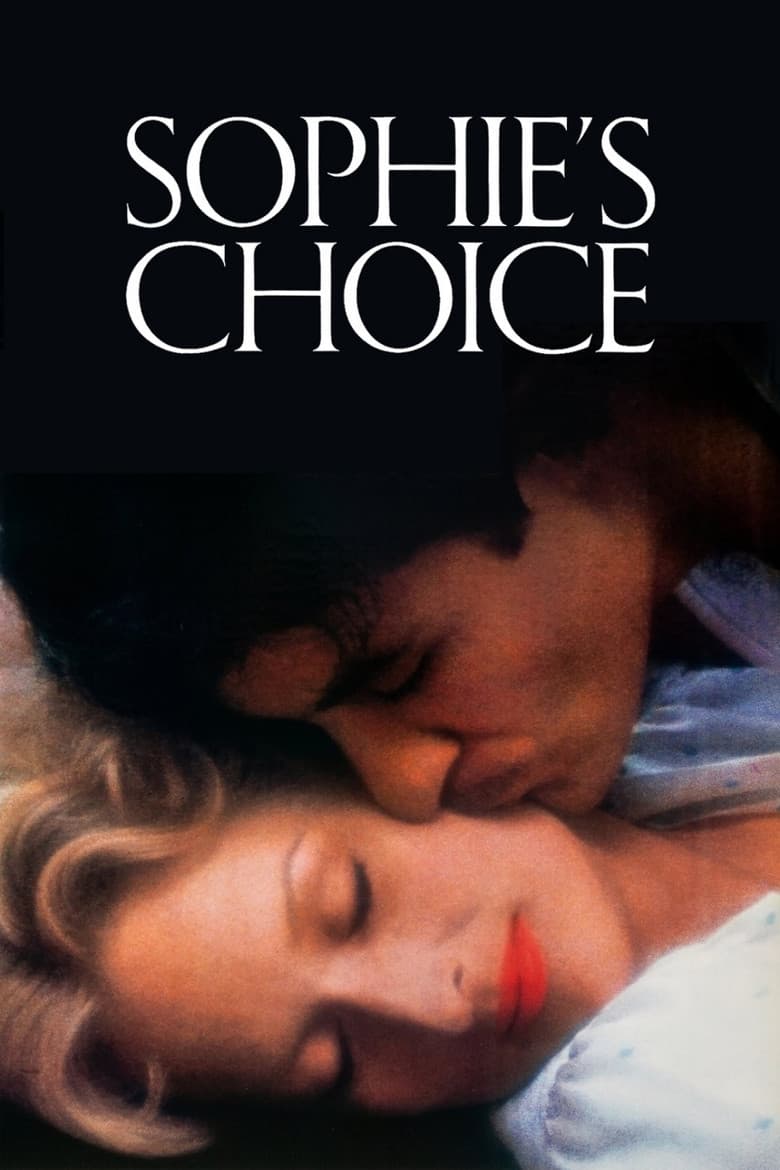
Set in postwar Brooklyn, the film follows Stingo, a young Southern writer who becomes drawn into the troubled lives of Sophie, a Polish immigrant, and Nathan, her brilliant but unstable lover. As Stingo grows closer to Sophie, fragments of her past begin to surface, revealing the unimaginable trauma she endured during World War II. Meryl Streep’s extraordinary performance gives Sophie both fragility and emotional depth, capturing a woman shaped by guilt, memory, and the burden of survival. Directed by Alan J. Pakula and adapted from William Styron’s novel, Sophie’s Choice remains one of cinema’s most devastating explorations of trauma, memory, and moral anguish.
Watch for
- Meryl Streep’s performance, especially the way Sophie shifts between warmth, charm, fear, and collapse as different parts of her past resurface.
- How Pakula contrasts the relative safety of postwar Brooklyn with the unbearable weight of memory, making the past feel ever-present even in quiet scenes.
- The triangular dynamic among Sophie, Nathan, and Stingo, which reveals how desire, dependency, admiration, and instability bind the characters together.
- The film’s gradual unveiling of Sophie’s history, where withheld details and emotional hesitation make the final revelations all the more devastating.
Production notes
Sophie's Choice was Alan J. Pakula's adaptation of William Styron's 1979 novel about a Polish Holocaust survivor living in Brooklyn after the war. Pakula wrote the screenplay himself (drawing substantially on Styron's text) and directed the production. Meryl Streep played Sophie Zawistowski in a substantial performance widely considered one of the great lead-actress performances of the 1980s — Streep learned both Polish and German for the role and her substantial linguistic commitment was central to the film's authenticity. Kevin Kline played the volatile American Jewish chemist Nathan Landau (Sophie's lover), with Peter MacNicol as the young Southern writer Stingo (the novel's narrator-protagonist, modeled substantially on Styron himself). The cast included Rita Karin as Yetta Zimmerman, Stephen D. Newman as Larry, Greta Turken as Leslie Lapidus, Josh Mostel as Morris Fink, and Marcell Rosenblatt as Astrid Weinstein. The famous closing sequence — Sophie's revelation of the substantial moral choice that gives the film its title, made on her arrival at Auschwitz — was filmed with substantial creative commitment and has become one of the most thoroughly devastating sequences in 1980s American cinema. Cinematographer Néstor Almendros shot the film. Composer Marvin Hamlisch contributed the score. Production cost approximately $12 million.
Trivia
- Meryl Streep learned both Polish and German for the role of Sophie — substantial linguistic preparation that included substantial vocal coaching and immersion sessions; the substantial commitment to authentic accent work has been continuously cited as a foundational example of Streep's characteristic preparation method that would define her subsequent four-decade career.
- Meryl Streep won her second Academy Award for Best Actress for Sophie's Choice — following her Best Supporting Actress win for Kramer vs. Kramer (1979); the two-Oscar achievement at age 33 established her as the canonical American leading lady of her generation, and she would subsequently receive nineteen additional Oscar nominations across her career.
- Kevin Kline made his film debut as the volatile Nathan Landau after substantial Broadway success (including Tony wins for On the Twentieth Century and The Pirates of Penzance); Sophie's Choice launched his subsequent four-decade film career, including his Best Supporting Actor Oscar win for A Fish Called Wanda (1988).
- The famous closing sequence — Sophie's revelation of the substantial moral choice that gives the film its title, made on her arrival at Auschwitz, where a Nazi officer forces her to choose which of her two children will be sent to the gas chambers — was filmed with substantial creative commitment; Meryl Streep reportedly required only one take to complete the substantial revelation monologue, with the substantial emotional commitment of that single take preserved in the final film.
- Sophie's Choice received five Academy Award nominations including Best Actress (Streep, winning), Best Cinematography, Best Costume Design, Best Original Score (Hamlisch), and Best Adapted Screenplay (Pakula); it did not receive a Best Picture or Best Director nomination, an outcome that has been continuously discussed as one of the more notable Oscar oversights of the early 1980s.
Legacy
Sophie's Choice received five Academy Award nominations and won one — Best Actress for Meryl Streep (her second Oscar after her Best Supporting Actress win for Kramer vs. Kramer in 1979). It was selected for the National Film Registry in 2024. Meryl Streep's performance as Sophie Zawistowski has been continuously cited as one of the great lead-actress performances of the 1980s; the substantial linguistic preparation (Polish and German fluency for the role) established the characteristic Streep approach that would define her subsequent four-decade career. The famous closing sequence — Sophie's revelation of the substantial moral choice — has become permanent shorthand for impossible moral dilemma, with the phrase 'Sophie's Choice' entering common English usage as a description of any substantial impossible-choice situation. The film's substantial engagement with the Holocaust's continuing effects on survivors — particularly the substantial psychological damage that resulted from impossible moral situations during the war — has aged into one of the canonical American treatments of the territory, alongside Schindler's List (1993) and more substantial Holocaust cinema. Among Alan J. Pakula's films, Sophie's Choice sits alongside All the President's Men (1976) and Klute (1971) as the canonical achievements of his career.