The Sixth Sense
Vibe
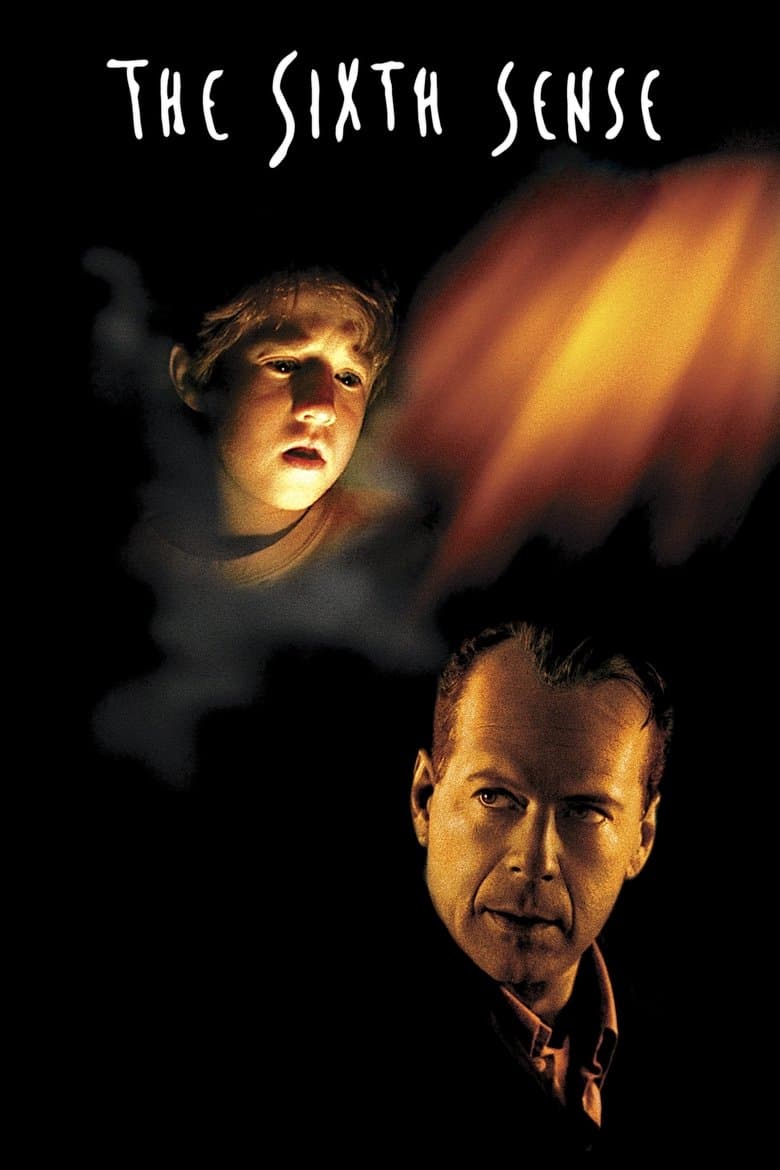
M. Night Shyamalan’s supernatural thriller follows child psychologist Malcolm Crowe as he begins treating Cole Sear, a frightened young boy who claims he can see and speak with the dead. What starts as a therapeutic case gradually opens into something more unsettling and compassionate, as Malcolm tries to understand the truth of Cole’s visions and the burden they place on his life. Haley Joel Osment gives Cole extraordinary vulnerability and gravity, while Bruce Willis anchors the film with quiet sadness and restraint. Blending ghost-story suspense with intimate emotional drama, The Sixth Sense became one of the defining supernatural thrillers of its era.
Watch for
- Haley Joel Osment’s performance, especially the way Cole’s fear, exhaustion, and fragile trust make the supernatural elements feel emotionally real.
- Shyamalan’s use of stillness, framing, and quiet domestic spaces, which creates tension through restraint rather than constant shocks.
- The recurring visual clues and patterns that quietly support the film’s final revelation without calling attention to themselves.
- How the relationship between Malcolm and Cole gradually shifts from clinical distance to mutual need, giving the film its emotional core beneath the suspense.
Production notes
The Sixth Sense was M. Night Shyamalan's third feature film and his substantial commercial-critical breakthrough — a supernatural psychological thriller about a child psychologist treating a young boy who claims to see dead people. Shyamalan wrote and directed the film; Hollywood Pictures (a Disney subsidiary) had paid approximately $2.5 million for Shyamalan's spec screenplay — substantial for an emerging writer-director's third feature. Bruce Willis played the child psychologist Malcolm Crowe in a substantial against-type casting decision (Willis being best known for action-leading-man roles in Die Hard and similar features); the casting was substantial for Willis's career, opening the way to subsequent dramatic work. Haley Joel Osment was 11 when he played the troubled young patient Cole Sear — a performance that received the Academy Award nomination for Best Supporting Actor. Toni Collette played Cole's mother Lynn Sear, with Olivia Williams as Anna Crowe (Malcolm's wife), Donnie Wahlberg in a brief but substantial role as Malcolm's former patient Vincent Grey, Trevor Morgan as Tommy Tammisimo, M. Night Shyamalan himself as Dr. Hill, and Mischa Barton as the deceased Kyra Collins. Cinematographer Tak Fujimoto shot the film. Composer James Newton Howard contributed the score. Production cost approximately $40 million.
Trivia
- M. Night Shyamalan was 28 when he wrote, directed, and substantially established his Hollywood career with The Sixth Sense; the film's substantial commercial success — grossing approximately $672 million worldwide on its $40 million budget — established Shyamalan as one of the most commercially viable young American filmmakers of his generation.
- Bruce Willis took the lead role for a substantially reduced fee compared to his typical action-leading-man rates — reportedly approximately $14 million plus a percentage of grosses rather than his usual upfront fee — because his Disney contract required him to make the film as part of compensation for an earlier Disney production (Broadway Brawler) he had withdrawn from after creative differences with director Lee Grant.
- The famous closing-act twist — Malcolm Crowe (Bruce Willis) himself being one of the deceased who 'don't know they're dead' — has become one of the most-discussed plot twists in American cinema; the substantial subsequent influence on twist-ending filmmaking has been continuous, and the substantial commercial success of the film was substantially enabled by audiences returning for repeat viewings to spot the substantial foreshadowing.
- Haley Joel Osment's substantial Best Supporting Actor Academy Award nomination at age 11 made him one of the youngest acting nominees in Oscar history; Osment lost to Michael Caine for The Cider House Rules, but his substantial subsequent child-acting career included A.I. Artificial Intelligence (2001) and Pay It Forward (2000).
- The Sixth Sense received six Academy Award nominations including Best Picture, Best Director (Shyamalan), Best Supporting Actor (Osment), Best Supporting Actress (Collette), Best Original Screenplay (Shyamalan), and Best Film Editing — winning none; it lost most categories to American Beauty in one of the more contested 1999 Oscar contests.
Legacy
The Sixth Sense received six Academy Award nominations including Best Picture and Best Director (M. Night Shyamalan), winning none. It grossed approximately $672 million worldwide on its $40 million budget — making it one of the highest-grossing horror-thriller features of the 1990s and the second-highest-grossing film of 1999 (after Star Wars: The Phantom Menace). It was selected for the National Film Registry in 2024. The famous closing-act twist — Malcolm Crowe (Bruce Willis) himself being one of the deceased who 'don't know they're dead' — has become one of the most-discussed plot twists in American cinema; the substantial subsequent influence on twist-ending filmmaking has been continuous across decades, with direct lineage to Shyamalan's own subsequent twist-driven films (Unbreakable, Signs, The Village) and to contemporary work from Christopher Nolan and Jordan Peele. Haley Joel Osment's famous line 'I see dead people' has become permanent shorthand in popular culture, continuously referenced and parodied. The film effectively launched M. Night Shyamalan's substantial subsequent career and established the supernatural-psychological-thriller form as a substantial commercial-prestige genre in late-1990s American cinema.