Shane
Vibe
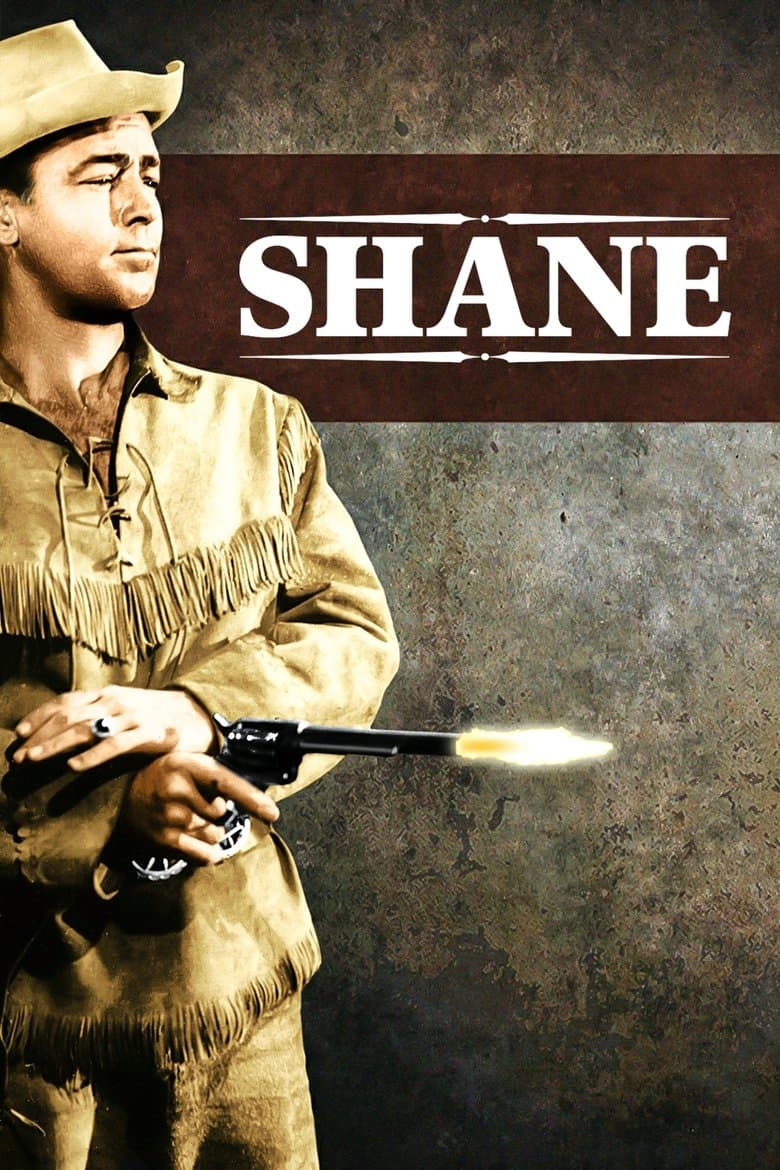
George Stevens’s classic Western follows a mysterious drifter and former gunfighter who rides into a Wyoming valley where homesteaders are being terrorized by a powerful cattle baron. Taken in by the Starrett family, Shane forms a quiet bond with them—especially with young Joey, who sees in him the fading ideal of the Western hero. Though he longs to leave violence behind, Shane is gradually drawn into a conflict that can only end in bloodshed. Alan Ladd’s restrained performance gives the character both mythic presence and deep melancholy. Blending sweeping landscape, moral drama, and elegiac emotion, Shane remains one of the defining films of the American Western.
Watch for
- Alan Ladd’s still, controlled performance, which makes Shane feel both larger than life and quietly burdened by the past he cannot escape.
- How Stevens contrasts the open beauty of the Wyoming landscape with the tension and threat surrounding the homesteaders’ daily lives.
- The perspective of young Joey, whose admiration turns Shane into a near-mythic figure and gives the film much of its emotional resonance.
- The final showdown and aftermath, where the film’s themes of sacrifice, violence, and the loneliness of the Western hero come fully into focus.
Production notes
Shane was George Stevens's adaptation of Jack Schaefer's 1949 novel, with the screenplay by A.B. Guthrie Jr. The film was Paramount's prestige western produced after the commercial success of Stevens's A Place in the Sun (1951), with Stevens himself producing alongside the director credit. Alan Ladd played the mysterious gunfighter Shane, with Jean Arthur in her final film appearance as Marian Starrett, Van Heflin as her husband Joe Starrett, Brandon De Wilde as their 10-year-old son Joey, Walter Jack Palance (later just Jack Palance) as the hired killer Jack Wilson, Ben Johnson as Chris Calloway, and Emile Meyer as the cattleman Rufus Ryker. The film was shot on location in Wyoming's Grand Teton National Park, with the Tetons themselves providing the dramatic mountain backdrop. Cinematographer Loyal Griggs shot the film in Technicolor and won the Academy Award for Best Cinematography. Composer Victor Young contributed the score. The famous closing image — Joey calling 'Shane! Come back!' after the wounded Shane rides away — has become one of the most-quoted moments in any western. Production cost approximately $3.1 million.
Trivia
- Jean Arthur — who plays Marian Starrett opposite Alan Ladd — was 50 when she made the film, in her final on-screen appearance after nearly three decades of Hollywood work; Arthur had been one of the major leading ladies of 1930s screwball comedy and had played opposite James Stewart in Mr. Smith Goes to Washington (1939), and Shane was her dignified farewell to the screen.
- Brandon De Wilde was 10 when he played Joey Starrett and received an Academy Award nomination for Best Supporting Actor — one of the youngest nominees in that category's history; De Wilde would go on to a substantial subsequent career before his death in a 1972 car accident at age 30.
- Jack Palance (then Walter Jack Palance) was reportedly an inexperienced horseman during production, and his famous mounting-and-dismounting sequence required multiple takes; George Stevens chose to use the most awkward-looking take in the final edit, with the implicit notion that the character Wilson would naturally not be a smooth rider but would have a deliberately threatening physicality.
- The film was shot on location in Wyoming's Grand Teton National Park — the Tetons themselves providing the dramatic mountain backdrop — and the location choice was Stevens's deliberate response to John Ford's earlier monopolization of Monument Valley as the canonical western setting; Shane's distinctly different visual approach helped open the western genre to alternative landscape settings.
- The famous closing line — Joey calling 'Shane! Come back!' after the wounded Shane rides away — has become one of the most-quoted moments in any western, with the parting referring to both the character's literal departure and the symbolic end of the American frontier myth that the western genre had inherited from the 19th century.
Legacy
Shane received six Academy Award nominations including Best Picture (losing to From Here to Eternity), Best Director (George Stevens, losing to Fred Zinnemann for the same film), Best Supporting Actor (Brandon De Wilde and Jack Palance both nominated, both losing), Best Adapted Screenplay, and Best Cinematography (winning the latter). It was selected for the National Film Registry in 1993. The film's elegiac register — Shane as the gunfighter whose obsolescence is depicted with mature melancholy — established the template for subsequent revisionist westerns, from The Searchers (1956) to The Wild Bunch (1969) to Unforgiven (1992). The famous closing line 'Shane! Come back!' has become one of the most-quoted moments in any American western, embedded in popular culture and parodied across decades of subsequent media. The film's specific approach to violence — restrained, morally serious, with the consequences of gunfire shown rather than minimized — was particularly influential. Among Stevens's films, Shane sits alongside A Place in the Sun (1951) and Giant (1956) as the canonical works of his epic-prestige period at Paramount.