Saving Private Ryan
Vibe
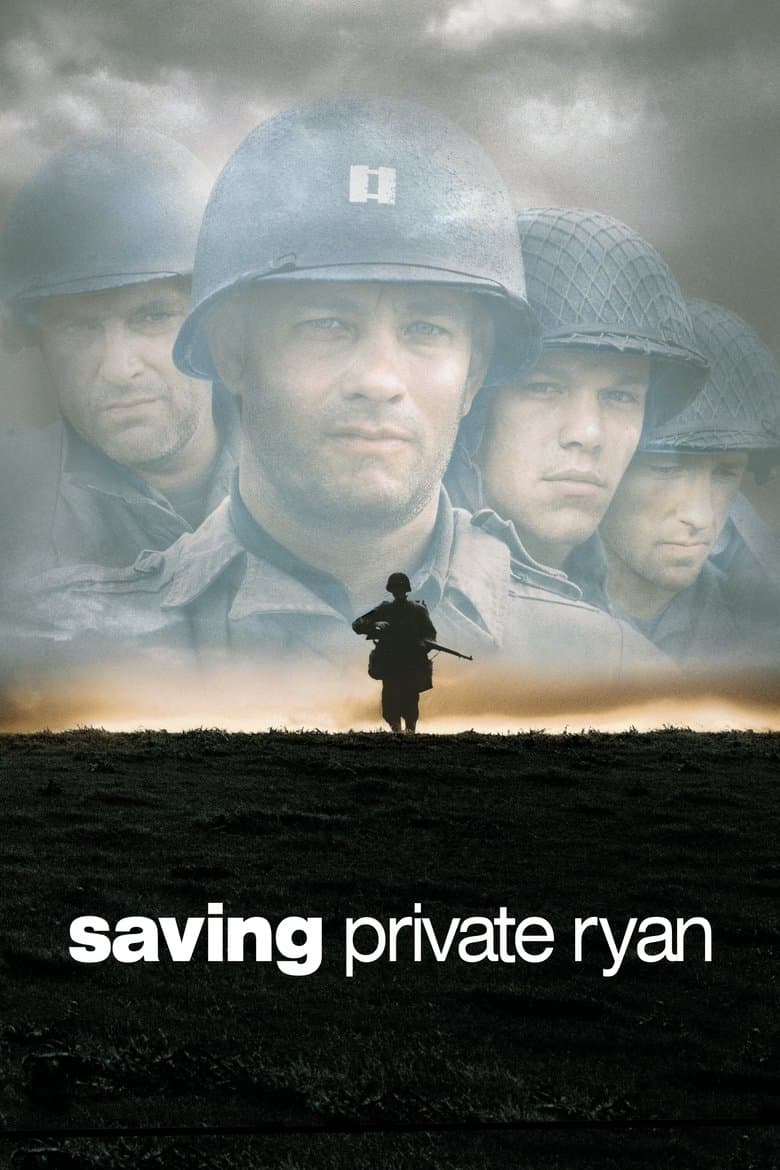
Steven Spielberg’s World War II epic begins with the Allied invasion of Normandy in a sequence whose visceral realism changed the modern war film. In the aftermath of D-Day, Captain John Miller and a small squad of American soldiers are sent deep into occupied France to find Private James Ryan, whose brothers have all been killed in combat. What begins as a mission of military bureaucracy gradually becomes a searching meditation on duty, sacrifice, and the value of a single life amid mass destruction. Anchored by Tom Hanks’s restrained performance and Spielberg’s harrowing immediacy, Saving Private Ryan remains one of the most influential and emotionally powerful war films ever made.
Watch for
- The Omaha Beach landing sequence, where handheld camerawork, fragmented sound, and disorienting detail create one of the most immersive combat scenes ever filmed.
- Tom Hanks’s performance as Captain Miller, especially the quiet restraint that makes his authority feel humane, weary, and deeply earned.
- How the film shifts from large-scale battle spectacle to small-group tension, using conversations, silences, and disagreements to reveal the psychological strain of the mission.
- The recurring contrast between the randomness of death and the soldiers’ need to find meaning in their orders, which gives the film its emotional and moral weight.
Production notes
Saving Private Ryan was Steven Spielberg's WWII drama set in the immediate aftermath of the June 6, 1944 D-Day invasion of Normandy — about a U.S. Army Ranger captain leading a small squad to retrieve a paratrooper whose three brothers have all been killed in combat. The screenplay was by Robert Rodat, who had developed the project from his own original screenplay. Tom Hanks played Captain John H. Miller, with Matt Damon as Private James Francis Ryan, Tom Sizemore as Sergeant Mike Horvath, Edward Burns as Private Richard Reiben, Barry Pepper as Private Daniel Jackson, Adam Goldberg as Private Stanley Mellish, Vin Diesel as Private Adrian Caparzo, Giovanni Ribisi as the medic Irwin Wade, Jeremy Davies as Corporal Timothy E. Upham, and Ted Danson, Paul Giamatti, Bryan Cranston, and Dennis Farina in supporting roles. The film's famous opening Omaha Beach landing sequence — approximately 25 minutes of relentless combat realism — required substantial production resources and developed new approaches to combat-cinema sound and visual aesthetics. Cinematographer Janusz Kamiński shot the film. Composer John Williams contributed the score. Production cost approximately $70 million.
Trivia
- The famous opening Omaha Beach landing sequence — approximately 25 minutes of relentless combat realism — required substantial production resources and was widely cited by actual WWII veterans as the most accurate cinematic representation of D-Day combat ever produced; the sequence reportedly caused PTSD episodes in some Normandy-veteran audience members during contemporary screenings.
- Tom Hanks won his second consecutive Academy Award for Best Actor for Saving Private Ryan — following his wins for Philadelphia (1993) and Forrest Gump (1994); Hanks was the first actor since Spencer Tracy in 1937-1938 to win consecutive Best Actor Oscars, an achievement that has continued to be rare in Oscar history.
- Saving Private Ryan was Steven Spielberg's substantial commercial-critical return to mainstream prestige drama after his 1993 Schindler's List (which had won Best Picture and Best Director); the film's commercial and critical success demonstrated Spielberg's continuing capacity for serious dramatic work alongside his commercial-blockbuster filmmaking.
- Saving Private Ryan won five Academy Awards including Best Director (Spielberg, his second), Best Cinematography (Kamiński), Best Sound, Best Film Editing, and Best Sound Effects Editing — but it lost Best Picture to Shakespeare in Love in one of the most controversial Best Picture decisions of the 1990s; the loss has been continuously discussed as evidence of strategic Oscar campaigning by Miramax Films.
- The film grossed approximately $482 million worldwide on its $70 million budget — making it the highest-grossing R-rated film of 1998 and one of the highest-grossing R-rated American films of the 1990s; the success demonstrated the commercial viability of substantial adult-content WWII filmmaking.
Legacy
Saving Private Ryan won five Academy Awards including Best Director (Steven Spielberg's second after Schindler's List, 1993) — but lost Best Picture to Shakespeare in Love in one of the most controversial Best Picture decisions of the 1990s. It was selected for the National Film Registry in 2014. The famous opening Omaha Beach landing sequence has been continuously cited as the most accurate cinematic representation of D-Day combat ever produced — actual WWII veterans reportedly experienced PTSD episodes during contemporary screenings, and the sequence has substantially shaped subsequent decades of combat-cinema. The film triggered substantial subsequent renewed cultural attention to the WWII generation, including Spielberg and Hanks's continuing collaboration on HBO's Band of Brothers (2001) and The Pacific (2010) miniseries, and a substantial revival of public interest in the history of the war. Among American WWII films, Saving Private Ryan sits alongside The Best Years of Our Lives (1946), The Bridge on the River Kwai (1957), Patton (1970), and Schindler's List (1993) as the canonical achievements. Tom Hanks's central performance remains one of the most thoroughly admired American military-leadership performances in cinema.