Pulp Fiction
Vibe
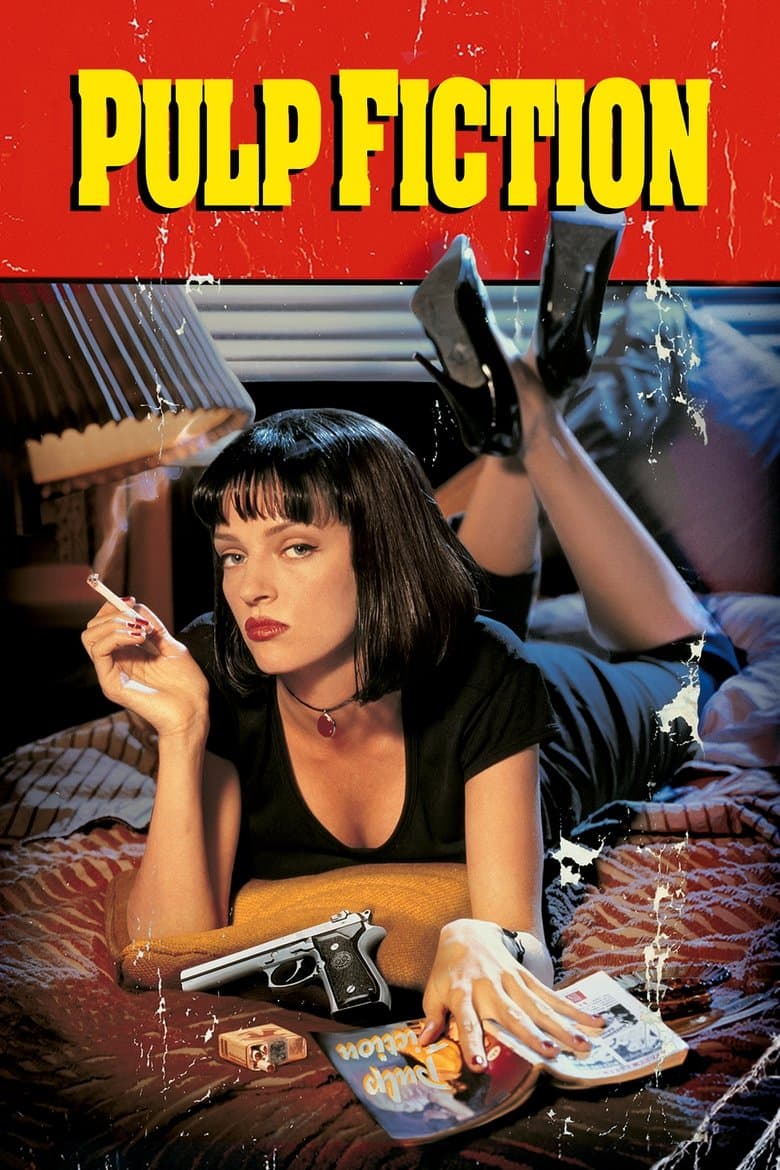
Quentin Tarantino’s innovative crime film weaves together multiple stories of hitmen, gangsters, boxers, and low-level thieves moving through the same Los Angeles underworld. Told in a boldly nonlinear structure, the film jumps across time and perspective, turning coincidence, repetition, and reversal into part of its narrative thrill. John Travolta, Samuel L. Jackson, Uma Thurman, and Bruce Willis anchor an ensemble cast whose performances give Tarantino’s stylized dialogue both swagger and surprising emotional texture. Blending dark humor, pop-cultural wit, sudden violence, and moments of existential reflection, Pulp Fiction became one of the defining films of the 1990s and a landmark of independent American cinema.
Watch for
- How the nonlinear structure creates surprise, irony, and thematic resonance, especially when later scenes completely change the meaning of what came before.
- The rhythm of Tarantino’s dialogue, where seemingly casual conversations about food, television, or etiquette gradually become expressions of power, intimacy, and menace.
- Samuel L. Jackson’s performance as Jules, whose mix of theatrical confidence, comic timing, and spiritual unease gives the film much of its unexpected moral depth.
- The contrast between the film’s cool surfaces and its sudden ruptures of violence, which keep the tone unstable and make even ordinary scenes feel charged with possibility.
Production notes
Pulp Fiction was Quentin Tarantino's second feature film — the breakthrough that established him as a major American filmmaker after his 1992 debut Reservoir Dogs. The screenplay by Tarantino (with story credit shared by Roger Avary) was structured as three interweaving narratives, with substantial chronological displacement that scrambled the cause-and-effect relationships among the stories. Miramax Films produced the project on an approximately $8 million budget. The cast included John Travolta as Vincent Vega (a role that revived Travolta's career after over a decade of commercial decline), Samuel L. Jackson as Jules Winnfield, Uma Thurman as Mia Wallace (Vincent's boss's wife), Bruce Willis as the boxer Butch Coolidge, Harvey Keitel as the fixer Mr. Wolf, Tim Roth and Amanda Plummer as the robbers Pumpkin and Honey Bunny, Ving Rhames as Marsellus Wallace, Christopher Walken in a cameo as Captain Koons, Steve Buscemi as a Buddy Holly-impersonating waiter, and Quentin Tarantino himself as Jimmie Dimmick. The film's substantial use of period-specific popular music, the elaborate set-piece dialogue scenes, and the moral-ambiguity of all the major characters became some of the most influential aesthetic choices in 1990s American cinema. Cinematographer Andrzej Sekuła shot the film.
Trivia
- John Travolta's casting as Vincent Vega revived his career after over a decade of commercial decline; Travolta had been working primarily in television and direct-to-video productions before Pulp Fiction, and the role's Oscar nomination led directly to his subsequent decade of major Hollywood comeback work including Get Shorty (1995), Michael (1996), and Phenomenon (1996).
- Samuel L. Jackson's performance as Jules Winnfield — including the famous Ezekiel 25:17 monologue ('The path of the righteous man is beset on all sides...') — has become one of the most-quoted performances in 1990s American cinema; Jackson lost the Best Supporting Actor Academy Award to Martin Landau for Ed Wood, an outcome that has been continuously discussed as one of the more contested supporting-actor decisions of the 1990s.
- Pulp Fiction was the first independent film to gross over $100 million at the worldwide box office — grossing approximately $214 million on its $8 million budget; the success effectively launched the 1990s independent-cinema boom that would extend to Miramax's subsequent prestige acquisitions and the Sundance Film Festival's substantial commercial importance.
- The famous Twist contest sequence — John Travolta and Uma Thurman dancing the Batusi at Jack Rabbit Slim's — was substantially improvised by Tarantino and the actors during rehearsals; the sequence has become one of the most-quoted dance moments in 1990s American cinema and was substantially shaped by Tarantino's deep cinephile knowledge of the original Batman television series.
- Pulp Fiction won the Palme d'Or at the 1994 Cannes Film Festival — the most prestigious award in international cinema — and received seven Academy Award nominations including Best Picture, Best Director (Tarantino), Best Original Screenplay (winning), and four acting nominations; the screenplay win established Tarantino as a major Hollywood writer.
Legacy
Pulp Fiction won the Palme d'Or at the 1994 Cannes Film Festival and the Academy Award for Best Original Screenplay (on seven total nominations including Best Picture and Best Director). It was the first independent film to gross over $100 million at the worldwide box office — grossing approximately $214 million on its $8 million budget. It was selected for the National Film Registry in 2013. The film's commercial and critical success effectively launched the 1990s independent-cinema boom and established Quentin Tarantino as one of the most influential American filmmakers of the next three decades. The film's substantial use of period-specific popular music, the elaborate set-piece dialogue scenes, and the moral-ambiguity of all the major characters have been continuously imitated across subsequent decades of American filmmaking, sometimes successfully (Boogie Nights, Out of Sight, The Big Lebowski) and sometimes as failed Tarantino-clone work. John Travolta's career was substantially revived by his Oscar-nominated performance. Samuel L. Jackson's Ezekiel 25:17 monologue has become one of the most-quoted performances in 1990s American cinema. Among Quentin Tarantino's films, Pulp Fiction remains the canonical achievement.