The Philadelphia Story
Vibe
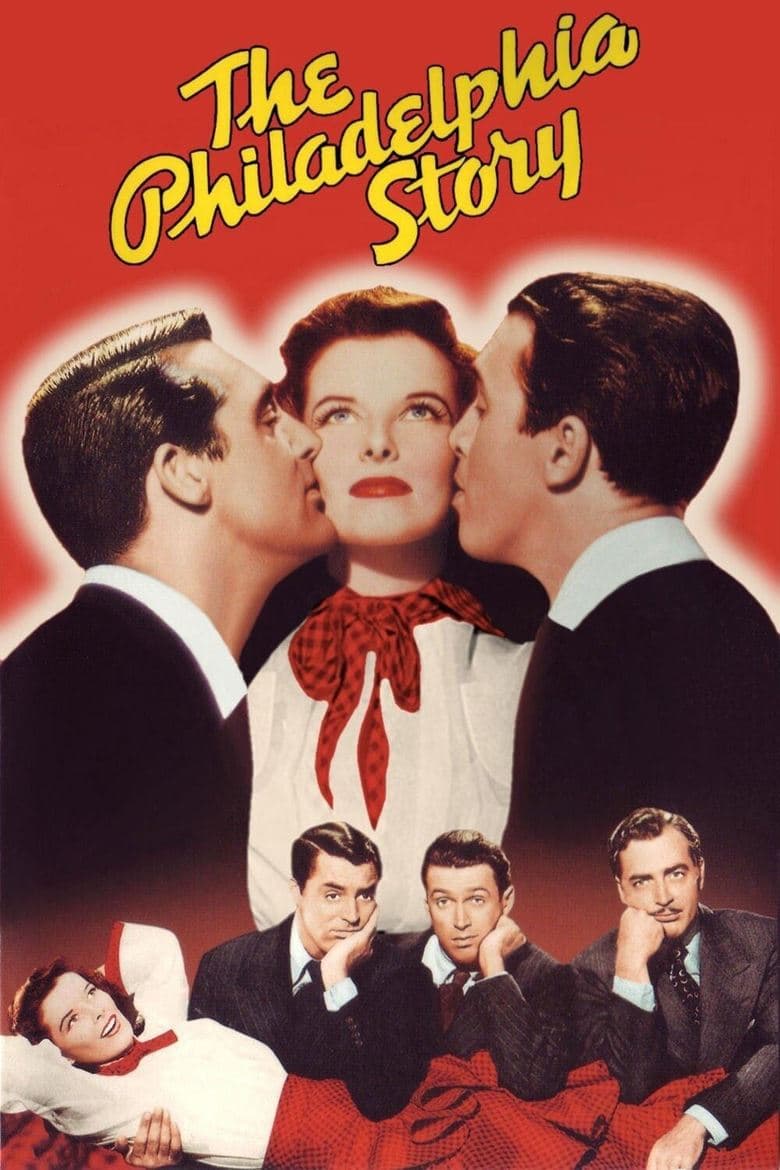
This sophisticated romantic comedy follows wealthy Philadelphia socialite Tracy Lord as she prepares to remarry after a highly publicized divorce. Her carefully controlled plans are thrown into disarray when her ex-husband C.K. Dexter Haven reappears alongside a cynical reporter and a photographer assigned to cover the wedding. As old feelings resurface and new attractions complicate matters, Tracy is forced to confront her own pride, vulnerability, and assumptions about love. Directed by George Cukor, the film sparkles with urbane wit and sharp observations about class, marriage, and self-knowledge. Anchored by luminous performances from Katharine Hepburn, Cary Grant, and James Stewart, The Philadelphia Story remains one of the great romantic comedies of Hollywood’s Golden Age.
Watch for
- The shifting triangle among Tracy, Dexter, and Mike Connor, where attraction, resentment, and admiration are constantly being recalibrated through dialogue and gesture.
- Katharine Hepburn’s performance, especially the way Tracy’s confidence gradually gives way to self-awareness and emotional openness.
- George Cukor’s handling of ensemble scenes, which keeps the film light on its feet while allowing every exchange to sharpen character and tension.
- James Stewart’s timing and vulnerability, which bring warmth and unpredictability to a film otherwise built on polish and social control.
Production notes
The Philadelphia Story was George Cukor's adaptation of Philip Barry's 1939 Broadway play, which had been written specifically for Katharine Hepburn — Hepburn herself owned the film rights, having received them from Howard Hughes as a gift, and used the leverage to negotiate her return to MGM after several years of being labeled 'box-office poison.' Donald Ogden Stewart wrote the screenplay, winning the Academy Award for the adaptation. Hepburn played Tracy Lord opposite Cary Grant as her ex-husband C.K. Dexter Haven and James Stewart as the tabloid reporter Mike Connor. The cast included Ruth Hussey as the photographer Liz Imbrie, John Howard as Tracy's fiancé George Kittredge, Roland Young as Uncle Willie, John Halliday as Tracy's father Seth Lord, Mary Nash as her mother Margaret, and Virginia Weidler as her younger sister Dinah. Cinematographer Joseph Ruttenberg shot the film. Composer Franz Waxman contributed the score. Production cost approximately $914,000.
Trivia
- Katharine Hepburn herself owned the film rights to Philip Barry's stage play — having received them as a gift from Howard Hughes — and used the leverage to negotiate her own return to MGM after Hollywood had labeled her 'box-office poison' in the late 1930s; her ownership effectively saved her career.
- James Stewart won the Academy Award for Best Actor for his performance as Mike Connor — the only Oscar he won in his career — defeating Henry Fonda (The Grapes of Wrath), Laurence Olivier (Rebecca), Raymond Massey (Abe Lincoln in Illinois), and Charlie Chaplin (The Great Dictator); the win is generally considered a make-up vote for Stewart's previous year's loss for Mr. Smith Goes to Washington.
- Cary Grant donated his entire salary for the film — $137,000 — to the British War Relief Fund; the donation was one of the most substantial individual contributions to British war relief by any Hollywood star, and Grant requested no publicity for the gesture during his lifetime.
- George Cukor directed the film after Joseph L. Mankiewicz produced it; the Cukor-Mankiewicz partnership at MGM produced a series of distinguished comedies of manners during this period, including subsequent films that drew on similar high-society-and-witty-dialogue territory.
- The Philadelphia Story received six Academy Award nominations and won two — Best Actor (Stewart) and Best Adapted Screenplay (Donald Ogden Stewart, no relation); it lost Best Picture and Best Director to Rebecca and John Ford's The Grapes of Wrath in the highly competitive 1940 ceremony.
Legacy
The Philadelphia Story won two Academy Awards (Best Actor for James Stewart, Best Adapted Screenplay) on six nominations, and was selected for the National Film Registry in 1995. The film's 1956 musical adaptation High Society — starring Bing Crosby, Grace Kelly, and Frank Sinatra — brought the story to a new generation, though the original is generally considered the superior version. The film effectively rescued Katharine Hepburn's commercial career after Hollywood had labeled her 'box-office poison' in the late 1930s, and her 'Tracy Lord' has remained the canonical Hepburn performance for the screwball-comedy period of her work. The dialogue — Donald Ogden Stewart's Oscar-winning adaptation of Philip Barry's stage play — is regularly cited as one of the great American comedies of dialogue, alongside Bringing Up Baby (1938) and His Girl Friday (1940) as the high-water marks of late-1930s screwball-comedy writing. Among American films of 1940 — a year that also produced The Grapes of Wrath, Rebecca, and Fantasia — The Philadelphia Story stands as the most thoroughly satisfying comedy of manners.