A Night at the Opera
Vibe
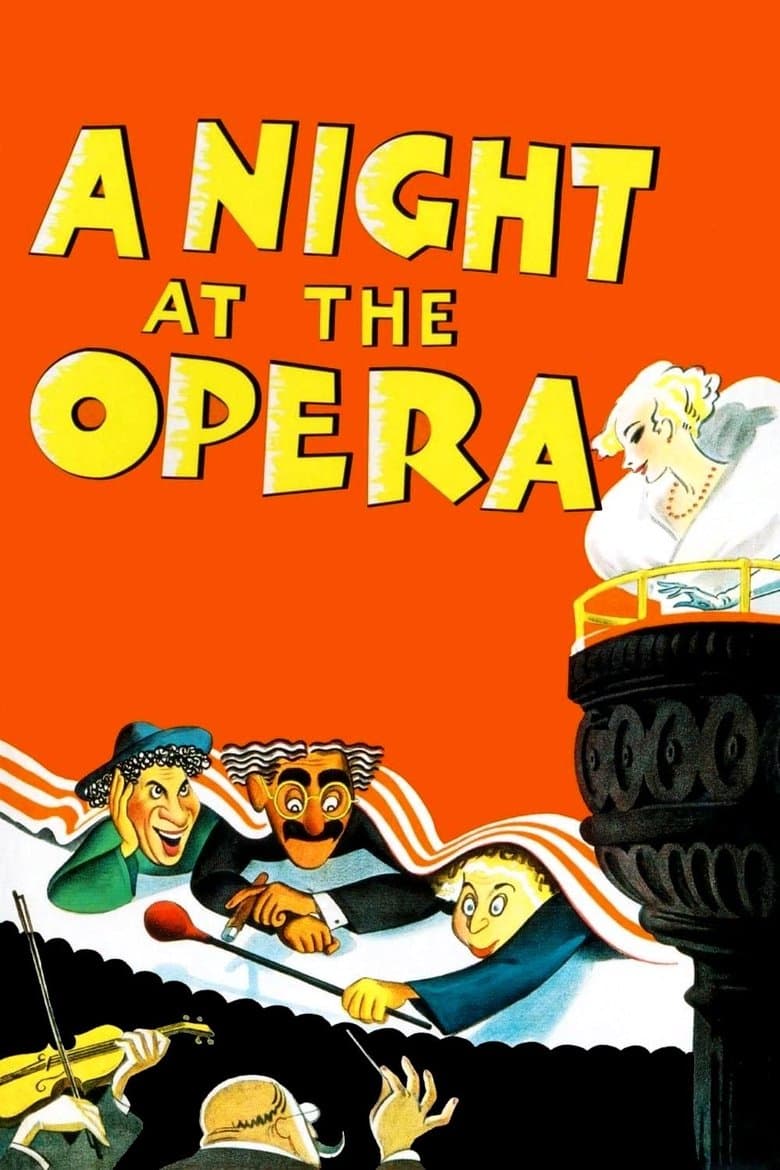
The Marx Brothers deliver one of their most celebrated comedies in this riotous musical farce set in the world of grand opera. Groucho stars as the fast-talking Otis B. Driftwood, a scheming impresario who tries to help two young lovers and aspiring singers succeed while humiliating pompous managers, wealthy patrons, and every institution standing in their way. Chico and Harpo add layers of comic sabotage through wordplay, musical playfulness, and gleeful physical chaos, turning refinement into disorder at every opportunity. With its polished MGM production values and some of the brothers’ most famous routines, including the legendary stateroom scene, A Night at the Opera remains one of the great American screen comedies.
Watch for
- How the film balances the Marx Brothers’ chaos with a more traditional romantic and musical framework, giving the comedy a structure to constantly disrupt.
- The precision of the brothers’ timing, especially in the contract routine and the famous stateroom sequence, where escalation and rhythm are everything.
- How opera and high society are treated not with reverence but with delighted irreverence, making performance and prestige feel inherently unstable.
- The different comic energies of Groucho, Chico, and Harpo, whose verbal attack, streetwise logic, and silent anarchy complement one another with near-musical exactness.
Production notes
A Night at the Opera was the first Marx Brothers film for MGM, produced by Irving Thalberg after the brothers' Paramount contract had been substantially compromised by the commercial underperformance of their previous Duck Soup (1933). Thalberg's substantial intervention was central — he insisted that the brothers' anarchic comedic register be substantially tempered by stronger romantic-musical subplots and clearer narrative architecture; the resulting hybrid model would shape the brothers' subsequent decade of work. The screenplay was credited to George S. Kaufman, Morrie Ryskind, and James Kevin McGuinness, with substantial uncredited contributions from staff writers. Groucho Marx played the impresario Otis B. Driftwood, with Harpo Marx as Tomasso, Chico Marx as Fiorello, and Allan Jones (as the romantic tenor Ricardo Baroni) replacing Zeppo Marx in the romantic-leading-man role that Zeppo had previously filled. Kitty Carlisle played the soprano Rosa Castaldi, with Walter Woolf King as the villainous tenor Rodolfo Lassparri and Margaret Dumont in her established role as the wealthy benefactor Mrs. Claypool. The famous stateroom sequence — approximately twenty people crammed into a small ship's stateroom — has become one of the most-quoted physical-comedy sequences in any cinema. Production cost approximately $1 million.
Trivia
- A Night at the Opera was the first Marx Brothers film for MGM after their Paramount contract had been substantially compromised by the commercial underperformance of Duck Soup (1933); Irving Thalberg's substantial restructuring of the brothers' comedic approach toward stronger romantic-musical subplots was the substantial commercial recovery strategy, and the resulting hybrid model would shape the brothers' subsequent decade of work.
- Allan Jones replaced Zeppo Marx in the romantic-leading-man role that Zeppo had previously filled across the brothers' Paramount films; Zeppo had left the act after Duck Soup (1933) to pursue work as a talent agent, and the substantial restructuring of the comedic register with a non-Marx romantic lead would continue for the rest of the brothers' MGM films.
- The famous stateroom sequence — approximately twenty people crammed into a small ship's stateroom — has become one of the most-quoted physical-comedy sequences in any cinema; the sequence has been continuously imitated and parodied across decades of subsequent comic work, including most prominently I Love Lucy's substantial physical-comedy tradition.
- Irving Thalberg's substantial creative intervention in the Marx Brothers' working method was central to A Night at the Opera's commercial success; Thalberg insisted on extensive pre-shoot road-show testing of the comedic sequences, with the brothers performing key sequences in front of live audiences and refining the material based on the audience response — a substantial change from their previous improvisational approach.
- A Night at the Opera was a substantial commercial success — grossing approximately $1.7 million on its $1 million budget — and demonstrated the viability of the substantial restructured Marx Brothers model; the brothers' subsequent MGM films (A Day at the Races, At the Circus, Go West, The Big Store) continued the restructured approach across the rest of the decade.
Legacy
A Night at the Opera was a substantial commercial success on its 1935 release and established the substantial restructured Marx Brothers approach that would shape their MGM decade. It was selected for the National Film Registry in 1993. The famous stateroom sequence has been continuously cited as one of the most thoroughly realized physical-comedy sequences in any cinema, with substantial subsequent influence on comic cinema and television. The substantial creative intervention by Irving Thalberg — restructuring the Marx Brothers' anarchic comedic register toward stronger romantic-musical subplots and clearer narrative architecture — has been continuously debated as either a substantial commercial recovery or a substantial creative compromise; subsequent critics have generally considered the earlier Paramount films (Duck Soup, Horse Feathers, Animal Crackers) to be more thoroughly representative of the brothers' creative voice, while acknowledging that A Night at the Opera's commercial restructuring was central to their continued ability to produce films. Among the Marx Brothers' films, A Night at the Opera sits alongside Duck Soup (1933) as the canonical achievement — Duck Soup as the brothers' most thoroughly anarchic work, and A Night at the Opera as the most thoroughly commercially successful synthesis of their comedic register with conventional Hollywood narrative form.