Mr. Smith Goes to Washington
Vibe
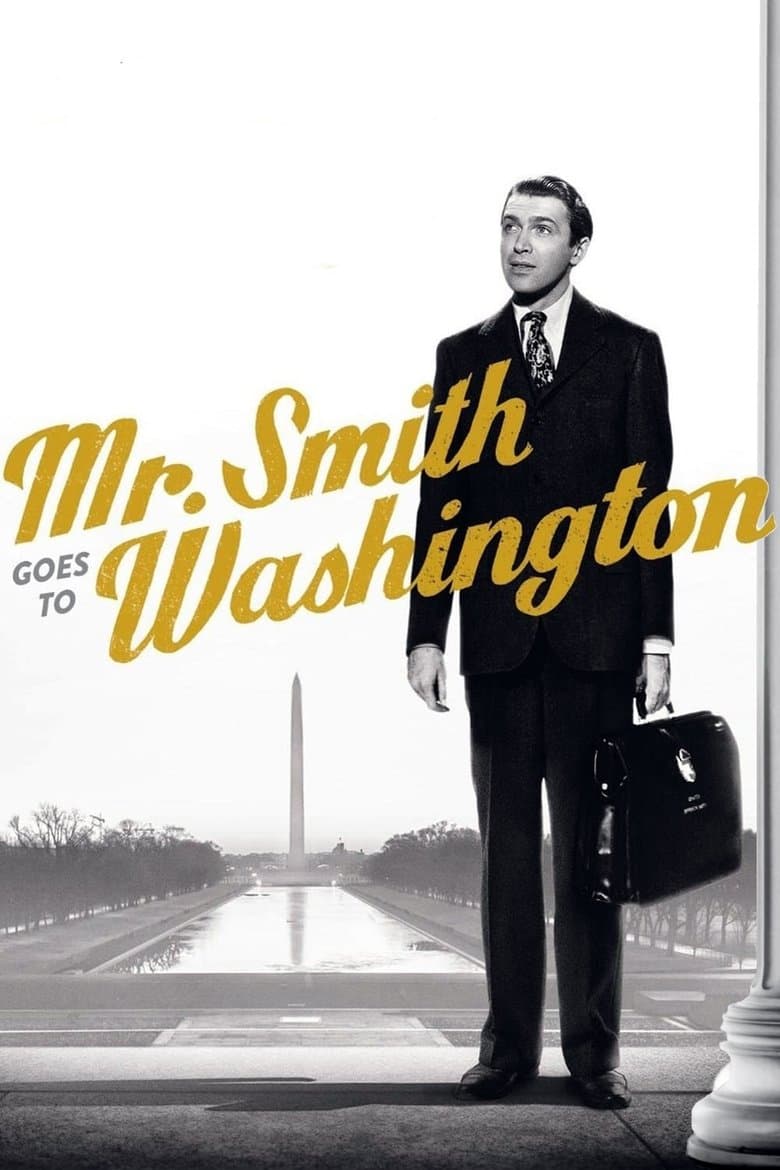
Frank Capra’s political drama follows idealistic young senator Jefferson Smith, unexpectedly appointed to the U.S. Senate and quickly confronted by a political system shaped by corruption and powerful interests. Naive but principled, Smith refuses to cooperate with the entrenched machine that expects his silence. With the help of his sharp but disillusioned secretary, he takes a dramatic stand on the Senate floor, launching a marathon filibuster to expose the truth. James Stewart’s heartfelt performance captures Smith’s growing determination and moral courage. Blending humor, drama, and patriotic conviction, Mr. Smith Goes to Washington remains one of cinema’s most stirring celebrations of democratic ideals and individual conscience.
Watch for
- James Stewart’s gradual transformation from naive newcomer to determined defender of democratic principles.
- The famous Senate filibuster sequence, where physical exhaustion and moral conviction collide in one of cinema’s great dramatic set pieces.
- Capra’s balance of satire and sincerity in portraying Washington’s political culture.
- The dynamic between Jefferson Smith and his secretary Clarissa Saunders, whose cynicism slowly gives way to renewed belief in the system.
Production notes
Mr. Smith Goes to Washington was Frank Capra's follow-up to his Oscar-winning You Can't Take It With You (1938) and continued his cycle of films built around populist American themes. Sidney Buchman wrote the screenplay, adapting Lewis R. Foster's unpublished story 'The Gentleman from Montana.' James Stewart played Jefferson Smith — the role established him as a major leading man, displacing the romantic-comedy roles he had been playing — opposite Jean Arthur as the politically savvy secretary Saunders. The cast included Claude Rains as the corrupt Senator Joseph Paine, Edward Arnold as the political boss Jim Taylor, and a young Beulah Bondi as Smith's mother. Cinematographer Joseph Walker shot the film; the elaborate Senate-chamber set was reportedly the largest indoor movie set ever built at Columbia. Composer Dimitri Tiomkin scored the film. The Senate-chamber sequences had been researched in detail — the actual U.S. Senate had refused permission for filming on location, and the film built its own scaled replica based on photographs and architectural drawings. Production cost approximately $1.5 million.
Trivia
- Mr. Smith Goes to Washington's premiere on October 17, 1939 at Constitution Hall in Washington, D.C. caused real political controversy — actual U.S. senators reportedly walked out of the screening, with Senator Alben Barkley calling the film 'a grotesque distortion' of the Senate's actual conduct.
- Joseph Kennedy, the U.S. Ambassador to the United Kingdom, attempted to suppress the film's European release entirely, fearing it would damage American prestige overseas; the U.S. State Department briefly considered Kennedy's request before deciding the film's pro-democracy themes were ultimately favorable.
- James Stewart's filibuster sequence required him to perform for over five days of shooting; he reportedly used a chemical that gave his throat genuine hoarseness for the climactic scene, contributing to the genuinely exhausted vocal quality that distinguishes the performance.
- The film received 11 Academy Award nominations — among the most of any 1939 release — but won only one, Best Original Story; it lost Best Picture and most other categories to Gone with the Wind, which dominated that year's ceremony.
- James Stewart's performance launched his subsequent two-decade career as Hollywood's most beloved 'everyman' leading actor; the role transformed his on-screen image from romantic-comedy player to morally serious dramatic actor, a transformation that would deepen further after his post-WWII work with Hitchcock and Anthony Mann.
Legacy
Mr. Smith Goes to Washington has aged into one of the most-cited American films about democratic ideals and their corruption. It received 11 Academy Award nominations and won one (Best Original Story for Lewis R. Foster). It was selected for the National Film Registry in 1989. The film's central image — Stewart's exhausted senator filibustering against a corrupt political establishment — has become permanent visual shorthand for democratic resistance, regularly invoked across decades of subsequent political discourse from both ends of the political spectrum. The film's specific Senate-chamber controversy at release — actual senators walking out, Joseph Kennedy attempting to suppress its European distribution — has aged into a useful historical example of American political establishment's self-protective instinct against pro-democratic art. James Stewart's performance became the canonical 'morally serious everyman' template for American cinema, shaping his subsequent work with Hitchcock and his postwar leading-man identity. Among Capra's films, Mr. Smith Goes to Washington stands as the synthesis of his populist-democratic vision at its most fully realized.