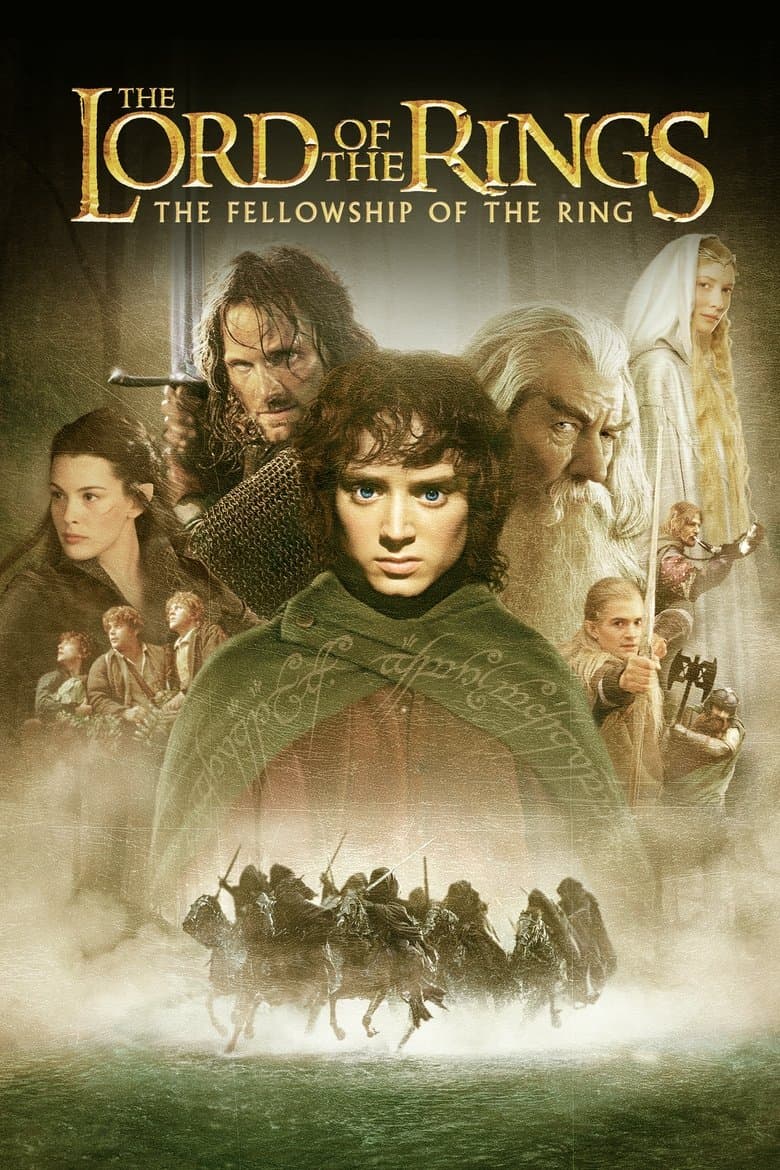
The Lord of the Rings: The Fellowship of the Ring
Vibe
Peter Jackson’s epic fantasy adventure begins the cinematic adaptation of J.R.R. Tolkien’s monumental trilogy with the story of Frodo Baggins, a young hobbit who inherits a ring of immense and corrupting power. Charged with carrying it out of the Shire and toward destruction, Frodo joins a fellowship of allies—hobbits, men, an elf, a dwarf, and the wizard Gandalf—on a perilous journey across Middle-earth. Jackson balances mythic scale with emotional intimacy, using sweeping landscapes, practical craftsmanship, and groundbreaking effects to make Tolkien’s world feel fully lived-in. With Howard Shore’s stirring score and a deeply committed ensemble, The Fellowship of the Ring launched one of modern cinema’s most acclaimed fantasy sagas.
Watch for
- How Jackson shifts the tone from the pastoral warmth of the Shire to an increasingly haunted and perilous world, making the journey feel like a true loss of innocence.
- The visual and emotional weight given to the Ring itself, which is treated not just as an object of plot but as a source of temptation, dread, and psychological pressure.
- The interplay among the members of the Fellowship, whose contrasting backgrounds and temperaments turn the quest into both an adventure and a test of trust.
- Howard Shore’s score and the film’s layered production design, which give each culture and setting in Middle-earth a distinct identity and help the world feel ancient, coherent, and mythic.
Production notes
The Lord of the Rings: The Fellowship of the Ring was Peter Jackson's adaptation of the first volume of J.R.R. Tolkien's epic fantasy trilogy — produced as part of a substantial three-film simultaneous production that became one of the most ambitious cinema undertakings of the century. The screenplay by Fran Walsh, Philippa Boyens, and Peter Jackson adapted Tolkien's 1954 source novel across approximately three hours of running time. New Line Cinema produced the entire trilogy simultaneously across approximately fifteen months of principal photography in New Zealand — an enormous financial commitment that would have been ruinous had the films underperformed. Elijah Wood played Frodo Baggins, with Ian McKellen as Gandalf, Viggo Mortensen as Aragorn (replacing Stuart Townsend after substantial pre-production work), Sean Astin as Sam, Liv Tyler as Arwen, John Rhys-Davies as Gimli, Orlando Bloom as Legolas, Sean Bean as Boromir, Cate Blanchett as Galadriel, Hugo Weaving as Elrond, Christopher Lee as Saruman, and Ian Holm as Bilbo. Cinematographer Andrew Lesnie shot the film. Composer Howard Shore contributed the score across the entire trilogy. Production cost approximately $93 million for Fellowship alone.
Trivia
- Peter Jackson's three-film simultaneous production was an enormous financial commitment for New Line Cinema — approximately $281 million across the entire trilogy — that would have been ruinous had the films underperformed; the substantial commercial success of Fellowship validated the gamble and enabled the subsequent trilogy installments.
- Viggo Mortensen replaced Stuart Townsend as Aragorn after substantial pre-production work — Townsend had been cast and had begun filming when Peter Jackson decided he was too young for the role; Mortensen joined the production essentially in process, with approximately one day's notice before he began shooting principal photography in New Zealand.
- Christopher Lee was the only major cast member who had personally met J.R.R. Tolkien — Lee had encountered the author briefly at a pub in Oxford in the 1950s — and his substantial knowledge of Tolkien's source material was substantial during pre-production; Lee reportedly read the source novels annually for over fifty years before his casting as Saruman.
- The film's substantial use of forced-perspective photography for the size-difference work between Hobbits and other races was achieved through extensive practical-effects work rather than digital compositing — actors of varying heights were positioned at different distances from the camera, with substantial set construction to maintain the illusion across complex multi-character shots.
- Fellowship received thirteen Academy Award nominations and won four — Best Cinematography (Andrew Lesnie), Best Makeup, Best Original Score (Howard Shore), and Best Visual Effects; it lost Best Picture to A Beautiful Mind in one of the more contested Oscar contests of the early 2000s, with the subsequent Return of the King winning Best Picture in 2003.
Legacy
The Lord of the Rings: The Fellowship of the Ring received thirteen Academy Award nominations and won four. It grossed approximately $887 million worldwide on its $93 million production budget. It was selected for the National Film Registry in 2007. The substantial commercial success of Fellowship — the first installment of Peter Jackson's three-film simultaneous production — validated New Line Cinema's enormous financial commitment and enabled the subsequent trilogy installments, which collectively grossed nearly $3 billion worldwide. The subsequent Return of the King (2003) won 11 Academy Awards including Best Picture — making the trilogy the only fantasy film series to win Best Picture, and one of the few film series with a sequel matching the original's reception. The films effectively launched the subsequent 2000s and 2010s fantasy-epic boom, with direct lineage to Peter Jackson's own Hobbit trilogy (2012-2014), HBO's Game of Thrones (2011-2019), and Amazon's Rings of Power (2022-present). Among fantasy-epic productions of the 21st century, the Lord of the Rings trilogy remains the canonical achievement, with Fellowship as the foundational installment that demonstrated the form's commercial viability.