The Last Picture Show
Vibe
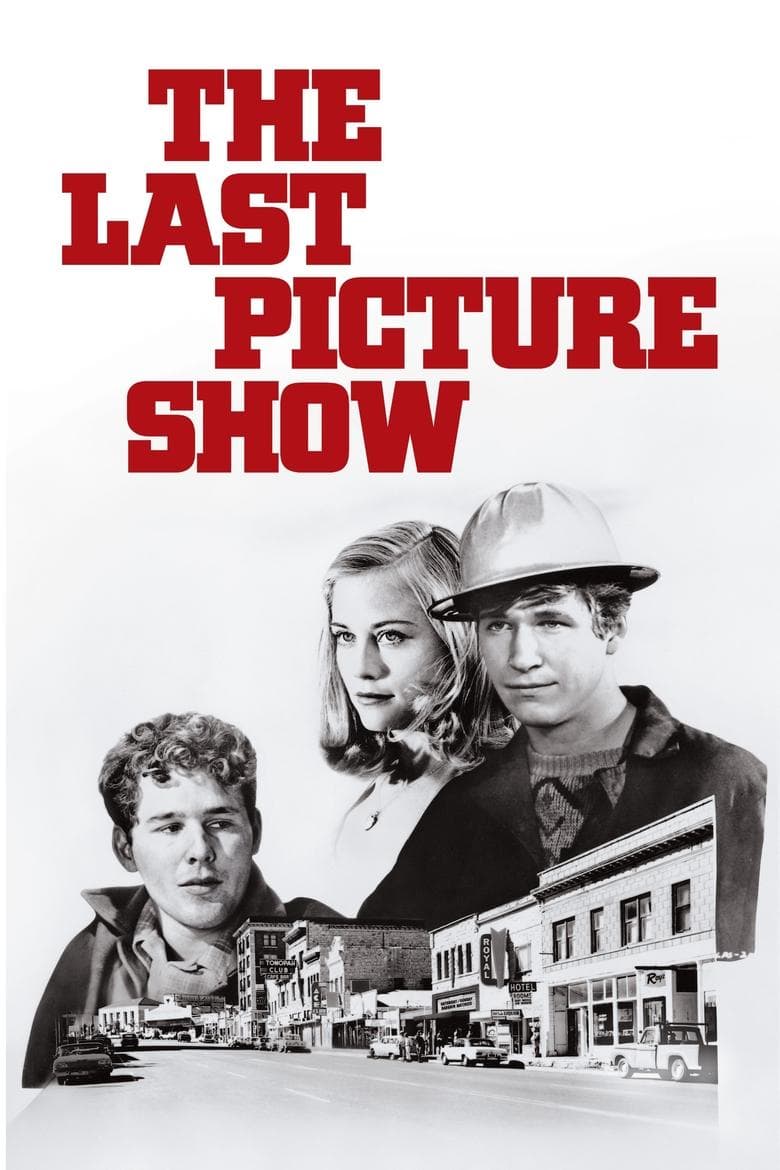
Set in a small Texas town in the early 1950s, this coming-of-age drama follows a group of teenagers and young adults drifting through love, loneliness, and uncertain futures as the life of their community slowly fades around them. Centered on the closing of the town’s movie theater, the film turns everyday routines, broken relationships, and missed opportunities into a quietly devastating portrait of youth at the edge of adulthood. Directed by Peter Bogdanovich and shot in luminous black-and-white, The Last Picture Show evokes both the mythology and the emptiness of small-town America. It remains one of the most poignant American films about nostalgia, desire, and the end of innocence.
Watch for
- How Bogdanovich uses black-and-white imagery, empty streets, and worn-down interiors to make the town itself feel like a place already slipping into memory.
- The ensemble performances, especially the way small hesitations, awkward encounters, and emotional evasions reveal longing and disappointment beneath ordinary behavior.
- The significance of the movie theater as more than a setting: it becomes a symbol of communal life, fantasy, and a disappearing cultural world.
- How the film balances youthful desire with adult sorrow, showing that its coming-of-age story is also a broader meditation on loneliness, aging, and emotional ruin.
Production notes
The Last Picture Show was Peter Bogdanovich's adaptation of Larry McMurtry's 1966 novel about late-1950s small-town Texas adolescence — substantial as Bogdanovich's second feature after his commercial debut Targets (1968). The screenplay was by Bogdanovich and McMurtry (who would also write Hud, Terms of Endearment, and Lonesome Dove). Bogdanovich filmed in deliberately stark black-and-white — substantially unusual for 1971 American cinema — to achieve a deliberately archaic visual register that referenced both the substantial 1950s small-town setting and the substantial influence of John Ford's previous American cinema. The cast included Timothy Bottoms as the young Sonny Crawford, Jeff Bridges as the high-school football star Duane Jackson, Cybill Shepherd (in her film debut) as the wealthy beauty Jacy Farrow, Cloris Leachman as the football coach's neglected wife Ruth Popper, Ben Johnson as the pool-hall and movie-theater owner Sam the Lion, Ellen Burstyn as Jacy's mother Lois Farrow, Eileen Brennan as the waitress Genevieve, and Sam Bottoms (Timothy Bottoms's younger brother) as Billy. Cinematographer Robert Surtees shot the film. Production cost approximately $1.3 million.
Trivia
- Cybill Shepherd made her film debut as the wealthy beauty Jacy Farrow at age 21 — Peter Bogdanovich discovered her on a magazine cover and cast her against substantial industry skepticism; Shepherd's substantial subsequent on-set affair with Bogdanovich (he was 32 and married at the time) and their substantial subsequent relationship reportedly damaged his marriage and shaped his subsequent career.
- Ben Johnson and Cloris Leachman both won Academy Awards for Best Supporting Actor and Best Supporting Actress for their substantial performances; Johnson played the wise pool-hall owner Sam the Lion, and Leachman played the neglected coach's wife Ruth Popper — two of the most substantial supporting performances of the early 1970s.
- Peter Bogdanovich filmed in deliberately stark black-and-white — substantially unusual for 1971 American cinema — to achieve a deliberately archaic visual register; the substantial influence of John Ford was central to the choice, and Ford himself reportedly told Bogdanovich (his substantial admirer and biographer) that the film was one of the best small-town Texas portraits ever filmed.
- Jeff Bridges received an Academy Award nomination for Best Supporting Actor for his performance as Duane Jackson — Bridges's substantial breakthrough role after several years of work in television and minor features; the substantial subsequent five-decade career launched directly from this performance, including his eventual Best Actor Oscar win for Crazy Heart (2009).
- The Last Picture Show received eight Academy Award nominations and won two — Best Supporting Actor (Johnson) and Best Supporting Actress (Leachman); it lost Best Picture, Best Director, and Best Original Screenplay to The French Connection in one of the more contested 1971 Oscar contests.
Legacy
The Last Picture Show received eight Academy Award nominations and won two — Best Supporting Actor (Ben Johnson) and Best Supporting Actress (Cloris Leachman). It was selected for the National Film Registry in 1998. Peter Bogdanovich's substantial second feature established him as one of the major American directors of his generation, and the substantial subsequent decade of his work included What's Up, Doc? (1972) and Paper Moon (1973) before his career substantially declined in the late 1970s. The film's substantial influence on subsequent decades of small-town-Americana filmmaking has been continuous, with direct lineage to Wim Wenders's American films (Paris, Texas, 1984), Terrence Malick's Days of Heaven (1978), and contemporary work from David Gordon Green and Richard Linklater. Jeff Bridges's substantial breakthrough role launched his subsequent five-decade career, including his eventual Best Actor Oscar win for Crazy Heart (2009). Larry McMurtry's substantial source novel generated subsequent McMurtry-adapted Hollywood productions — Hud (1963, adapted from his earlier novel Horseman, Pass By), Terms of Endearment (1983), and Lonesome Dove (1989) — establishing McMurtry as the canonical American novelist of contemporary Texas. The 1990 Bogdanovich-directed sequel Texasville reunited the cast but was substantially less successful.