Intolerance
Vibe
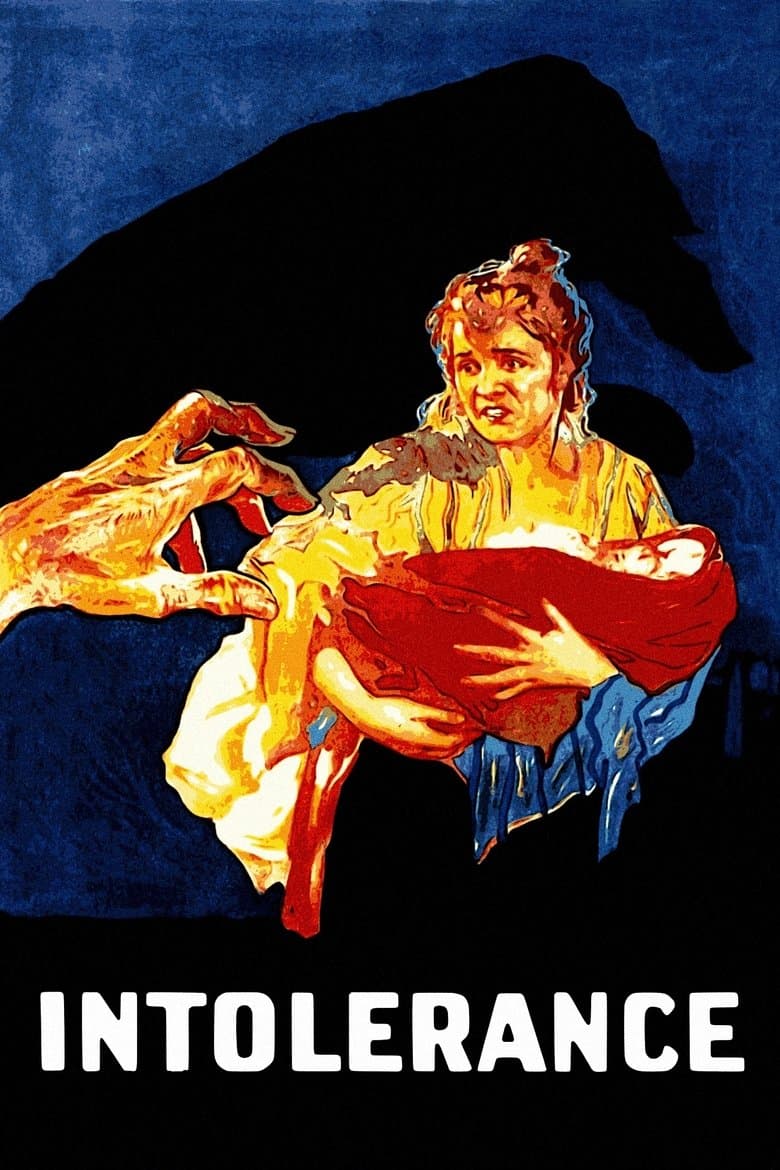
D.W. Griffith’s ambitious silent epic interweaves four stories set across different eras, each dramatizing how persecution, fanaticism, and moral rigidity recur throughout human history. Moving between ancient Babylon, Judea at the time of Christ, sixteenth-century France, and a contemporary American melodrama, the film links its narratives through increasingly bold cross-cutting and visual symbolism. Griffith’s colossal sets, especially the Babylon sequences, announced a new scale of cinematic spectacle, while the film’s restless editing pushed narrative form toward something more abstract and symphonic. Though demanding and unconventional for its time, Intolerance became a landmark of early filmmaking and one of the boldest experiments in silent-era narrative ambition.
Watch for
- How Griffith’s cross-cutting grows more rapid and complex as the film builds toward its climaxes, turning editing itself into a source of tension and meaning.
- The Babylon sequences, where scale, architecture, and crowd movement create some of the most astonishing visual spectacle in early cinema.
- The recurring image of the rocking cradle, which serves as a symbolic link among the four stories and gives the film its overarching emotional thread.
- The contrast between the different visual styles of the four narratives, showing how Griffith adjusts performance, staging, and rhythm to suggest distinct historical worlds.
Production notes
Intolerance was D.W. Griffith's massive follow-up to The Birth of a Nation (1915) — and his deliberate response to the substantial public criticism the earlier film had received. Griffith conceived Intolerance as a four-part epic interweaving narratives from four different historical periods (modern-day America, ancient Babylon, the life of Christ, and Renaissance France's St. Bartholomew's Day Massacre), all unified by the theme of intolerance across human history. The screenplay was by Griffith with substantial uncredited contributions. The production was extraordinarily ambitious — particularly the Babylon segment's massive set construction at the corner of Sunset and Hollywood Boulevards in Los Angeles, with elephants atop pillars and a wall reportedly 200 feet high. The cast included Lillian Gish as the unifying mother figure, Mae Marsh as the Dear One (modern story), Robert Harron as the Boy (modern story), Constance Talmadge as the Mountain Girl (Babylon), Alfred Paget as Belshazzar, Henry B. Walthall as the Catholic Prince Henri (French story), and Howard Gaye as Christ. Cinematographer G.W. Bitzer shot the film. Composer Joseph Carl Breil contributed the score. Production cost approximately $2 million — an extraordinary budget for any 1916 film.
Trivia
- Intolerance's Babylon segment was the largest and most expensive set ever constructed for a silent film — built at the corner of Sunset and Hollywood Boulevards in Los Angeles with elephants atop pillars and a wall reportedly 200 feet high; the set remained standing for several years after production before its 1919 demolition, becoming a major Hollywood tourist attraction.
- D.W. Griffith conceived Intolerance as a deliberate response to the substantial public criticism The Birth of a Nation (1915) had received for its racist content; the film's substantial focus on cross-cultural and cross-historical themes of injustice was Griffith's attempt to demonstrate his commitment to humanitarian themes more broadly.
- Intolerance was a substantial commercial failure on its 1916 release — losing approximately $1 million for D.W. Griffith — and the loss effectively ended Griffith's independent production career; he was forced to sign with United Artists and other distributors for the remainder of his career, and never again attempted a production of comparable scale.
- The film's complex four-part interwoven structure was substantially unprecedented for 1916 American cinema; subsequent decades of critical reassessment have continued to debate whether the structure represents genuine narrative innovation or substantial dramatic confusion, with both views having continuous proponents.
- Intolerance has been recognized as a substantial influence on subsequent generations of filmmakers — particularly Soviet filmmakers Sergei Eisenstein and Vsevolod Pudovkin, who studied the film's editing techniques as foundational texts for their own subsequent montage-theory work in the 1920s.
Legacy
Intolerance is widely regarded as one of the most ambitious silent films and one of the most substantial American cinema achievements of the 1910s. It was selected for the inaugural class of the National Film Registry in 1989. The film's commercial failure on its 1916 release effectively ended D.W. Griffith's independent production career and demonstrated the financial risks of ambitious large-scale production; the failure shaped subsequent decades of Hollywood production-financing decisions. The film's substantial influence on subsequent generations of filmmakers — particularly Soviet filmmakers Sergei Eisenstein and Vsevolod Pudovkin, who studied the film's editing techniques as foundational texts for their own subsequent montage-theory work in the 1920s — has been continuously recognized. The Babylon set's massive Sunset and Hollywood Boulevards construction became permanent symbolic shorthand for Hollywood's early ambition; the set remained a major Hollywood tourist attraction for several years before its 1919 demolition. Among silent-era American films, Intolerance sits alongside Birth of a Nation (1915), The Gold Rush (1925), and The General (1926) as the canonical achievements of the period, though it remains the most thoroughly difficult to categorize given its unique structural ambition.