In the Heat of the Night
Vibe
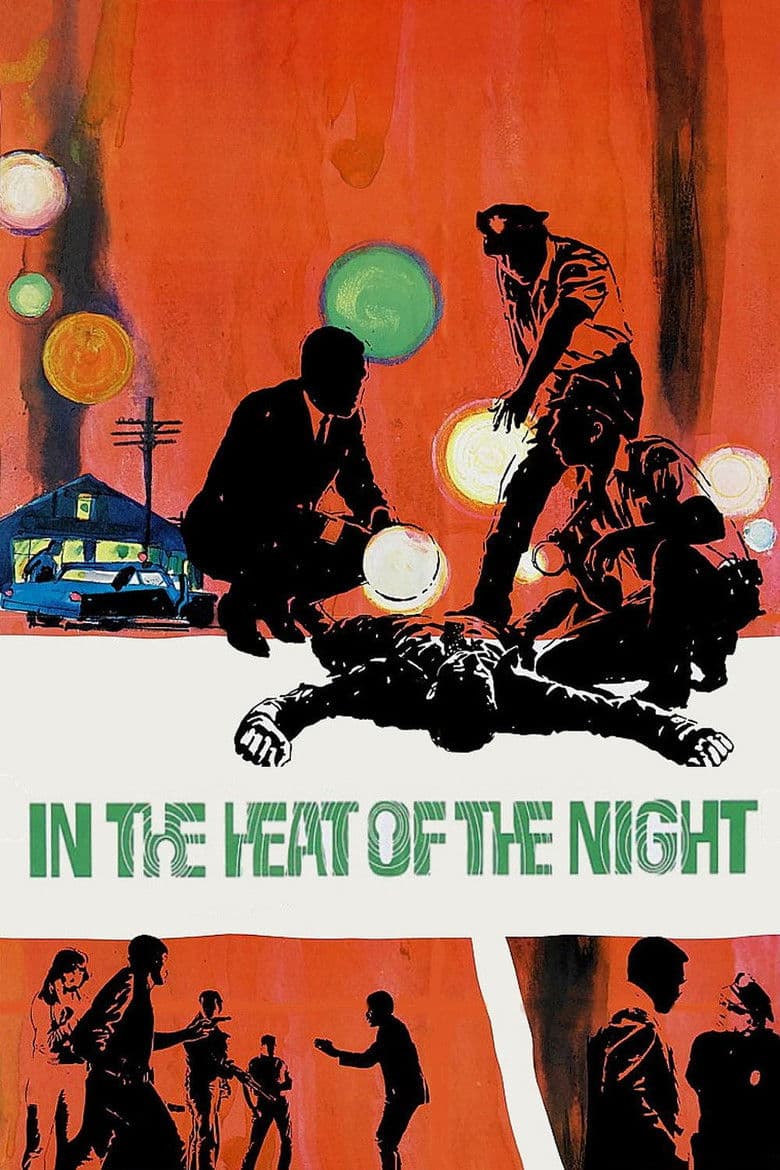
When a wealthy businessman is found murdered in a small Mississippi town, local police chief Bill Gillespie reluctantly finds himself working alongside Virgil Tibbs, a highly skilled Black homicide detective from Philadelphia who is initially treated as a suspect rather than an investigator. As Tibbs stays to help solve the case, the murder inquiry becomes inseparable from the racial hostility and social tensions surrounding it. Sidney Poitier brings Virgil a quiet authority and steel, while Rod Steiger gives Gillespie a mixture of bluster, prejudice, and grudging respect. Blending procedural tension with sharp social commentary, In the Heat of the Night remains one of the most powerful American crime dramas of the civil rights era.
Watch for
- The contrast between Poitier’s controlled, precise performance and Steiger’s more volatile, defensive energy, which gives the partnership its tension and gradual complexity.
- How the film uses Southern heat, night streets, and small-town spaces to create a sense of physical discomfort that mirrors the social hostility surrounding the case.
- The interrogation and confrontation scenes, where pauses, glances, and posture often reveal as much about race and status as the dialogue does.
- The way the mystery plot and the racial dynamics continually feed each other, making the investigation feel like both a crime story and a study of institutional prejudice.
Production notes
In the Heat of the Night was Norman Jewison's adaptation of John Ball's 1965 novel — about a Northern Black homicide detective who is detained by Mississippi police during a routine investigation and ultimately drafted into helping solve a local murder. The screenplay was by Stirling Silliphant. Sidney Poitier played the detective Virgil Tibbs, with Rod Steiger as the racist Mississippi police chief Bill Gillespie. The cast included Lee Grant as the widowed Mrs. Colbert, Warren Oates as the racist deputy Sam Wood, Quentin Dean as the teenage Delores Purdy, William Schallert as Mayor Schubert, and Beah Richards as Mama Caleba. The film's substantial racial-tension content was particularly significant given its 1967 release — the film was shot at the height of the American civil rights movement, with the Civil Rights Act of 1964 and the Voting Rights Act of 1965 having recently been signed into law. The film's famous slap sequence — Tibbs being slapped by a wealthy Mississippi plantation owner, and Tibbs immediately slapping back — was substantially unprecedented for 1967 American cinema, with substantial influence on subsequent civil-rights-themed films. Cinematographer Haskell Wexler shot the film. Composer Quincy Jones contributed the score, with Ray Charles performing the title theme. Production cost approximately $2 million.
Trivia
- The famous slap sequence — Tibbs being slapped by a wealthy Mississippi plantation owner, and Tibbs immediately slapping back — was substantially unprecedented for 1967 American cinema; Sidney Poitier himself reportedly insisted on the substantial reciprocity, threatening to withdraw from the production unless the slap-back was included.
- Sidney Poitier appeared in three substantial 1967 films — Guess Who's Coming to Dinner, To Sir, with Love, and In the Heat of the Night — all of which received substantial commercial success; the three films collectively established Poitier as the dominant Black leading man in mainstream American cinema, a position no Black actor would substantially match for nearly two decades.
- The famous Sidney Poitier line 'They call me Mister Tibbs!' has become one of the most-quoted moments in American cinema; the American Film Institute named it one of the 100 greatest movie quotes, and the line was substantially significant in 1967 American cinema for asserting Black professional dignity in a racially hostile environment.
- Rod Steiger won the Academy Award for Best Actor for his performance as the racist Mississippi police chief Bill Gillespie; the win was substantial recognition of his substantial dramatic range, and the role established him as one of the canonical American character actors of his generation.
- In the Heat of the Night won five Academy Awards including Best Picture, Best Actor (Steiger), Best Adapted Screenplay (Silliphant), Best Film Editing, and Best Sound; the Best Picture win — defeating Bonnie and Clyde, The Graduate, and Doctor Doolittle — was widely interpreted as Hollywood's recognition of the contemporary civil rights moment.
Legacy
In the Heat of the Night won five Academy Awards including Best Picture, Best Actor (Rod Steiger), and Best Adapted Screenplay. It was selected for the National Film Registry in 2002. The Best Picture win — defeating Bonnie and Clyde, The Graduate, and Doctor Doolittle — was widely interpreted as Hollywood's recognition of the contemporary civil rights moment, with the film functioning as the studio system's substantial late-1960s engagement with American racial dynamics. Sidney Poitier's Virgil Tibbs has remained one of the canonical Black protagonist performances in American cinema. The famous line 'They call me Mister Tibbs!' has been continuously cited as one of the most-quoted moments in American cinema. The film generated multiple direct sequels — They Call Me Mister Tibbs! (1970) and The Organization (1971), both starring Poitier — and a subsequent CBS television series (1988-1995) starring Carroll O'Connor as Gillespie and Howard Rollins as Tibbs. Among American films about racial conflict in the South, In the Heat of the Night sits alongside To Kill a Mockingbird (1962) and Mississippi Burning (1988) as the canonical Hollywood studio-era treatments of the territory.