Gone with the Wind
Vibe
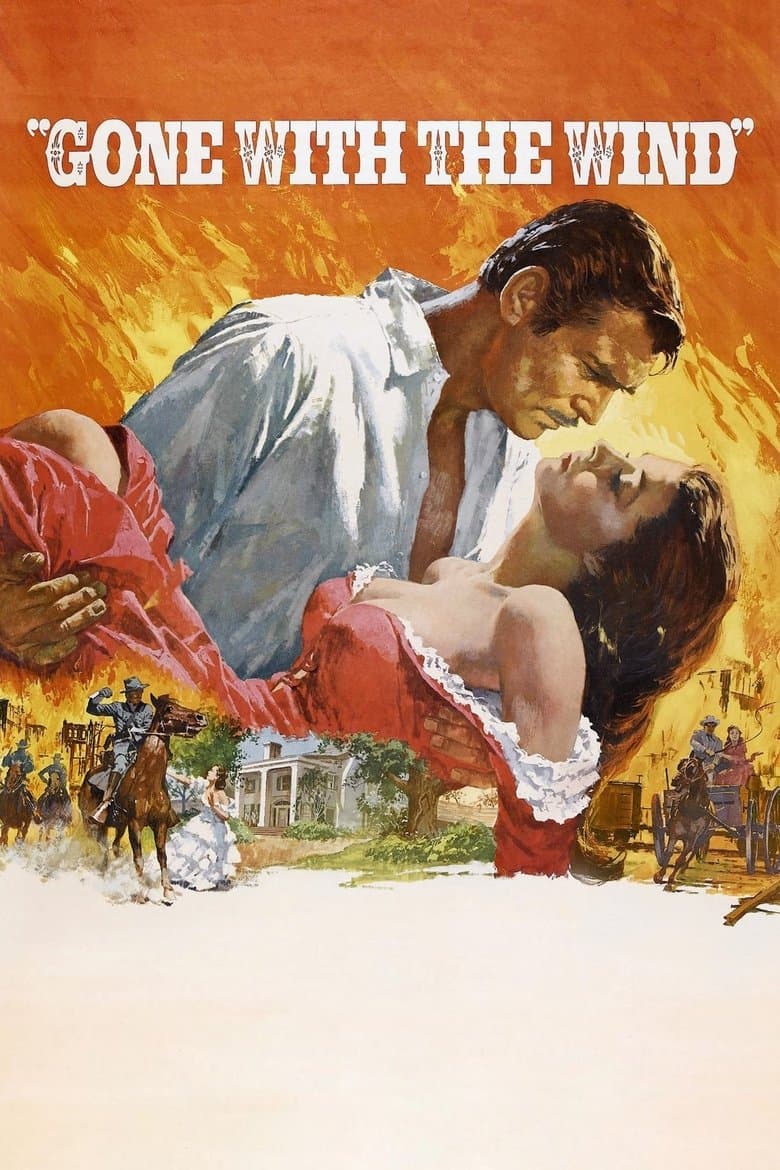
Set against the sweeping backdrop of the American Civil War and Reconstruction, Gone with the Wind follows Scarlett O’Hara, the headstrong daughter of a Georgia plantation owner whose comfortable world collapses as war devastates the South. Determined to survive at any cost, Scarlett navigates years of hardship, shifting fortunes, and complicated romances, including her volatile relationship with the charming but cynical Rhett Butler. Produced by David O. Selznick and directed primarily by Victor Fleming, the film became one of Hollywood’s most ambitious productions, renowned for its grand scale, Technicolor spectacle, and unforgettable performances by Vivien Leigh and Clark Gable. Though its romanticized depiction of the Old South remains widely debated today, the film endures as a landmark achievement in cinematic storytelling.
Watch for
- The sweeping Technicolor imagery, particularly the burning of Atlanta and the wide plantation landscapes that define the film’s epic scale.
- Vivien Leigh’s performance as Scarlett, capturing both her resilience and her selfishness as the character evolves over years of hardship.
- The shifting relationship between Scarlett and Rhett Butler, where romance, pride, and emotional vulnerability collide.
- Moments where spectacle gives way to intimate character drama, revealing how personal survival becomes Scarlett’s driving force.
Production notes
Gone with the Wind was producer David O. Selznick's adaptation of Margaret Mitchell's 1936 Pulitzer Prize-winning novel — the most highly anticipated film of its era, with a famously chaotic four-year production. The casting search for Scarlett O'Hara involved hundreds of actresses tested across two years; British actress Vivien Leigh was cast just as filming was about to begin. Selznick burned through three directors during production: George Cukor was fired weeks into shooting, replaced by Victor Fleming (who took the directing credit), and Sam Wood directed sequences during Fleming's exhaustion-induced absence. The screenplay was rewritten by multiple writers including F. Scott Fitzgerald, Sidney Howard (who received the credit), and Ben Hecht. Clark Gable played Rhett Butler, with Leslie Howard as Ashley, Olivia de Havilland as Melanie, Hattie McDaniel as Mammy, and Butterfly McQueen as Prissy. Max Steiner composed the score. Cinematographers Lee Garmes and Ernest Haller shared duties on the Technicolor production. The film cost approximately $4 million — a record budget at the time.
Trivia
- Hattie McDaniel became the first African American to win an Academy Award, taking Best Supporting Actress for her performance as Mammy; she was forced to sit at a segregated table at the back of the ceremony, separated from the rest of the Gone with the Wind cast.
- The famous Atlanta-burning sequence was filmed before Vivien Leigh had been cast as Scarlett; the production used standing sets from earlier films (including King Kong's outer wall) and burned them, with Selznick using doubles in long shot until casting was finalized.
- Producer David O. Selznick reportedly fired three directors over the course of production — George Cukor was replaced by Victor Fleming after a few weeks, and Sam Wood directed sequences during Fleming's exhaustion-induced absences.
- Clark Gable's famous final line — 'Frankly, my dear, I don't give a damn' — required Selznick to fight the Production Code office for permission to use the word 'damn'; the studio paid a $5,000 fine to keep the line in.
- Gone with the Wind grossed approximately $200 million worldwide on its initial release and, when adjusted for inflation, remains the highest-grossing film of all time in domestic American box office — a record it has held for over eighty years.
Legacy
Gone with the Wind won eight Academy Awards including Best Picture, Best Director (Victor Fleming), Best Actress (Vivien Leigh), and the historic Best Supporting Actress for Hattie McDaniel — the first Oscar awarded to an African American performer. Adjusted for inflation, the film remains the highest-grossing American release of all time. It was selected for the National Film Registry in 1989. The film's complicated cultural legacy has been the subject of extensive ongoing debate: its romanticization of antebellum Southern slavery, its sympathetic treatment of Confederate causes, and its portrayal of Black characters have generated continuous critical reassessment, leading HBO Max in 2020 to add an introductory historical context disclaimer to its streaming version. Despite these concerns, the film's commercial dominance, technical achievements (especially the Technicolor Atlanta-burning sequence), and Vivien Leigh's central performance have kept it in active critical circulation. As a cultural object, Gone with the Wind continues to be both celebrated and interrogated as one of the most thoroughly American mythological films of the 20th century.