Forrest Gump
Vibe
Robert Zemeckis’s sweeping drama follows the improbable life of Forrest Gump, a kindhearted Alabama man whose steady decency carries him through some of the most defining moments of postwar American history. From college football and Vietnam to political scandal, ping-pong diplomacy, and unexpected business success, Forrest repeatedly finds himself at the center of events he never tries to control. Tom Hanks’s performance gives the character warmth, sincerity, and emotional clarity, grounding the film’s broad historical canvas in something deeply human. Through a blend of nostalgia, humor, romance, and technical innovation, Forrest Gump became one of the most recognizable and culturally resonant American films of the 1990s.
Watch for
- Tom Hanks’s performance, especially the way Forrest’s directness and emotional consistency anchor a story that constantly shifts across tone, place, and era.
- How the film uses historical events and pop-cultural touchstones as backdrop, turning Forrest into both participant in and witness to modern American mythmaking.
- The visual effects work that inserts Forrest into archival footage, which was groundbreaking for its time and central to the film’s narrative design.
- The recurring contrast between Forrest’s simple worldview and the chaos around him, which gives the film both its humor and its emotional perspective.
Production notes
Forrest Gump was Robert Zemeckis's adaptation of Winston Groom's 1986 novel, with the screenplay by Eric Roth. The film required substantial digital-effects work for its era — much of it from Industrial Light & Magic — to integrate the title character into archival footage of historical events from the 1960s through the early 1980s. Tom Hanks played the title character, an intellectually-limited Alabama man whose life inadvertently intersects with major events in twentieth-century American history. Robin Wright played Jenny Curran, with Gary Sinise as Lieutenant Dan Taylor, Mykelti Williamson as Bubba Blue, and Sally Field as Forrest's mother. The film required ILM to digitally insert Tom Hanks into actual archival footage of Presidents Kennedy, Johnson, and Nixon — using techniques that had not previously been attempted at this scale. Cinematographer Don Burgess shot the film. Composer Alan Silvestri contributed the score, with extensive use of period-appropriate popular music. Production cost approximately $55 million.
Trivia
- Tom Hanks won his second consecutive Academy Award for Best Actor for Forrest Gump — following his win for Philadelphia (1993) — making him only the second actor in Oscar history to win consecutive Best Actor Oscars (after Spencer Tracy in 1937 and 1938).
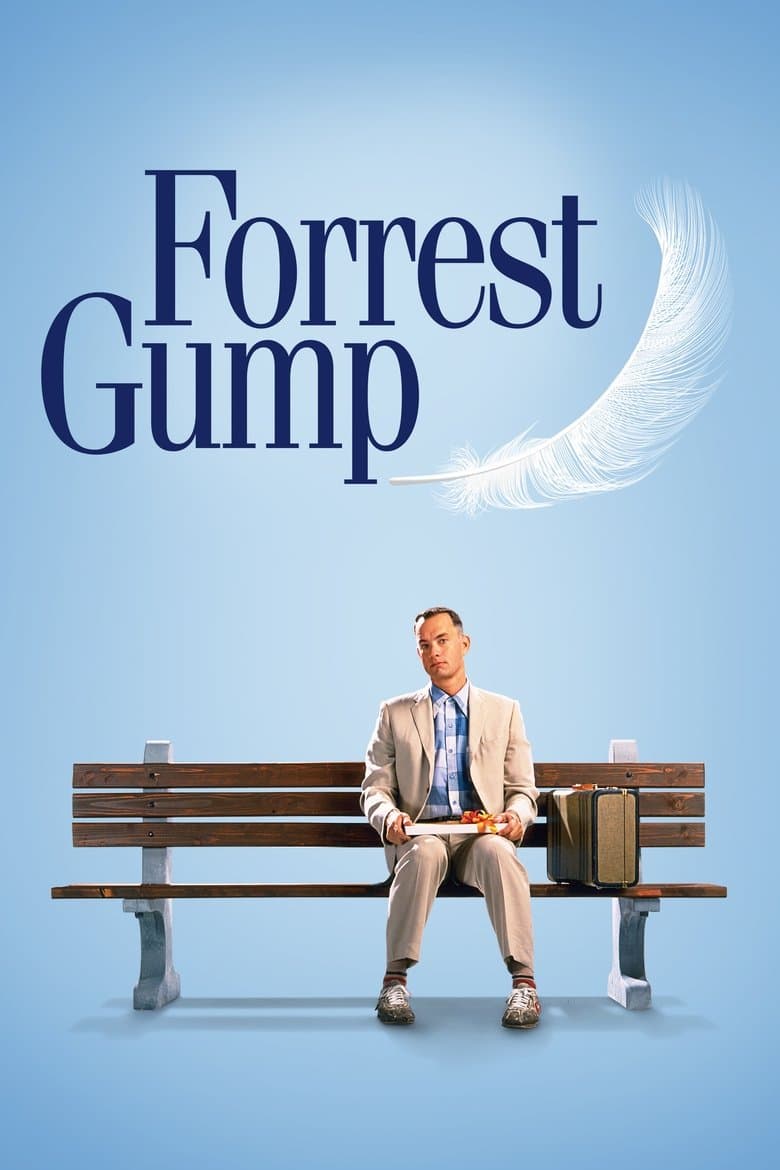
- The famous opening-credits feather sequence — a single feather drifting from sky to ground — required approximately 70 separate computer-generated shots, with the feather's behavior modeled on actual feather physics; the sequence has become one of the most-quoted opening sequences in 1990s American cinema.
- Forrest Gump grossed approximately $678 million worldwide on its $55 million budget — making it the highest-grossing film of 1994 and one of the highest-grossing American films to that point in cinema history.
- The film's depiction of major events from American twentieth-century history — including the Vietnam War, the anti-war movement, the civil rights era, Watergate, the AIDS crisis, and the early Reagan years — was substantially shaped by Robert Zemeckis's deliberate aesthetic of treating the protagonist as a fortunate-accidental witness to American history rather than as participant or commentator.
- Forrest Gump won six Academy Awards including Best Picture, Best Director (Zemeckis), Best Actor (Hanks), Best Adapted Screenplay (Roth), Best Visual Effects, and Best Film Editing; the win has been continuously discussed as one of the more contested Best Picture decisions of the 1990s, with Pulp Fiction and The Shawshank Redemption considered by many critics to have been the stronger contenders.
Legacy
Forrest Gump won six Academy Awards including Best Picture, Best Director, and Best Actor (Tom Hanks's second consecutive Best Actor Oscar). It grossed approximately $678 million worldwide on its $55 million budget — the highest-grossing film of 1994. It was selected for the National Film Registry in 2011. The film's central thesis — that the protagonist passively witnesses major American twentieth-century events while pursuing his own straightforward life — has been the subject of substantial ongoing critical debate, with some critics seeing the film as warmly humanistic and others as politically reactionary (the film's perceived dismissal of the counterculture and 1960s political movements has been a sustained source of critical objection). The American Film Institute named Forrest Gump's 'Life is like a box of chocolates' line one of the 100 greatest movie quotes. Tom Hanks's performance launched the next phase of his career — moving him from comedic-leading-man status to dramatic-leading-man with consistent prestige casting — and the role has remained the most thoroughly identified with him across his subsequent four decades of work.