Duck Soup
Vibe
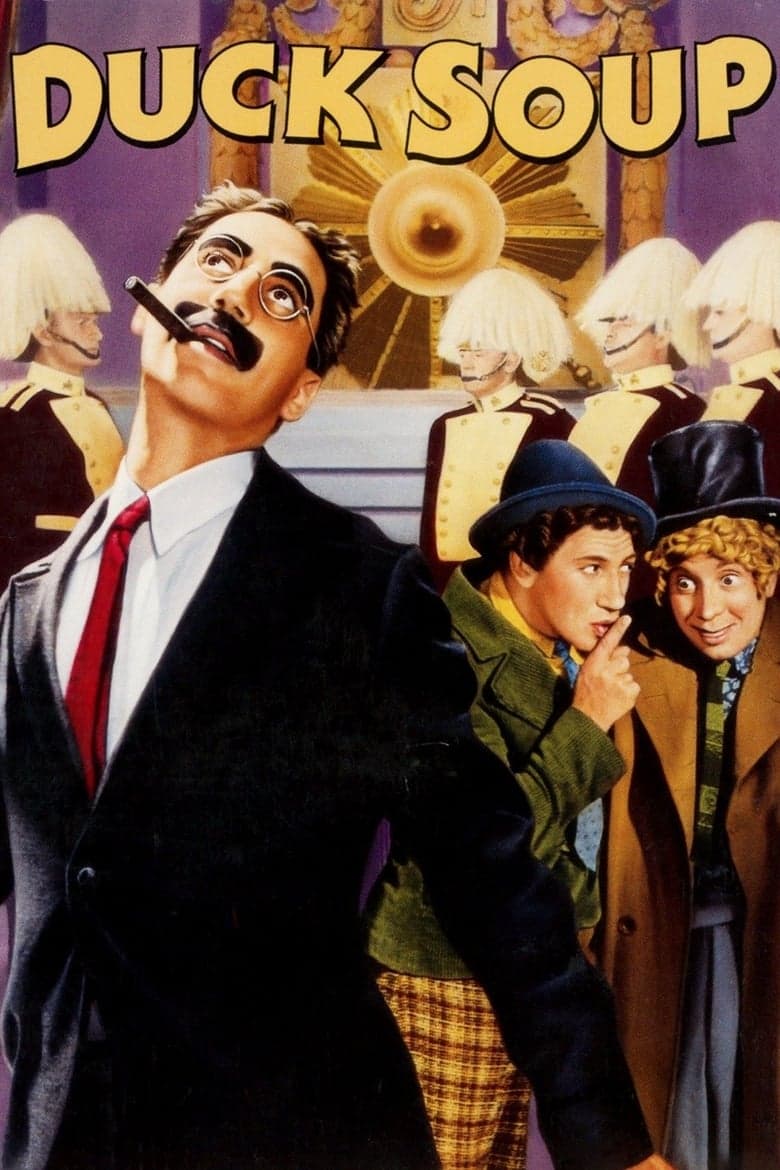
This anarchic Marx Brothers comedy skewers politics, diplomacy, and militarism through the absurdly unstable nation of Freedonia. Groucho Marx plays Rufus T. Firefly, a reckless and gloriously unqualified leader whose vanity, insults, and whims push the country toward chaos and war. Around him, spies, opportunists, and nonsense logic pile up into a nonstop assault of wordplay, slapstick, and anti-authoritarian mockery. Though only loosely interested in plot, the film moves with astonishing comic velocity, turning every scene into an opportunity for sabotage, ridicule, and gleeful disorder. Initially a commercial disappointment, Duck Soup later came to be recognized as one of the greatest screen comedies ever made.
Watch for
- Groucho Marx’s performance as Firefly, especially the way his speed, self-importance, and verbal aggression turn authority itself into the punchline.
- The famous mirror sequence, where timing, choreography, and escalating absurdity create one of the most celebrated visual routines in comedy history.
- How the film treats plot as something to be constantly interrupted or derailed, making comic rhythm and destruction more important than narrative logic.
- The war scenes, where costumes, props, and patriotic spectacle are stripped of seriousness and turned into pure farce.
Production notes
Duck Soup was the fifth and final Marx Brothers film for Paramount Pictures — and the brothers' most thoroughly anarchic political comedy. The screenplay was credited to Bert Kalmar and Harry Ruby (with additional dialogue by Arthur Sheekman and Nat Perrin), but the brothers' substantial improvisation during production made the credited screenplay only an approximate guide to the finished film. Leo McCarey directed — the only Marx Brothers film directed by a major Hollywood director with his own substantial reputation, McCarey having previously worked with Laurel and Hardy and would later direct the Best Picture-winning Going My Way (1944). Groucho Marx played Rufus T. Firefly, the newly-appointed dictator of the bankrupt nation of Freedonia; Harpo Marx played the silent stooge Pinky, Chico Marx played the fraudulent peanut vendor Chicolini, and Zeppo Marx played Firefly's secretary Bob Roland (in Zeppo's final Marx Brothers film). Margaret Dumont played the wealthy benefactor Mrs. Teasdale (her seventh of seven Marx Brothers films). The film's central narrative — Firefly leading Freedonia into a war with neighboring Sylvania over a petty insult — was widely interpreted as anti-war satire. Production cost approximately $1 million.
Trivia
- Duck Soup was the fifth and final Marx Brothers film for Paramount Pictures — the studio dropped the brothers after the film's commercial underperformance; the brothers subsequently moved to MGM under producer Irving Thalberg, who substantially restructured their comedic approach for the subsequent A Night at the Opera (1935) and A Day at the Races (1937).
- The film's central narrative — Firefly leading Freedonia into a war with neighboring Sylvania over a petty insult — was widely interpreted as anti-war satire, particularly given the contemporary 1933 European political situation; Adolf Hitler had taken power in Germany earlier that year, and the film's anti-authoritarian comedy was a substantial commercial risk given Paramount's substantial European market.
- The famous 'mirror sequence' — in which Harpo (dressed as Groucho) pretends to be Groucho's mirror reflection by perfectly mirroring his movements — has been continuously celebrated as one of the most thoroughly realized physical-comedy sequences in any cinema; the sequence has been continuously imitated and parodied across decades of subsequent comic work, including I Love Lucy (1955) and Animaniacs (1993).
- Mussolini's Italian government reportedly banned Duck Soup from theatrical exhibition, taking offense at the film's satirical depiction of Firefly's dictator-leadership; the ban was extensive enough that Groucho Marx reportedly considered it the highest compliment any reviewer had paid to the film, and he frequently cited the ban in subsequent interviews.
- Duck Soup was a commercial disappointment on its 1933 release — losing money for Paramount and contributing to the studio's decision to drop the brothers — but the film has aged into one of the most thoroughly respected works of the Marx Brothers' catalog and is regularly cited as their masterpiece.
Legacy
Duck Soup was a commercial disappointment on its 1933 release but has aged into one of the most thoroughly respected works of the Marx Brothers' catalog and is regularly cited as their masterpiece. It was selected for the National Film Registry in 1990. The famous 'mirror sequence' has been continuously celebrated as one of the most thoroughly realized physical-comedy sequences in any cinema, with substantial subsequent influence on comic cinema from I Love Lucy (1955) to Animaniacs (1993). The film's anti-war and anti-authoritarian register has aged into permanent relevance — particularly given the historical proximity of the film's 1933 release to the actual rise of European authoritarianism and the subsequent war. The film's specific approach to political satire — absurdist comic register applied to the actual mechanisms of war, propaganda, and dictatorship — has been continuously cited as one of the foundational templates for subsequent political comedy work, with direct lineage to The Great Dictator (1940), Dr. Strangelove (1964), and contemporary work from Veep to Succession. Among the Marx Brothers' films, Duck Soup sits alongside A Night at the Opera (1935) as the canonical achievements of the team, though Duck Soup remains the brothers' most thoroughly anarchic and politically pointed work.