Dr. Strangelove
Vibe
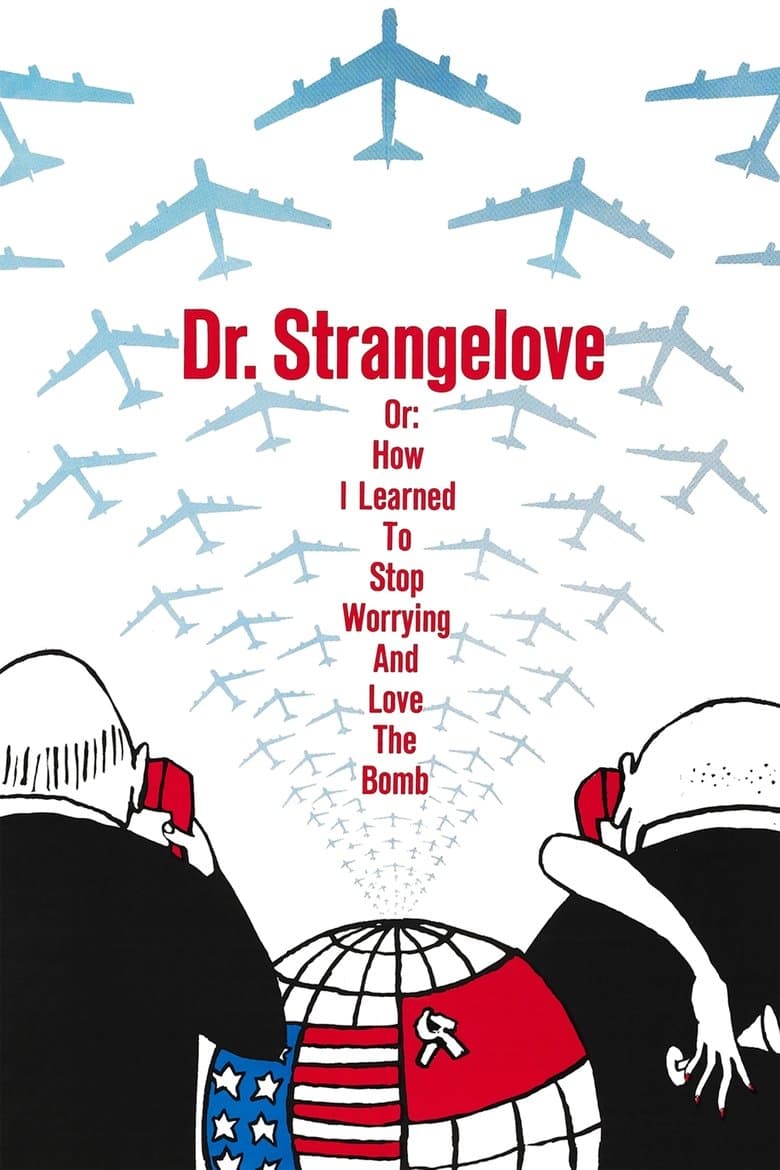
Stanley Kubrick’s razor-sharp satire explores the absurd logic of nuclear deterrence during the Cold War. When a rogue U.S. Air Force general orders a surprise nuclear strike on the Soviet Union, American political and military leaders race to stop the attack before it triggers global annihilation. Much of the film unfolds inside the Pentagon’s war room, where bureaucratic confusion, political egos, and flawed military doctrine only deepen the crisis. Peter Sellers delivers a trio of unforgettable performances, including the eccentric former Nazi scientist Dr. Strangelove. By blending outrageous comedy with chilling plausibility, Kubrick exposes the terrifying fragility of nuclear strategy in one of cinema’s most daring political satires.
Watch for
- Peter Sellers’s trio of performances, each embodying a different facet of political and military absurdity.
- The iconic war room set, whose circular design and stark lighting emphasize the theatrical nature of global decision-making.
- Kubrick’s deadpan humor, where calm bureaucratic dialogue contrasts with the catastrophic stakes of nuclear war.
- The film’s unforgettable final sequence, which underscores the ultimate absurdity of mutually assured destruction.
Production notes
Dr. Strangelove or: How I Learned to Stop Worrying and Love the Bomb was Stanley Kubrick's adaptation of Peter George's serious 1958 novel Red Alert (Two Hours to Doom in the U.K.) — but Kubrick had developed the project as a straight Cold War thriller for over a year before deciding the only honest treatment of nuclear-deterrence absurdity was satire. Terry Southern joined Kubrick and George on the screenplay, contributing much of the film's blackly comic register. Peter Sellers performed three roles — Group Captain Lionel Mandrake, President Merkin Muffley, and the title character Dr. Strangelove — and was originally cast in a fourth (Major Kong) before injuring his ankle and being replaced by Slim Pickens. George C. Scott played General Buck Turgidson, with Sterling Hayden as the paranoid General Ripper, Keenan Wynn as Colonel Bat Guano, James Earl Jones in his film debut as Lieutenant Lothar Zogg, and Tracy Reed as the only female speaking role in the film. Cinematographer Gilbert Taylor shot the film. Production cost approximately $1.8 million.
Trivia
- Peter Sellers was originally cast in four roles, including Major T.J. 'King' Kong (the bomber-pilot character who rides the bomb in the famous closing image); Sellers injured his ankle during production and was replaced by Slim Pickens, whose Texan-cowboy performance gave the role its iconic register.
- George C. Scott's broadly comedic performance as General Buck Turgidson was reportedly the result of Stanley Kubrick tricking him into doing increasingly larger takes; Scott had wanted to play the character straight, and Kubrick had him do 'just one more big one' as warm-up before settling on the over-the-top takes that appear in the film. Scott reportedly never forgave Kubrick.
- The famous 'War Room' set, designed by Ken Adam, became one of the most influential production designs in film history; Steven Spielberg later said the set inspired his approach to film design, and the War Room imagery has been imitated and parodied countless times.
- Dr. Strangelove was originally going to end with a custard-pie fight in the War Room — that sequence was actually shot — but Kubrick cut it after deciding the more abstract closing montage of nuclear explosions worked better; the cut footage is reportedly preserved in archives.
- The film was released on January 29, 1964, originally scheduled for late 1963 but delayed after the Kennedy assassination; the line where Slim Pickens initially calls the survival kit 'enough stuff to have a pretty good weekend in Vegas' was redubbed to 'Dallas' for political sensitivity, then reverted in later prints.
Legacy
Dr. Strangelove received four Academy Award nominations including Best Picture (losing to My Fair Lady) and was selected for the inaugural class of the National Film Registry in 1989. The American Film Institute named it the third-greatest American comedy of all time. The film fundamentally shaped how American cinema treats nuclear weapons and military bureaucracy — its black-comedy approach to the unthinkable became the template for subsequent Cold War satires (WarGames, Crimson Tide, On the Beach). Peter Sellers's three-role performance — particularly the wheelchair-bound Strangelove with his uncontrollable Nazi-saluting hand — is regularly cited as one of the greatest comic performances in American cinema. The closing image of Slim Pickens riding a nuclear warhead like a rodeo bull, the cackling final 'Yee-haw!' — has become permanent visual shorthand for nuclear absurdity. The film's specific Cold War context has aged into prophetic relevance during subsequent nuclear-tension periods, and its core insight — that the men in charge of the world's most powerful weapons are themselves absurd — has remained continuously useful.