Do the Right Thing
Vibe
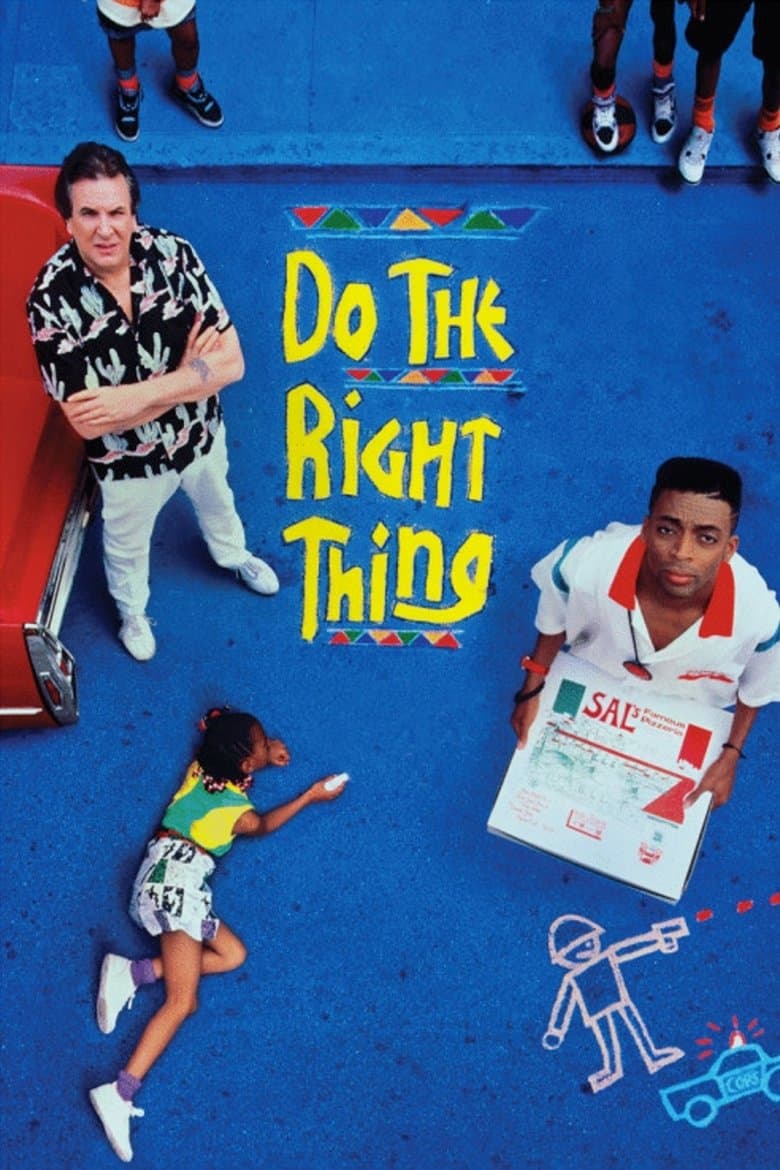
Spike Lee’s vibrant and provocative drama unfolds over the course of a sweltering summer day in a Brooklyn neighborhood, where ordinary routines gradually give way to rising tension and open conflict. Through a dense network of residents, customers, friends, and rivals, the film captures a community alive with humor, music, pride, resentment, and unspoken grievance. Lee’s energetic direction and ensemble cast create a street-level portrait of urban life that is at once richly specific and politically explosive. As the heat intensifies, so do the pressures around race, power, and belonging, making Do the Right Thing one of the most urgent and influential American films ever made about community and racial tension.
Watch for
- How Lee uses color, heat, and camera movement to make the neighborhood feel physically alive and increasingly volatile as the day wears on.
- The ensemble structure, where even brief encounters and side conversations deepen the film’s sense of community and reveal competing perspectives rather than a single viewpoint.
- Public Enemy’s “Fight the Power,” which functions not just as soundtrack but as a recurring force within the world of the film, shaping mood, identity, and confrontation.
- The tonal shifts between humor, argument, music, and violence, which make the film’s final eruption feel both shocking and tragically inevitable.
Production notes
Do the Right Thing was Spike Lee's substantial third feature — his racially charged drama set during the hottest day of summer in Brooklyn's Bedford-Stuyvesant neighborhood, where racial tensions between the Black community and the Italian-American owners of a local pizzeria gradually escalate to violent confrontation. Lee wrote, directed, produced, and starred in the film. Lee himself played the pizza-delivery worker Mookie, with Danny Aiello as the pizzeria owner Sal, John Turturro as Sal's racist son Pino, Richard Edson as Sal's other son Vito, Ossie Davis as the neighborhood elder Da Mayor, Ruby Dee as Da Mayor's longtime companion Mother Sister, Giancarlo Esposito as the politically conscious Buggin' Out, Bill Nunn as the boombox-carrying Radio Raheem, Samuel L. Jackson as the radio DJ Mister Señor Love Daddy, Rosie Perez (in her film debut) as Mookie's girlfriend Tina, and Joie Lee (Spike Lee's sister) as Mookie's sister Jade. The film's substantial engagement with contemporary American racial politics — including substantial references to the 1986 Howard Beach incident and other actual contemporary racial-tension events — was central to its critical reception. Cinematographer Ernest Dickerson shot the film with substantial heat-saturated color work. Composer Bill Lee (Spike Lee's father) contributed the score. Production cost approximately $6.5 million.
Trivia
- Public Enemy's 'Fight the Power' — written specifically for the film by Public Enemy at Spike Lee's substantial request — has become one of the canonical American protest songs; the substantial Bomb Squad production and Chuck D's substantial political lyricism made the track one of the most substantially influential hip-hop singles of the late 1980s.
- Rosie Perez made her film debut as Mookie's girlfriend Tina — including the famous opening-credits dance sequence performed to 'Fight the Power'; Spike Lee had discovered her dancing at a New York nightclub, and Perez's substantial subsequent career launched from this performance, including her Best Supporting Actress Oscar nomination for Fearless (1993).
- Do the Right Thing's substantial influence on Quentin Tarantino was central — Tarantino's later Pulp Fiction (1994) reportedly contained substantial homages to Do the Right Thing's specific energy, and Tarantino's casting of Samuel L. Jackson in Pulp Fiction (after Jackson had broken through with Do the Right Thing) was substantial.
- Roger Ebert and Gene Siskel's substantial championship of the film at the 1989 Cannes Film Festival was central to its commercial-critical recognition; Ebert subsequently named Do the Right Thing the best film of the 1980s, a substantial elevation that helped establish Spike Lee as one of the major American directors of his generation.
- Do the Right Thing received two Academy Award nominations — Best Supporting Actor (Danny Aiello) and Best Original Screenplay (Spike Lee) — winning none, and was substantially excluded from the Best Picture and Best Director categories in one of the most controversial Oscar oversights of the late 1980s; the omission has been continuously discussed as evidence of the substantial racial bias of contemporary Academy voting.
Legacy
Do the Right Thing received two Academy Award nominations (Best Supporting Actor for Danny Aiello and Best Original Screenplay for Spike Lee) — winning none, and was substantially excluded from the Best Picture and Best Director categories in one of the most controversial Oscar oversights of the late 1980s. It was selected for the National Film Registry in 1999. Roger Ebert subsequently named Do the Right Thing the best film of the 1980s, a substantial elevation that helped establish Spike Lee as one of the major American directors of his generation. The film's substantial engagement with contemporary American racial politics has aged into permanent relevance — substantial subsequent American moments (the 1991 Rodney King beating, the substantial subsequent civil-rights moments of the 1990s, the 2014 Eric Garner death whose 'I can't breathe' line directly echoes Radio Raheem's death in Do the Right Thing, the substantial subsequent Black Lives Matter movement of the 2010s) have continuously demonstrated the film's substantial prophetic register. Public Enemy's 'Fight the Power' has become one of the canonical American protest songs. Among films about contemporary American racial conflict, Do the Right Thing remains the canonical text — and stands alongside In the Heat of the Night (1967) as one of the two major Hollywood treatments of the territory across the postwar American century.