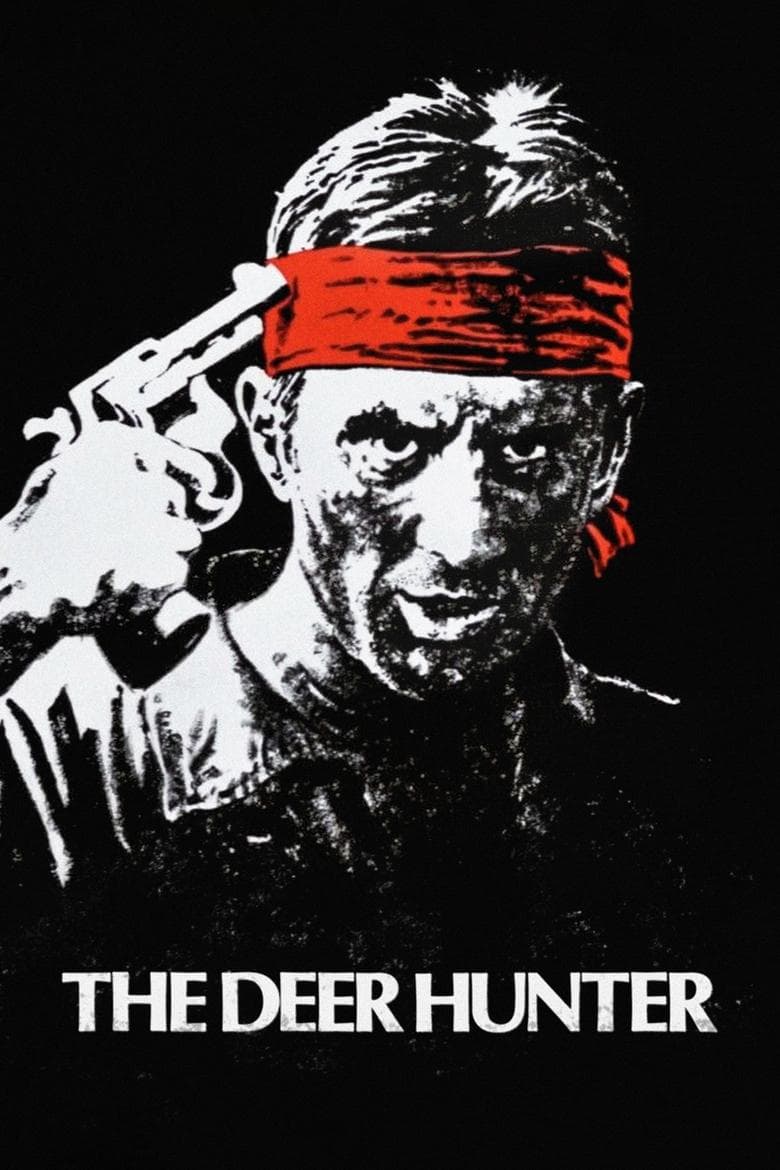
The Deer Hunter
Vibe
Michael Cimino’s epic drama follows a group of working-class friends from a Pennsylvania steel town whose lives are irrevocably altered by the Vietnam War. Divided into distinct movements before, during, and after combat, the film traces how friendship, ritual, and ordinary life are fractured by trauma and loss. Robert De Niro, Christopher Walken, and Meryl Streep bring enormous emotional weight to a story concerned less with battlefield strategy than with what war does to identity, community, and memory. Cimino’s deliberate pacing gives the characters’ shared world a fullness that makes its devastation all the more painful. The Deer Hunter remains one of the most haunting American films about war and its aftermath.
Watch for
- How Cimino patiently builds the steel-town world in the opening section, making friendship, work, marriage, and ritual feel fully lived before war tears them apart.
- Robert De Niro and Christopher Walken’s contrasting performances, which reveal different responses to violence, survival, and emotional dislocation.
- The Russian roulette scenes, not just for their shock, but for how they externalize terror, helplessness, and the psychological absurdity of war.
- The film’s tonal shift after the war, where silence, distance, and fractured reunions become as devastating as anything on the battlefield.
Production notes
The Deer Hunter was Michael Cimino's three-hour Vietnam War epic — his second feature, after the minor Thunderbolt and Lightfoot (1974). The screenplay was credited to Deric Washburn (with a story credit shared by Washburn, Cimino, Louis Garfinkle, and Quinn K. Redeker), though Cimino's uncredited rewriting was substantial during production. The film follows three Pennsylvania steelworker friends — Michael, Steven, and Nick — through their deployment to Vietnam and the psychological aftermath of their return. Robert De Niro played Michael Vronsky, with John Savage as Steven Pushkov, Christopher Walken as Nick Chevotarevich (a performance that won Walken the Academy Award for Best Supporting Actor), John Cazale in his fifth and final film (filmed shortly before his 1978 death from bone cancer), Meryl Streep as Linda, and George Dzundza as the bar-owner John. The infamous Russian-roulette sequences — used both as central torture/forced-game by the Viet Cong and later as a self-destructive obsession of Walken's character — became some of the most controversial and influential set pieces in any American war film. Cinematographer Vilmos Zsigmond shot the film. Production cost approximately $15 million.
Trivia
- John Cazale — the actor who appeared in only five feature films before his 1978 death from bone cancer (The Godfather, The Conversation, The Godfather Part II, Dog Day Afternoon, and The Deer Hunter) — was diagnosed with terminal cancer during pre-production; Cimino filmed Cazale's scenes first to ensure he could complete his work, and the actor died approximately seven months before the film's release.
- Meryl Streep was 28 when she made the film and had been romantically involved with John Cazale during the production; she has subsequently said in interviews that her involvement with The Deer Hunter was substantially shaped by her commitment to staying with Cazale through his final illness, and the experience profoundly affected her subsequent career and personal life.
- Christopher Walken won the Academy Award for Best Supporting Actor for his performance as Nick Chevotarevich; his role's psychological deterioration through repeated Russian-roulette episodes has been continuously studied as one of the great supporting performances in 1970s American cinema.
- The film's depiction of Vietnamese Viet Cong forcing American prisoners to play Russian roulette has been continuously disputed by historians; there is no documented evidence that the Viet Cong used Russian roulette as a torture technique, and the sequences have been widely criticized as anti-Vietnamese propaganda — a critique that has not substantially diminished the film's American commercial and critical reception.
- The Deer Hunter won five Academy Awards including Best Picture, Best Director (Cimino), Best Supporting Actor (Walken), Best Sound, and Best Film Editing; the win effectively launched Cimino's brief peak period, though his next film — Heaven's Gate (1980) — became one of the most thoroughly disastrous productions in Hollywood history.
Legacy
The Deer Hunter won five Academy Awards including Best Picture and Best Director (Michael Cimino), and was selected for the National Film Registry in 1996. Christopher Walken's Oscar-winning supporting performance as Nick Chevotarevich has been continuously studied as one of the great supporting performances in 1970s American cinema. The film's depiction of Vietnamese Viet Cong forcing American prisoners to play Russian roulette has been continuously disputed by historians and widely criticized as anti-Vietnamese propaganda — a critique that has shaped the film's contemporary reception more substantially than its original 1978 reception. Among American films about the Vietnam War, The Deer Hunter sits alongside Apocalypse Now (1979), Platoon (1986), and Full Metal Jacket (1987) as the canonical late-1970s and 1980s treatments. Michael Cimino's win established his briefly elevated status before his next film Heaven's Gate (1980) became one of the most thoroughly disastrous productions in Hollywood history — effectively ending the 'auteur-driven' New Hollywood era and triggering the corporate-controlled studio model that would dominate subsequent decades.