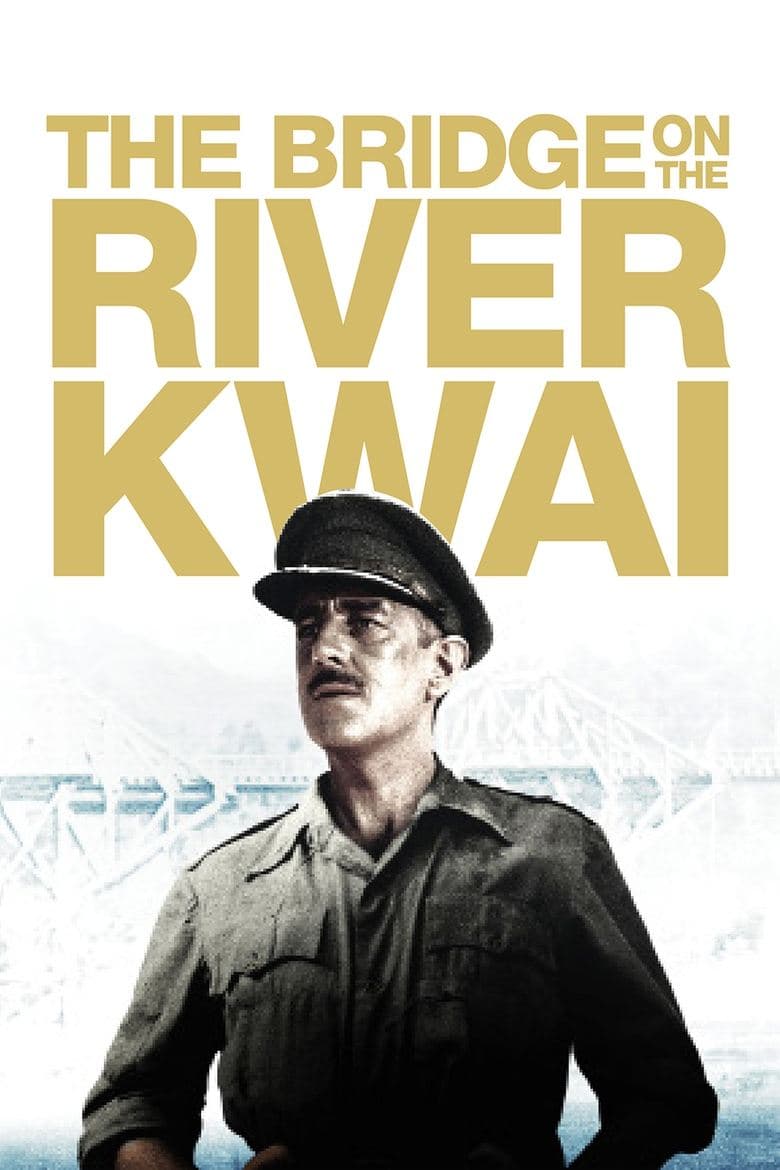
The Bridge on the River Kwai
Vibe
David Lean’s wartime epic follows British prisoners of war held by the Japanese in Burma during World War II and ordered to construct a strategic railway bridge. Their commanding officer, Colonel Nicholson, becomes determined to build the bridge to the highest standard as a matter of discipline and British pride—even as Allied commandos secretly plan a mission to destroy it. As Nicholson’s obsession deepens, the line between duty and collaboration begins to blur. Alec Guinness’s Oscar-winning performance anchors the film’s psychological tension, while Lean’s sweeping direction combines jungle spectacle with intimate character drama. Famous for its haunting whistled “Colonel Bogey March,” The Bridge on the River Kwai remains one of the most powerful explorations of honor, pride, and the contradictions of war.
Watch for
- Alec Guinness’s layered performance as Colonel Nicholson, whose sense of honor slowly turns into dangerous obsession.
- The film’s use of the jungle landscape, which heightens the tension and isolation of the prisoner-of-war camp.
- The famous whistled “Colonel Bogey March,” which becomes an ironic symbol of discipline and morale.
- The suspenseful final act as the bridge’s completion collides with the Allied sabotage mission.
Production notes
The Bridge on the River Kwai was David Lean's first epic-scale feature, made for producer Sam Spiegel and Columbia Pictures. The screenplay was officially credited to Pierre Boulle, the French author of the source novel — but was actually written by blacklisted American screenwriters Carl Foreman and Michael Wilson, neither of whom received public credit until the Academy retroactively awarded them the Oscar in 1985. The film was shot on location in Ceylon (now Sri Lanka), with the actual bridge constructed for the production by hundreds of local laborers and demolished on screen in the climactic finale. Alec Guinness played Colonel Nicholson in a performance that established him as a major screen actor; William Holden played the American naval commander Shears, with Sessue Hayakawa as Colonel Saito and Jack Hawkins as Major Warden. Cinematographer Jack Hildyard shot the film in CinemaScope. Composer Malcolm Arnold wrote the score, including the famous adapted whistle of 'Colonel Bogey March.' Production took eight months. The film cost approximately $3 million.
Trivia
- The screenplay was officially credited to Pierre Boulle (the French author of the source novel) but was actually written by blacklisted American screenwriters Carl Foreman and Michael Wilson — both Boulle and the Academy played along with the deception, and the Academy retroactively awarded the Oscar to Foreman and Wilson in 1985.
- Alec Guinness initially refused the role of Colonel Nicholson and only accepted after personal pleading from David Lean; the film established Guinness as a major dramatic screen actor, opening the way to his subsequent Lawrence of Arabia and Star Wars roles.
- The bridge that gets blown up in the climax was actually built for the production by hundreds of local laborers in Ceylon — a real working bridge — and was genuinely demolished on screen using approximately 1,200 pounds of explosives.
- Composer Malcolm Arnold won the Academy Award for the film's score; the 'Colonel Bogey March' whistle that the prisoners use as their march was originally composed in 1914 by Frederick J. Ricketts, with Arnold adding an orchestral arrangement specifically for the film.
- The film won seven Academy Awards including Best Picture, Best Director (Lean), Best Actor (Guinness), and Best Adapted Screenplay; Sessue Hayakawa was nominated for Best Supporting Actor for Saito but lost to Red Buttons for Sayonara.
Legacy
The Bridge on the River Kwai won seven Academy Awards including Best Picture and Best Director, and was selected for the National Film Registry in 1997. It established the David Lean epic template that Lawrence of Arabia (1962) and Doctor Zhivago (1965) would refine — the location-shot war story with morally complex antagonists, sustained running time, and visually overwhelming production design. The film's central thematic concern — the moral cost of professional pride, even in a context of wartime captivity — gave Alec Guinness one of the great roles in British cinema, and his performance remains one of the most-studied examples of restraint in dramatic acting. The film's blacklisted-writers controversy (Foreman and Wilson uncredited despite their authorship) became one of the defining stories of the McCarthy-era Hollywood blacklist, with the Academy's eventual 1985 correction representing one of the most public reversals of that period's injustices. Among war films of the 20th century, The Bridge on the River Kwai remains one of the most thoughtfully serious.