Blade Runner
Vibe
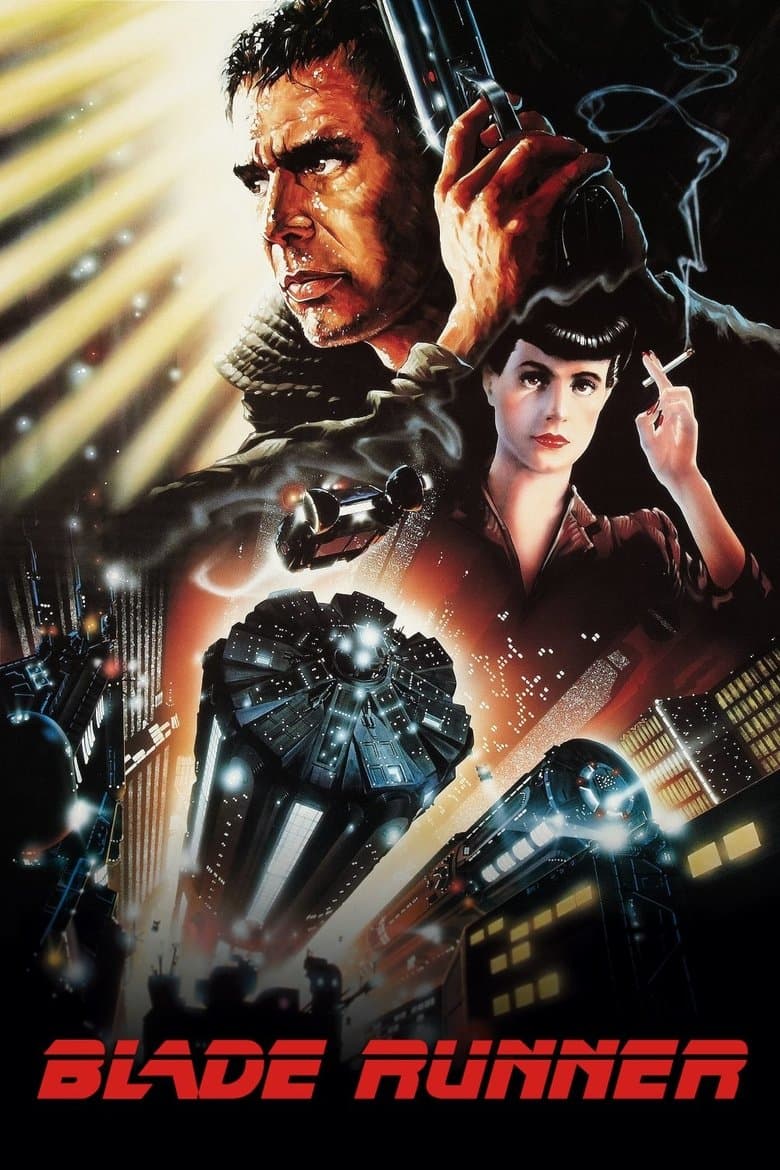
Ridley Scott’s visionary science fiction film unfolds in a rain-soaked future Los Angeles where synthetic humans known as replicants are engineered for dangerous labor in off-world colonies. When several of them return illegally to Earth, blade runner Rick Deckard is assigned to hunt them down. As the investigation progresses, the case becomes less a mission of pursuit than a meditation on memory, mortality, and what it means to be human. Harrison Ford gives Deckard a weary noir detachment, while the film’s extraordinary design fuses neon urban decay with futuristic spectacle. Blade Runner remains one of the most influential and philosophically resonant works in modern science fiction cinema.
Watch for
- How Scott uses light, shadow, rain, and layered cityscapes to create a world that feels both futuristic and decayed, turning environment into mood and meaning.
- The contrast between Deckard’s tired, procedural perspective and the replicants’ desperate intensity, which gradually shifts the film’s emotional center.
- Vangelis’s electronic score, which gives the film its dreamlike melancholy and helps blur the line between noir fatalism and futuristic wonder.
- The moments when the replicants speak about memory, fear, and survival, especially in the final act, where the film’s action premise opens into something far more reflective and haunting.
Production notes
Blade Runner was Ridley Scott's adaptation of Philip K. Dick's 1968 novel Do Androids Dream of Electric Sheep? (with substantial restructuring; the title 'Blade Runner' was acquired from an unrelated William S. Burroughs treatment). The screenplay by Hampton Fancher and David Peoples retained the source novel's substantial neo-noir-future structure while substantially restructuring the underlying philosophical questions about humanity and consciousness. Harrison Ford played Rick Deckard, the retired 'Blade Runner' (bounty hunter of escaped 'replicant' androids) drafted back into service to retire four substantial replicants who have escaped from off-world colonies to Earth. The cast included Rutger Hauer as the lead replicant Roy Batty, Sean Young as the substantial replicant Rachael (a corporate executive's substantial creation), Daryl Hannah as the replicant Pris, Edward James Olmos as the police officer Gaff, M. Emmet Walsh as the police captain Bryant, William Sanderson as the eccentric genetic designer J.F. Sebastian, Brion James as the replicant Leon, Joanna Cassidy as the replicant Zhora, and Joe Turkel as the corporate magnate Eldon Tyrell. The film's substantial production design — Lawrence G. Paull's substantial neo-noir-Tokyo-via-Los-Angeles future cityscape — has been continuously cited as one of the most influential visual designs in American cinema. Cinematographer Jordan Cronenweth shot the film. Composer Vangelis contributed the substantial electronic score. Production cost approximately $28 million.
Trivia
- Blade Runner was a substantial commercial disappointment on its 1982 release — grossing only approximately $33 million domestically against its $28 million budget — and the film's substantial subsequent reputation came primarily through home-video distribution and substantial critical reassessment; the substantial Director's Cut (1992) and The Final Cut (2007) versions have shaped the substantial continuing reception of the work.
- The film exists in seven different versions — including the original 1982 theatrical cut (with Harrison Ford voiceover narration and substantial 'happy ending' content added by the studio against Ridley Scott's preferences), the 1982 international cut (with substantial additional violence), the 1992 Director's Cut (substantially removing the voiceover and the 'happy ending'), and the 2007 Final Cut (Ridley Scott's substantial preferred version); the substantial number of versions has made Blade Runner one of the most extensively re-released films in American cinema.
- The famous 'tears in rain' monologue performed by Rutger Hauer as the dying replicant Roy Batty — including the substantial lines 'I've seen things you people wouldn't believe... All those moments will be lost in time, like tears in rain' — was reportedly substantially improvised by Hauer himself during production; the substantial improvised monologue has become one of the most-quoted moments in any American science-fiction film.
- Vangelis's substantial electronic score — combining synthesizers, saxophone, and substantial atmospheric ambient passages — was substantially nominated for the Golden Globe for Best Original Score but lost to John Williams's E.T. score; the substantial Vangelis approach has influenced subsequent decades of science-fiction-cinema scoring, with direct lineage to substantial subsequent synth-soundtrack work from Stranger Things and contemporary television.
- Blade Runner received two Academy Award nominations — Best Art Direction (Lawrence G. Paull) and Best Visual Effects (Douglas Trumbull, Richard Yuricich, and David Dryer) — winning neither; the substantial subsequent reputation as one of the canonical American science-fiction films has substantially exceeded the contemporary 1982 critical reception.
Legacy
Blade Runner was a substantial commercial disappointment on its 1982 release but has aged into one of the canonical American science-fiction films and one of the most substantially influential visual works in any American cinema. It was selected for the National Film Registry in 1993. The substantial production design — Lawrence G. Paull's neo-noir-Tokyo-via-Los-Angeles future cityscape — has been continuously cited as the canonical cyberpunk visual template, with substantial subsequent influence on The Matrix (1999), Ghost in the Shell (1995), the entire Cyberpunk gaming franchise, and contemporary work from Denis Villeneuve and substantial science-fiction filmmaking. The substantial Denis Villeneuve-directed Blade Runner 2049 (2017) — released thirty-five years after the original — was a substantial sequel that updated the property to contemporary visual-effects technology while preserving the original's substantial philosophical concerns; the sequel received eight Academy Award nominations including substantial wins for Cinematography (Roger Deakins) and Visual Effects. The famous 'tears in rain' monologue has become one of the most-quoted moments in any American science-fiction film. Among Ridley Scott's films, Blade Runner sits alongside Alien (1979) as the canonical achievements of his early career.