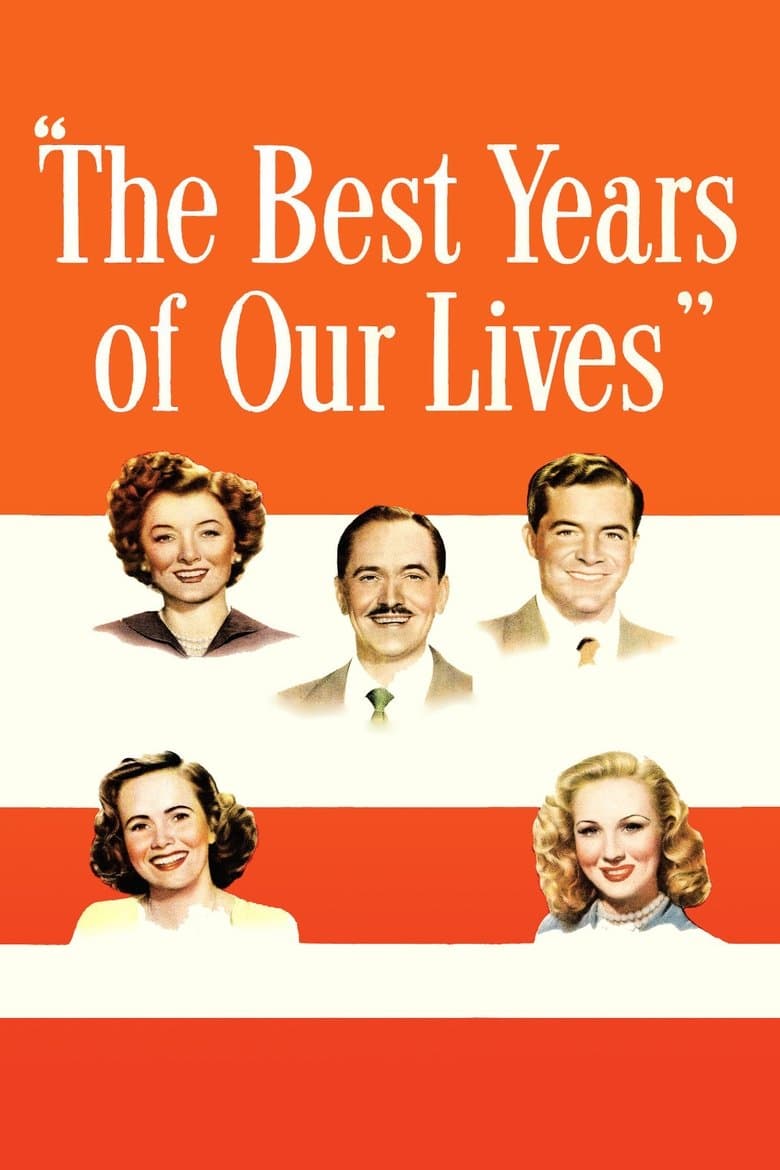
The Best Years of Our Lives
Vibe
William Wyler’s postwar drama follows three American veterans returning to civilian life after World War II and struggling to reconnect with a world that has moved on without them. Each man faces a different challenge: repairing family relationships, finding purpose in work, and living with the lasting effects of physical and emotional trauma. The film captures the uncertainty, dislocation, and quiet resilience experienced by millions of returning soldiers in the immediate aftermath of war. Harold Russell’s performance as a sailor who lost both hands during combat brings extraordinary authenticity and emotional force. Blending intimate character drama with social realism, The Best Years of Our Lives remains one of cinema’s most moving portraits of wartime reintegration.
Watch for
- Harold Russell’s performance, whose natural presence and lived experience give the film some of its most powerful and authentic moments.
- How the film balances three parallel stories, showing different forms of postwar dislocation rather than reducing the veteran experience to a single narrative.
- The quiet domestic scenes, where small gestures and conversations reveal the difficulty of reconnecting with family and routine.
- Wyler’s restrained direction and deep-focus compositions, which allow characters and relationships to unfold with unusual emotional realism.
Production notes
The Best Years of Our Lives was William Wyler's adaptation of Mackinlay Kantor's blank-verse novel Glory for Me (1945), with the screenplay by Robert E. Sherwood. The film was producer Samuel Goldwyn's deliberate response to the immediate post-WWII moment — Wyler had himself just returned from military service as a Lieutenant Colonel in the Army Air Forces, and the film was widely seen as the first major Hollywood treatment of returning veterans' difficulties readjusting to civilian life. Fredric March played the banker Al Stephenson, Dana Andrews played the Air Force pilot turned civilian-life-failure Fred Derry, and most remarkably, real WWII veteran Harold Russell — who had lost both hands in a 1944 demolition training accident — played the disabled sailor Homer Parrish. Russell had no prior acting experience. The cast included Myrna Loy as Al's wife Milly, Teresa Wright as Peggy Stephenson, Virginia Mayo as Marie Derry, and Cathy O'Donnell as Wilma Cameron. Cinematographer Gregg Toland (in his final feature) shot the film. Composer Hugo Friedhofer contributed the score. Production cost approximately $2.1 million.
Trivia
- Harold Russell, who plays the disabled sailor Homer Parrish, was a real WWII veteran who had lost both hands in a 1944 demolition training accident at Fort Sumter; he had no prior acting experience and was cast specifically for his authentic experience of physical disability and adjustment to prosthetic hooks.
- Harold Russell received two Academy Awards for the same film — Best Supporting Actor and an Honorary Award 'for bringing hope and courage to his fellow veterans through his appearance in The Best Years of Our Lives.' He remains the only person to receive two Oscars for the same performance.
- Director William Wyler had himself just returned from World War II military service as a Lieutenant Colonel in the Army Air Forces, where he had directed combat documentaries; the film was substantially shaped by his own experience of return, and he reportedly pushed for the film's resolutely unsentimental tone against studio preferences.
- Cinematographer Gregg Toland — the visual mind behind Citizen Kane — shot The Best Years of Our Lives in his final feature credit before his death from coronary thrombosis in 1948 at age 44; the deep-focus compositions in the film's home-front sequences extend Toland's earlier visual innovations.
- The film won seven Academy Awards including Best Picture, Best Director (Wyler), Best Actor (March), Best Supporting Actor (Russell), Best Adapted Screenplay (Sherwood), Best Original Score, and Best Film Editing — making it one of the most thoroughly Oscar-celebrated films of its era.
Legacy
The Best Years of Our Lives won seven Academy Awards including Best Picture and Best Director, and was selected for the National Film Registry in 1989. The film grossed over $11 million domestically (equivalent to over $175 million in 2024 dollars) — making it one of the highest-grossing films of the 1940s. Harold Russell's two Oscars for the same performance remain a unique achievement in Academy history, and his casting demonstrated Hollywood's brief postwar willingness to depict disability authentically rather than through able-bodied performers. The film's depiction of veterans' difficulties readjusting to civilian life — economic hardship, marital strain, institutional failure — gave American cinema one of its most thoroughly serious treatments of post-war reality. Among films of the immediate postwar era, The Best Years of Our Lives stands as the canonical American studio response to the moment, alongside William Wyler's earlier wartime documentary work. Its sustained influence on subsequent veteran-themed films, from The Deer Hunter to Coming Home to American Sniper, has been continuous.