Annie Hall
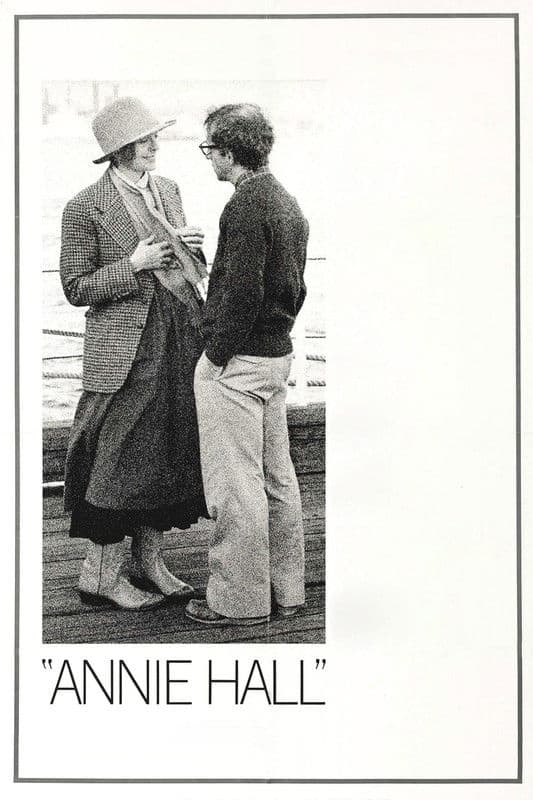
Vibe
Woody Allen’s romantic comedy rethinks the conventional love story through the anxious, self-questioning perspective of comedian Alvy Singer. Looking back on his relationship with the spirited and unpredictable Annie Hall, Alvy revisits the moments that drew them together and the differences that slowly pulled them apart. The film breaks from traditional storytelling with flashbacks, split screens, animated interludes, and direct address, turning memory itself into part of the narrative. Diane Keaton’s performance brought warmth, wit, and an instantly recognizable style to Annie, helping shape the film’s cultural legacy. Blending humor, introspection, and formal invention, Annie Hall became one of the defining films of 1970s American cinema.
Watch for
- The film’s playful formal experiments, including direct address, split screens, animation, and flashbacks that mirror the way memory works.
- The contrast between Alvy and Annie, whose chemistry and differences give the film both its humor and its emotional ache.
- Diane Keaton’s performance, especially the mix of spontaneity, vulnerability, and offbeat charm that makes Annie so memorable.
- How comedy gives way to reflection, revealing the film as less a love story than a meditation on why relationships fail.
Production notes
Annie Hall was Woody Allen's transition from purely-comic features (Sleeper, Love and Death) toward more autobiographically-inflected dramatic comedy. Allen wrote the screenplay with Marshall Brickman, originally as a much longer murder mystery titled Anhedonia; he and editor Ralph Rosenblum discovered during post-production that the romantic relationship between Alvy Singer and Annie Hall was the film's actual story, and they cut the murder plot entirely. Diane Keaton played Annie — Keaton's actual first name had been Diane Hall, and the character was substantially based on her; the relationship between Allen and Keaton portrayed in the film was substantially autobiographical. Tony Roberts played Alvy's friend Rob, with Carol Kane as Allison, Paul Simon as Tony Lacey, Christopher Walken in an early role as Annie's brother Duane, and Shelley Duvall, Janet Margolin, and Beverly D'Angelo in supporting roles. Cinematographer Gordon Willis (continuing his Godfather collaboration) shot the film. Production cost approximately $4 million.
Trivia
- Diane Keaton's actual first name had been Diane Hall before she changed it for her stage career; the character of Annie Hall was substantially based on her, and the romantic relationship between Allen and Keaton portrayed in the film was substantially autobiographical from their actual past relationship.
- Annie Hall was originally written as a much longer murder mystery titled Anhedonia; Woody Allen and editor Ralph Rosenblum discovered during post-production that the romantic relationship was the actual story, and they cut the entire murder subplot — a structural realization that became one of the most-told editing stories in American film.
- The famous 'Marshall McLuhan' scene — in which Alvy pulls McLuhan himself from off-camera to silence a pretentious academic — was filmed with the actual Marshall McLuhan, who had been a major figure in 1960s media theory; the scene has become permanent shorthand for the fantasy of being able to silence pompous authority figures with their own source material.
- Christopher Walken's small role as Annie's brother Duane (with the famous 'I have a sudden urge to drive into the oncoming traffic' monologue) was Walken's early breakthrough; the role helped establish the unsettling, dramatically-precise screen presence that would define his subsequent career.
- Annie Hall won four Academy Awards — Best Picture, Best Director (Allen), Best Actress (Keaton), and Best Original Screenplay — defeating Star Wars among others in 1977; the win has been continuously discussed as one of the more contested Best Picture decisions in Oscar history.
Legacy
Annie Hall is widely regarded as one of the great American romantic comedies and the moment when Woody Allen transitioned from gag-driven comic features to genuinely autobiographical dramatic comedy. It won four Academy Awards including Best Picture, Best Director, Best Actress, and Best Original Screenplay — defeating Star Wars and other major contenders in 1977. It was selected for the National Film Registry in 1992. Diane Keaton's central performance and her menswear-inspired costuming reshaped fashion across the late 1970s and remained influential for decades. The film's specific structural innovations — direct address to camera, split-screen for therapy sessions, subtitled subtext beneath surface dialogue, animated dream sequences — opened new territory for American romantic comedy and influenced subsequent work from When Harry Met Sally to (500) Days of Summer to High Fidelity. Allen's complicated subsequent personal-life controversies have generated ongoing public debate about how to engage with his earlier work, but Annie Hall's specific artistic achievements remain the canonical text against which his pre-controversy career is measured.