All the President's Men
Vibe
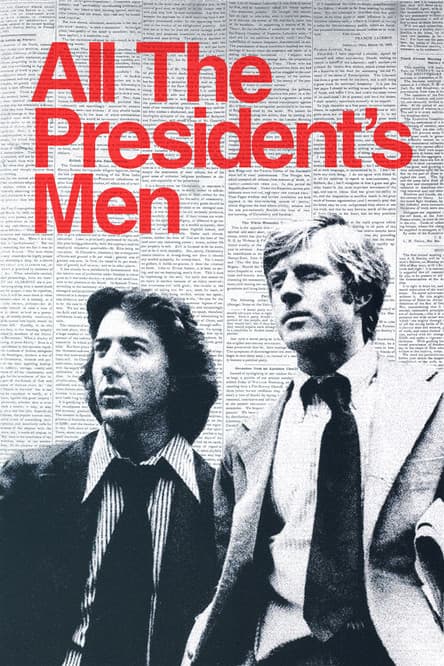
This political thriller follows Washington Post reporters Bob Woodward and Carl Bernstein as they investigate what first appears to be a routine break-in at the Democratic National Committee headquarters. As their reporting uncovers a widening pattern of deception, intimidation, and political abuse, the film turns the slow accumulation of facts into a story of mounting national consequence. Directed by Alan J. Pakula and anchored by Robert Redford and Dustin Hoffman, it captures investigative journalism as painstaking, uncertain, and deeply collaborative work. All the President’s Men remains one of the most compelling films ever made about the press, political power, and the discipline required to hold both accountable.
Watch for
- How Pakula builds tension through procedure, turning interviews, dead ends, and small factual breakthroughs into scenes of real suspense.
- The contrast between Redford and Hoffman’s performances, with Woodward’s caution and Bernstein’s aggressiveness gradually forming an effective investigative rhythm.
- Gordon Willis’s use of shadow, distance, and vast interior spaces, which makes offices, parking garages, and newsrooms feel charged with institutional secrecy.
- The way the film withholds easy triumph, emphasizing uncertainty, incremental progress, and the constant fear of getting the story wrong.
Production notes
All the President's Men was Alan J. Pakula's adaptation of Carl Bernstein and Bob Woodward's 1974 nonfiction book about The Washington Post's investigation of the Watergate break-in and the subsequent White House cover-up. The screenplay by William Goldman was extensively researched and substantially shaped by direct consultation with Bernstein and Woodward themselves. Robert Redford played Bob Woodward, with Dustin Hoffman as Carl Bernstein; both actors shadowed the actual journalists during pre-production. The cast included Jason Robards as Washington Post editor Ben Bradlee (a performance that won Robards the Academy Award for Best Supporting Actor), Jack Warden as Harry Rosenfeld, Martin Balsam as Howard Simons, Hal Holbrook as the anonymous source 'Deep Throat,' Robert Walden as Donald Segretti, and Stephen Collins as Hugh Sloan. The film's substantial location work in The Washington Post's actual newsroom required Pakula to coordinate with the newspaper during ongoing publication; cinematographer Gordon Willis shot the film. The famous 'Deep Throat' parking-garage sequences were shot at a real Arlington, Virginia parking garage. Composer David Shire contributed the score. Production cost approximately $8.5 million.
Trivia
- Robert Redford had personally optioned the film rights to Carl Bernstein and Bob Woodward's nonfiction book in 1974 — before the book was even published — and produced the film through his Wildwood Enterprises production company; Redford's substantial commitment to the project was substantial throughout development.
- Both Robert Redford and Dustin Hoffman shadowed the actual journalists during pre-production — Redford spending substantial time with Bob Woodward and Hoffman with Carl Bernstein — to develop authentic professional behavior; the substantial preparation gave the on-screen performances their characteristic newsroom-realist register.
- The anonymous source 'Deep Throat' — whose real-life identity remained one of the great mysteries of American political journalism for 31 years — was eventually revealed in 2005 to be W. Mark Felt, the FBI's Associate Director during the Nixon administration; Felt's identification confirmed substantial speculation that had circulated for decades.
- The famous Washington Post newsroom sequences required substantial set construction at Warner Bros. studios — Alan J. Pakula and his production designer George Jenkins built an exact replica of the actual newsroom at the Burbank studio, with extensive consultation from Post staff to match the real newsroom's substantial details.
- All the President's Men won four Academy Awards including Best Supporting Actor (Robards), Best Adapted Screenplay (Goldman), Best Art Direction (Jenkins), and Best Sound; it received eight total nominations including Best Picture (losing to Rocky), Best Director (losing to John G. Avildsen for the same film), and Best Supporting Actress (Jane Alexander).
Legacy
All the President's Men won four Academy Awards including Best Supporting Actor (Jason Robards) and Best Adapted Screenplay (William Goldman). It received eight Academy Award nominations including Best Picture and Best Director, losing both to Rocky and John G. Avildsen. It was selected for the National Film Registry in 2010. The film established the canonical Hollywood template for investigative-journalism cinema — its specific approach (extended dialogue sequences, substantial procedural detail, the integration of public events with private investigation) has shaped subsequent decades of similar work, with direct lineage to The Insider (1999), Good Night, and Good Luck (2005), and the Best Picture-winning Spotlight (2015). The film's substantial influence on actual journalism — the substantial wave of young people who entered investigative journalism in the late 1970s and early 1980s explicitly citing the film as inspiration — has been continuously documented. Robert Redford's commitment to producing the film through his Wildwood Enterprises was central to its existence — the project would likely not have been produced without his substantial personal involvement. Among American films about political journalism, All the President's Men remains the canonical text.