2001: A Space Odyssey
Vibe
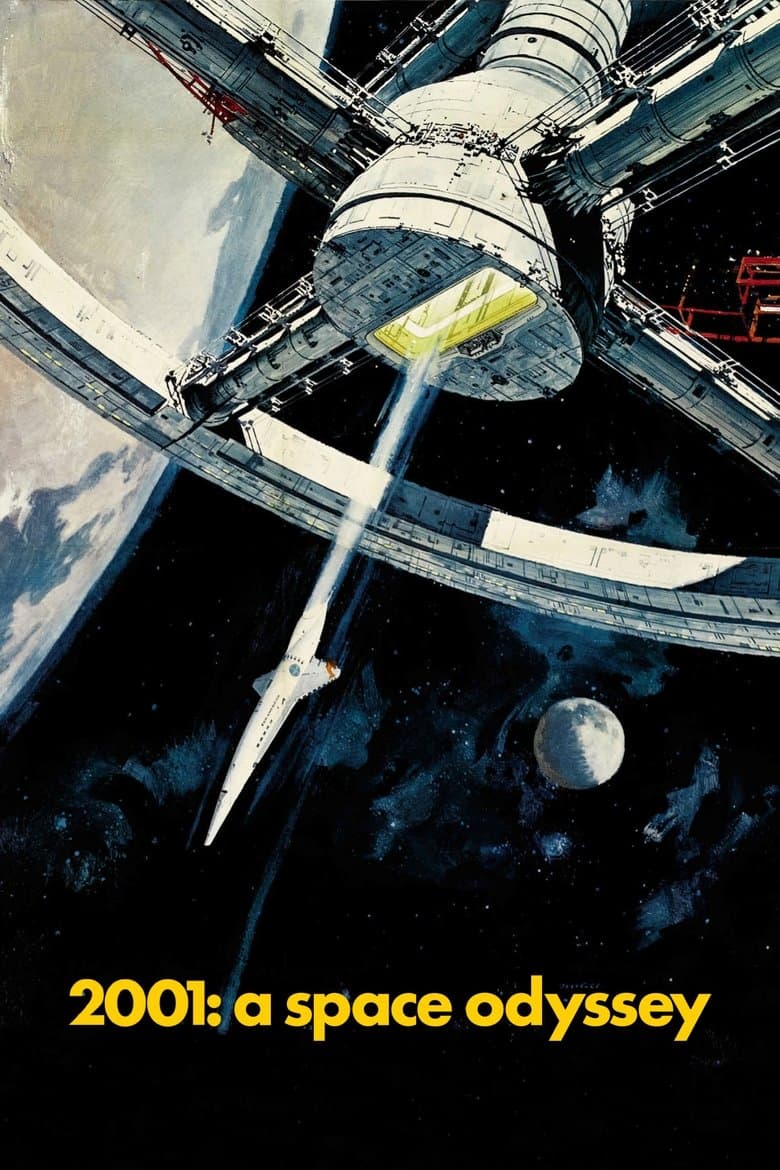
Stanley Kubrick’s visionary science fiction epic explores humanity’s evolution and its uneasy relationship with technology and the unknown. The film begins with prehistoric humans discovering the first tools before leaping forward to a spacefaring future where astronauts travel toward Jupiter aboard the spacecraft Discovery One, accompanied by the seemingly infallible computer HAL 9000. Rather than relying on traditional dialogue-driven storytelling, Kubrick builds meaning through striking imagery, classical music, and revolutionary visual effects. The appearance of mysterious monoliths hints at forces shaping human development across millennia. Both hypnotic and provocative, 2001: A Space Odyssey redefined the possibilities of science fiction cinema and remains one of the most ambitious and influential films ever made.
Watch for
- The famous match cut from a bone thrown into the air to a spacecraft in orbit, compressing millions of years of human progress in a single edit.
- HAL 9000’s calm voice and unsettling presence, which transform a computer into one of cinema’s most memorable antagonists.
- Kubrick’s use of classical music, including Strauss and Ligeti, which gives the film an operatic sense of scale and mystery.
- The surreal final sequence, where the film abandons conventional narrative to explore transformation and the unknown.
Production notes
2001: A Space Odyssey was Stanley Kubrick's collaboration with science-fiction author Arthur C. Clarke, who developed the film and a parallel novel simultaneously. Kubrick had been considering a science-fiction film for several years and approached Clarke, who proposed expanding his own 1948 short story 'The Sentinel' into a full narrative. The project took approximately four years to develop, write, and produce. The film's special effects were unprecedented for the era and required Kubrick to develop entirely new approaches: the stargate sequence used slit-scan photography, the rotating spaceship interiors used a giant centrifuge built specifically for the production, and the weightlessness sequences used wires and rotating sets. Douglas Trumbull and Wally Veevers contributed to the visual effects (Trumbull would go on to direct Silent Running and supervise effects on Close Encounters and Blade Runner). Keir Dullea played Dave Bowman, with Gary Lockwood as Frank Poole and Douglas Rain voicing the computer HAL 9000. Production cost approximately $10.5 million — an extraordinary budget for 1968.
Trivia
- Stanley Kubrick deliberately rejected an originally-composed Alex North score for the film, replacing it at the last minute with classical music selections including Strauss's 'Also sprach Zarathustra' and 'The Blue Danube'; North only learned his score had been rejected when he attended the premiere.
- HAL 9000's name is a one-letter shift back from IBM (each letter shifted one position earlier in the alphabet) — though Kubrick and Clarke both denied the connection was intentional, the persistent fan theory has substantial linguistic support.
- The 'stargate' sequence near the film's climax used slit-scan photography developed specifically for the production; the technique would later be adapted for Star Wars's hyperspace sequences and dozens of subsequent science-fiction films.
- 2001: A Space Odyssey received four Academy Award nominations and won only one — Best Visual Effects, awarded to Stanley Kubrick (technically the film's only Oscar despite its prestige); Kubrick had personally supervised the effects work.
- Arthur C. Clarke wrote the novel 2001: A Space Odyssey simultaneously with Kubrick's screenplay development; the two works were created in parallel, with Clarke's novel published shortly after the film's release providing the prose-narrative explanation that Kubrick had deliberately omitted from the visual film.
Legacy
2001: A Space Odyssey is widely regarded as the most influential science-fiction film ever made, and one of the most ambitious philosophical works in mainstream American cinema. It received four Academy Award nominations and won only Best Visual Effects, but the film's critical reputation has only grown over decades — Sight & Sound's 2012 critics' poll placed it sixth among all films ever made. It was selected for the National Film Registry in 1991. The film's visual effects, developed by Douglas Trumbull and others, established the visual vocabulary for nearly every subsequent science-fiction film — Star Wars, Close Encounters of the Third Kind, Blade Runner, and the entire visual-effects-driven blockbuster tradition all derive directly from 2001's achievements. HAL 9000 has become one of the most recognized fictional artificial intelligences in popular culture, frequently invoked in actual contemporary AI safety conversations. The film's deliberate rejection of conventional narrative structure — its long silences, its philosophical opacity, its refusal to explain — has made it a continuing touchstone for filmmakers (Christopher Nolan's Interstellar most directly) seeking to use cinema as serious philosophical inquiry.