12 Angry Men
Vibe
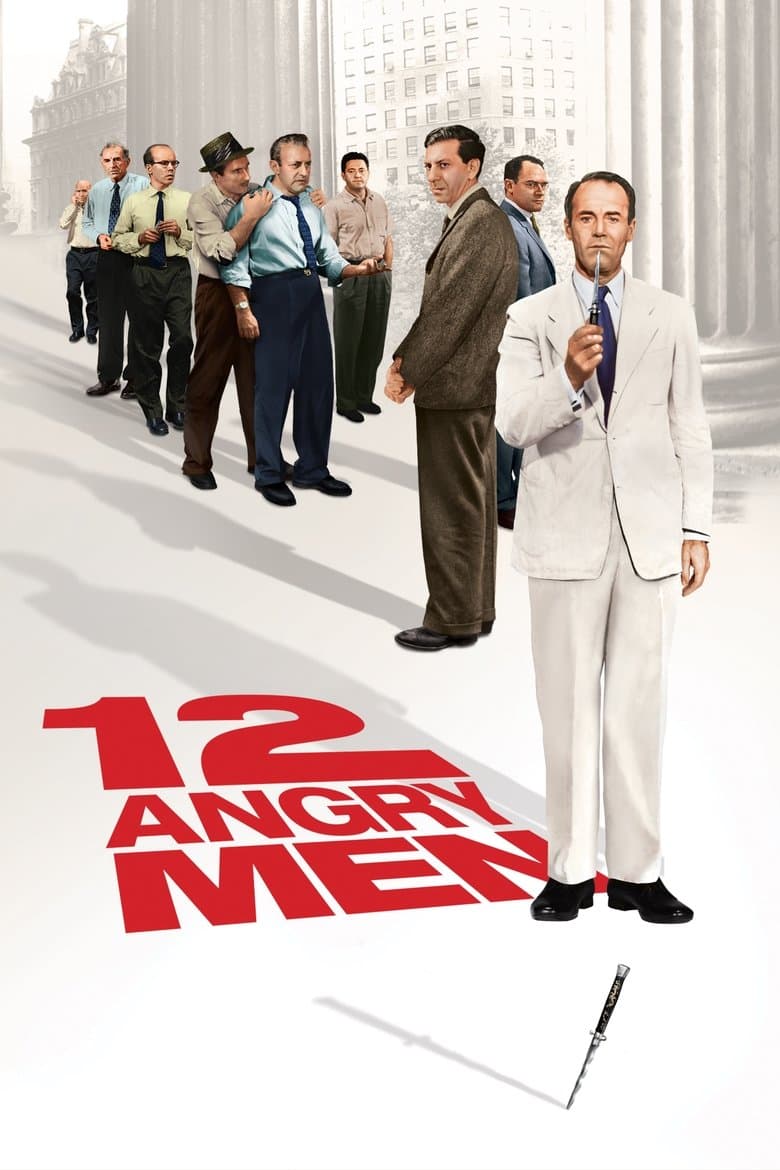
Sidney Lumet’s courtroom drama unfolds almost entirely inside a jury room, where twelve men must decide the fate of a teenage defendant accused of murder. What begins as an apparently open-and-shut case shifts when one juror refuses to deliver a guilty verdict without serious discussion, forcing the others to reexamine the evidence and their own assumptions. As tempers rise, hidden prejudices, personal histories, and competing ideas of justice come to the surface. Led by Henry Fonda’s calm, principled performance, the film turns conversation itself into gripping suspense. 12 Angry Men remains one of the most powerful American dramas about reason, doubt, and civic responsibility.
Watch for
- How Lumet gradually changes camera placement and framing to make the jury room feel more claustrophobic as the debate intensifies.
- Henry Fonda’s restrained performance, which anchors the film through patience, listening, and quiet moral conviction rather than overt theatricality.
- The way each juror’s body language, speech pattern, and emotional trigger reveals character even before their backstory is made explicit.
- How small pieces of evidence are revisited and reinterpreted, turning the film into a study of how certainty can crumble under careful attention.
Production notes
12 Angry Men was Sidney Lumet's directorial debut — a courtroom drama set almost entirely in the deliberation room of a New York City murder trial jury. The screenplay was by Reginald Rose, who had originally written the story as a 1954 CBS television teleplay before adapting it for feature production. Henry Fonda played the architect Juror #8 (the only juror to initially vote 'not guilty' and the protagonist who gradually convinces the other eleven to reconsider the case), and also co-produced the film through his Nova Productions company; Fonda's substantial personal commitment to the project was central to its existence. The cast was entirely male — twelve principal performers in essentially one deliberation-room setting — and included Lee J. Cobb as the bigoted Juror #3, Ed Begley as the prejudiced Juror #10, E.G. Marshall as the cool-headed stockbroker Juror #4, Jack Warden as the impatient Juror #7, Jack Klugman as the slum-raised Juror #5, Joseph Sweeney as the elderly Juror #9, Edward Binns as the working-class Juror #6, Robert Webber as the ad-executive Juror #12, John Fiedler as the meek Juror #2, Martin Balsam as the foreman Juror #1, and George Voskovec as the immigrant Juror #11. The film was shot entirely on a single deliberation-room set across approximately three weeks of production. Cinematographer Boris Kaufman shot the film. Composer Kenyon Hopkins contributed the limited score. Production cost approximately $340,000.
Trivia
- 12 Angry Men was Sidney Lumet's directorial debut after substantial work in live television drama; the substantial single-setting constraint of the production drew on Lumet's television background, and the substantial visual approach (gradually moving cameras closer to faces as tensions rose, and gradually shifting to longer lenses to compress the space) has been continuously studied as a foundational text of constrained-setting filmmaking.
- The entire film is set almost exclusively in a single deliberation room — with brief opening sequences at the courthouse exterior and closing sequences at the courthouse steps — making it one of the most thoroughly constrained-setting feature films ever produced; the substantial dramatic engagement maintained across approximately 90 minutes of essentially one location has been continuously studied as a foundational text.
- Henry Fonda co-produced the film through his Nova Productions company and personally championed the project to United Artists for distribution; Fonda's substantial personal commitment was central to the film's existence, and his substantial financial commitment to the project was substantial.
- 12 Angry Men was a substantial commercial disappointment on its 1957 release — losing money for United Artists despite the substantial critical praise — and its substantial subsequent reputation came primarily through television syndication and home-video distribution; the film's substantial influence on subsequent constrained-setting drama has been continuous across decades.
- 12 Angry Men received three Academy Award nominations — Best Picture, Best Director (Lumet), and Best Adapted Screenplay (Rose) — and won none; it lost Best Picture to The Bridge on the River Kwai in one of the more contested 1957 Oscar contests.
Legacy
12 Angry Men was a substantial commercial disappointment on its 1957 release but has aged into one of the most thoroughly respected American courtroom dramas. It received three Academy Award nominations and won none. It was selected for the National Film Registry in 2007. Sidney Lumet's directorial debut launched his substantial five-decade career as one of the canonical American directors of morally serious institutional drama, with his subsequent work on Serpico (1973), Dog Day Afternoon (1975), Network (1976), The Verdict (1982), and many other major productions. The film's substantial visual approach — gradually moving cameras closer to faces as tensions rose, and gradually shifting to longer lenses to compress the space — has been continuously studied as a foundational text of constrained-setting filmmaking. The 1997 William Friedkin-directed TV-movie remake starring Jack Lemmon and George C. Scott extended the property to a new generation, and the substantial subsequent influence on jury-room drama has been continuous across decades, with direct lineage to Reginald Rose's own subsequent courtroom-drama work, John Grisham's adaptations, and contemporary work from David E. Kelley's legal-drama television series. Among American courtroom dramas, 12 Angry Men remains the canonical text.