Wuthering Heights
Vibe
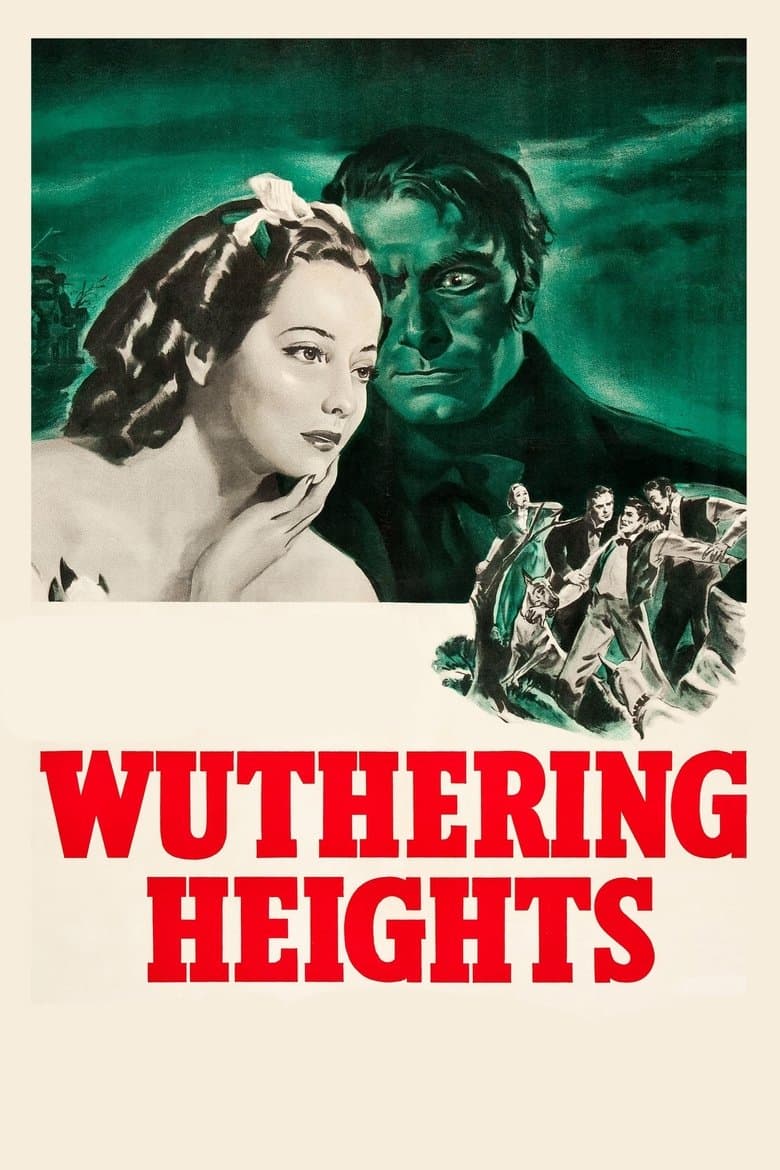
This romantic drama adapts Emily Brontë’s classic novel of passion, class conflict, and destructive longing on the Yorkshire moors. Raised together at Wuthering Heights, Heathcliff and Catherine Earnshaw form an intense bond that seems inseparable until pride, social ambition, and circumstance pull them apart. Laurence Olivier brings Heathcliff a brooding intensity that makes the character both magnetic and deeply wounded, while William Wyler’s direction emphasizes the windswept atmosphere and emotional severity of the story’s world. Focusing on the first half of Brontë’s novel, the film turns doomed love into a haunting study of obsession, resentment, and loss. Wuthering Heights remains one of Hollywood’s most enduring romantic tragedies.
Watch for
- Laurence Olivier’s performance as Heathcliff, especially the way rage, yearning, and wounded pride remain visible beneath his outward control.
- The film’s use of wind, shadows, interiors, and moorland space to create a Gothic atmosphere that feels inseparable from the characters’ emotions.
- How class difference and social aspiration quietly shape the tragedy, turning romance into a story of humiliation, separation, and revenge.
- The way Wyler balances heightened emotion with visual restraint, allowing longing and bitterness to accumulate through gesture, silence, and setting as much as dialogue.
Production notes
Wuthering Heights was William Wyler's adaptation of Emily Brontë's 1847 novel, with the screenplay by Ben Hecht and Charles MacArthur. The film covered only approximately the first half of Brontë's novel — the Cathy-Heathcliff romance up through Cathy's death — rather than the multi-generational structure of the source. The film starred Merle Oberon as Cathy Earnshaw and Laurence Olivier as Heathcliff in his first major American film role; Olivier had been working in British theater and film and would establish himself as a major Hollywood presence through this performance. The cast included David Niven as Cathy's eventual husband Edgar Linton, Geraldine Fitzgerald as Edgar's sister Isabella, Flora Robson as the housekeeper Ellen Dean (the film's narrator), Donald Crisp as Dr. Kenneth, Hugh Williams as Hindley Earnshaw, and Cecil Kellaway as Cathy and Hindley's father. The film was shot on the Goldwyn Studios California ranch — the Yorkshire moors of Brontë's novel substituted with California hillsides — with extensive use of soundstage exteriors for the moor sequences. Cinematographer Gregg Toland shot the film in deep-focus black-and-white. Composer Alfred Newman contributed the score. Production cost approximately $1.25 million.
Trivia
- Laurence Olivier was making his first major American film with Wuthering Heights; he had been working in British theater and film, and the role established him as a major Hollywood presence — opening the way to his subsequent Hollywood work including Rebecca (1940) and Pride and Prejudice (1940).
- Merle Oberon and Laurence Olivier reportedly had a difficult working relationship during production; Oberon was uncomfortable with Olivier's classical-theater preparation methods, and Olivier reportedly found Oberon's approach unprepared for the role's emotional demands — though the resulting on-screen chemistry has been continuously celebrated.
- The film's setting on the Yorkshire moors of Brontë's novel was substantially recreated through soundstage exteriors and California hillside locations — the actual Yorkshire moors were unavailable to the Hollywood production, and cinematographer Gregg Toland's deep-focus black-and-white photography helped sell the illusion of authentic English moorland.
- The film covers only approximately the first half of Brontë's novel — the Cathy-Heathcliff romance up through Cathy's death — rather than the multi-generational structure of the source; the choice has been the subject of continuous critical debate, with some critics finding the abbreviated structure dramatically effective and others objecting to the loss of the novel's longer thematic arc.
- Gregg Toland won the Academy Award for Best Cinematography for Wuthering Heights — his first Oscar in a career that would peak with Citizen Kane (1941); Wuthering Heights's deep-focus photography established many of the visual techniques Toland would refine for the Welles film two years later.
Legacy
Wuthering Heights received eight Academy Award nominations and won one (Best Cinematography for Gregg Toland); it lost Best Picture and Best Director to Gone with the Wind in the legendary 1939 Oscar race. It was selected for the National Film Registry in 2007. Laurence Olivier's performance as Heathcliff has remained one of the canonical interpretations of the role across the multiple subsequent screen adaptations of Brontë's novel — including the 1992 Peter Kosminsky version with Ralph Fiennes, the 2009 Coky Giedroyc/Andrea Arnold version with Tom Hardy and James Howson respectively, and other television adaptations. The film's substantial structural choice — covering only the Cathy-Heathcliff romance through Cathy's death rather than the full multi-generational novel — has been continuously debated as both effective dramatic compression and as substantial reductive simplification of Brontë's source material. Gregg Toland's Academy Award-winning cinematography on the film established many of the visual techniques he would refine for Citizen Kane (1941) two years later, marking Wuthering Heights as a critical moment in his stylistic development.