The Wizard of Oz
Vibe
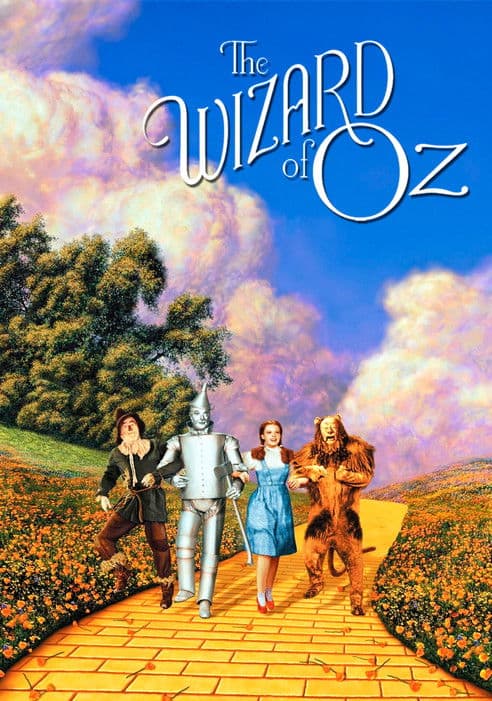
This beloved musical fantasy follows Kansas farm girl Dorothy Gale, who is swept away by a tornado to the magical land of Oz. Hoping to find her way home, Dorothy travels along the Yellow Brick Road toward the Emerald City, joined by three unlikely companions: a Scarecrow seeking a brain, a Tin Man longing for a heart, and a Cowardly Lion in search of courage. Along the way they face the Wicked Witch of the West and discover that the mysterious Wizard may not be what he seems. Directed by Victor Fleming and based on L. Frank Baum’s novel, the film is celebrated for its imaginative storytelling, unforgettable songs, and pioneering Technicolor imagery. Judy Garland’s performance and “Over the Rainbow” helped secure its place as one of the most enduring classics in American cinema.
Watch for
- The famous transition from sepia-toned Kansas to the colorful world of Oz, showcasing early Technicolor filmmaking at its most imaginative.
- Judy Garland’s performance as Dorothy, balancing innocence, determination, and emotional warmth throughout the journey.
- The chemistry between Dorothy and her companions, whose personal quests mirror the film’s deeper themes of self-discovery.
- How songs like “Over the Rainbow” and “If I Only Had a Brain” advance both the story and the characters’ emotional journeys.
Production notes
The Wizard of Oz was MGM's lavish Technicolor adaptation of L. Frank Baum's 1900 children's novel — a production whose chaos rivals any in studio history. Five directors worked on the film: Richard Thorpe (replaced after two weeks), George Cukor (a brief consulting role), Victor Fleming (who took the credit), King Vidor (who shot the Kansas sequences after Fleming left for Gone with the Wind), and Norman Taurog. The screenplay went through approximately a dozen writers. Judy Garland was cast as Dorothy after Shirley Temple's loanout from 20th Century Fox fell through; Garland was 16 during filming and was put on a punishing diet to look younger. The cast included Frank Morgan as the Wizard, Bert Lahr as the Cowardly Lion, Ray Bolger as the Scarecrow, Jack Haley as the Tin Man (after Buddy Ebsen was hospitalized by toxic aluminum-dust makeup), and Margaret Hamilton as the Wicked Witch. The Harold Arlen and Yip Harburg songs included 'Over the Rainbow.' Production cost approximately $2.7 million.
Trivia
- Buddy Ebsen was originally cast as the Tin Man but was hospitalized after the aluminum-dust makeup coated his lungs; Jack Haley took over the role with a paste-based makeup substitute, and Ebsen was reportedly never publicly credited or compensated for his original work.
- 'Over the Rainbow' was nearly cut from the final film — MGM executives felt the song slowed the Kansas opening — and the song was restored only after composer Yip Harburg and producer Arthur Freed personally intervened with the studio leadership.
- Margaret Hamilton was severely burned during filming when the Witch's exit-by-flame in Munchkinland malfunctioned; she suffered second- and third-degree burns and required six weeks of recovery before she could return to set.
- The film's elaborate sepia-to-Technicolor transition (Dorothy opening the door from black-and-white Kansas into the colored Land of Oz) was achieved by painting the inside of the Kansas farmhouse set in sepia tones, with Garland in a sepia-painted dress that she'd later discard for her color-printed gingham costume.
- Despite enormous production costs (approximately $2.7 million), The Wizard of Oz lost money on initial 1939 theatrical release; its status as a cultural classic was built on annual television broadcasts beginning in 1956, which made it one of the most-watched films in American history.
Legacy
The Wizard of Oz's commercial and critical legacy was built almost entirely after its modest 1939 theatrical release — through the annual CBS/NBC television broadcasts beginning in 1956 that became a shared American family ritual for two generations. The film won two Academy Awards (Best Original Song for 'Over the Rainbow' and Best Original Score) and was selected for the inaugural class of the National Film Registry in 1989. Judy Garland received a Special Juvenile Academy Award. The film's transition from sepia-Kansas to Technicolor-Oz remains one of the most quoted visual moments in American cinema, and its 'Over the Rainbow' was named the greatest film song of all time by the AFI. The film's cultural reach has extended into LGBTQ+ history (Judy Garland and the 'Friend of Dorothy' tradition), into Pink Floyd's Dark Side of the Moon synchronization tradition, and into countless subsequent fantasy films from Star Wars to The Matrix that have echoed its archetypal hero's-journey structure. Among American children's films, The Wizard of Oz occupies a uniquely permanent position.