Unforgiven
Vibe
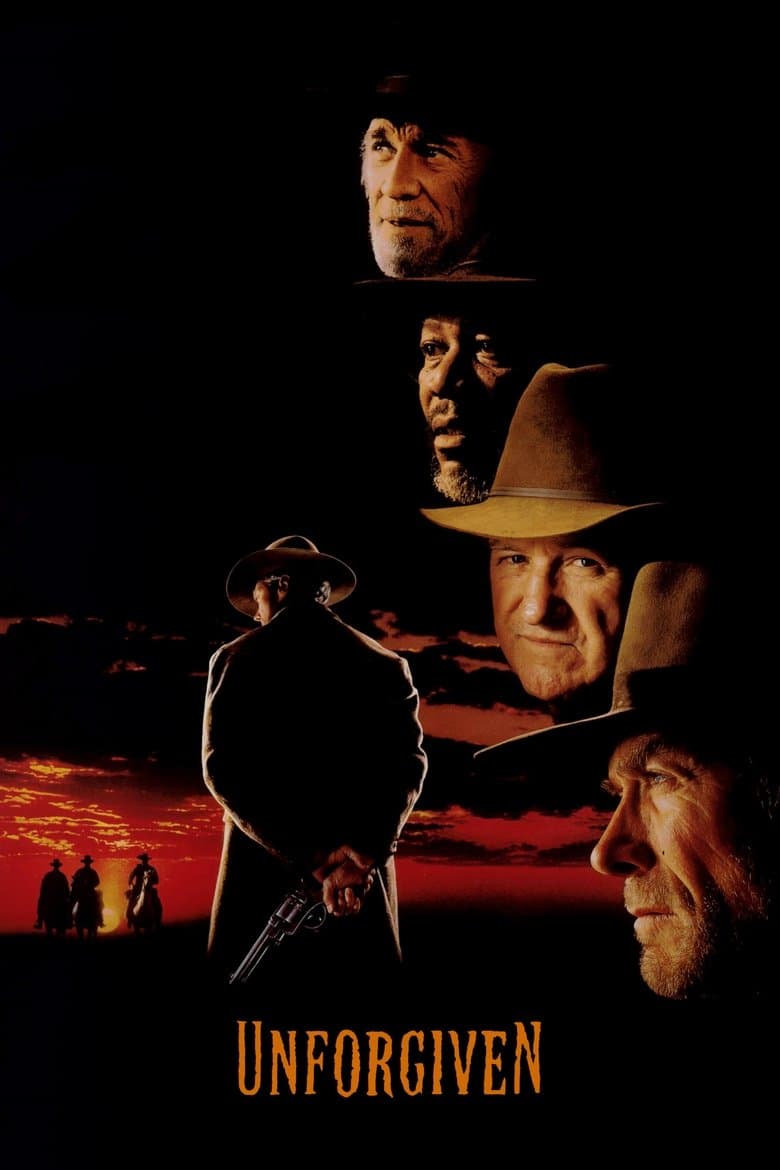
Clint Eastwood’s revisionist Western follows William Munny, a widowed farmer and former outlaw who reluctantly takes on one last killing job in order to provide for his children. Joined by his old partner Ned Logan and the brash Schofield Kid, Munny is pulled back into a world of violence he has tried to leave behind. Eastwood’s performance gives the character a weary gravity shaped by regret, age, and buried brutality. Rather than celebrating frontier violence, the film exposes its cost in pain, fear, humiliation, and moral damage. Unforgiven stands as one of the great late Westerns: elegiac, unsparing, and deeply reflective about the myths the genre was built on.
Watch for
- Eastwood’s performance, especially the way Munny’s restraint, exhaustion, and flashes of buried menace suggest a man haunted by what he once was.
- Gene Hackman’s Little Bill Daggett, whose confidence, cruelty, and self-justifying sense of order make him a chilling counterpoint to Munny.
- How the film treats violence without glamour—awkward, painful, and frightening even when it is swift—undercutting the clean satisfactions of classic Western gunplay.
- The presence of the dime novelist and English Bob, which reveals how legend, performance, and storytelling distort the realities of frontier life and death.
Production notes
Unforgiven was Clint Eastwood's revisionist western — his late-career meditation on the violence of his own genre legacy, dedicated to his mentors Sergio Leone and Don Siegel (both deceased by the time of production). The screenplay by David Webb Peoples had been written in the late 1970s and had been languishing in development for over a decade before Eastwood acquired the rights and chose to wait until he was old enough to play the lead role with appropriate weariness. Eastwood himself played William Munny, the aging widower and former killer who comes out of retirement for one final bounty. The cast included Gene Hackman as the sadistic sheriff Little Bill Daggett (a role that won Hackman the Academy Award for Best Supporting Actor), Morgan Freeman as Ned Logan (Munny's longtime friend and former partner), Richard Harris as the English Bob, Saul Rubinek as W.W. Beauchamp (Bob's biographer), Jaimz Woolvett as the Schofield Kid, Frances Fisher as Strawberry Alice, and Anna Levine as the scarred prostitute Delilah Fitzgerald. Cinematographer Jack N. Green shot the film. Composer Lennie Niehaus contributed the score. Production cost approximately $14.4 million.
Trivia
- Clint Eastwood acquired the rights to David Webb Peoples's screenplay in the late 1970s and chose to wait until he was old enough to play the lead role with appropriate weariness; Eastwood was 62 when he made Unforgiven, having been planning the production for approximately fifteen years before deciding the time was right.
- The film was dedicated to Eastwood's mentors Sergio Leone and Don Siegel — both directors had substantially shaped Eastwood's career, with Leone directing him in the 'Man with No Name' Dollars trilogy and Siegel directing him in Dirty Harry (1971) and other key roles; both directors had died before the film's 1992 production.
- Gene Hackman's performance as the sadistic sheriff Little Bill Daggett won him the Academy Award for Best Supporting Actor; the role was Hackman's most thoroughly villainous, and his win was widely interpreted as a make-up vote for previous decade's snubs of his work.
- Unforgiven won four Academy Awards including Best Picture, Best Director (Eastwood), Best Supporting Actor (Hackman), and Best Film Editing; the Best Picture and Best Director wins for Eastwood — at age 62, with his own substantial Western acting legacy — were widely interpreted as Hollywood's belated recognition of his three-decade contribution to the genre.
- The film's substantial meditation on the violence of the western genre — Eastwood's own genre legacy specifically — has been continuously cited as one of the most thoroughly self-aware revisionist westerns; the substantial influence on subsequent American westerns (Open Range, There Will Be Blood, the Coen Brothers' True Grit) has been continuous across the subsequent three decades.
Legacy
Unforgiven won four Academy Awards including Best Picture, Best Director (Clint Eastwood), Best Supporting Actor (Gene Hackman), and Best Film Editing. It was selected for the National Film Registry in 2004. The Best Picture and Best Director wins for Eastwood — at age 62, with his own substantial Western acting legacy — were widely interpreted as Hollywood's belated recognition of his three-decade contribution to the genre. The film's substantial meditation on the violence of the western genre — Eastwood's own genre legacy specifically, dedicated to his mentors Sergio Leone and Don Siegel — has been continuously cited as one of the most thoroughly self-aware revisionist westerns. The film's substantial influence on subsequent American westerns has been continuous across the subsequent three decades, with direct lineage to Open Range (2003), There Will Be Blood (2007), and the Coen Brothers' True Grit (2010). Among Clint Eastwood's directorial work, Unforgiven sits alongside Million Dollar Baby (2004) and Mystic River (2003) as the canonical achievements — the films that established him as one of the most thoroughly respected American directors of his generation, alongside his substantial work as an actor.