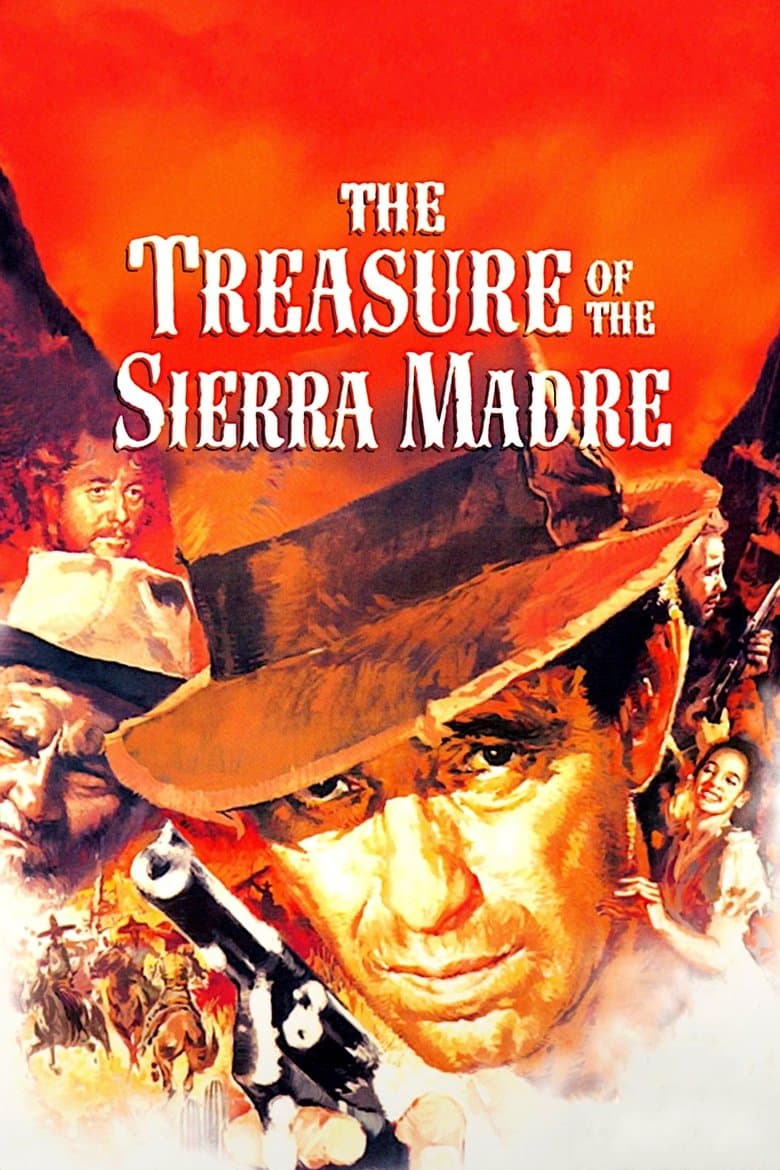
The Treasure of the Sierra Madre
Vibe
John Huston’s gripping adventure drama follows three down-on-their-luck Americans who set out to prospect for gold in the rugged mountains of Mexico. What begins as a hopeful partnership gradually unravels as the men strike it rich and suspicion begins to take hold. Humphrey Bogart delivers one of his most memorable performances as Fred C. Dobbs, whose growing paranoia and greed threaten to destroy the group from within. Huston’s direction blends suspenseful storytelling with stark location photography, emphasizing both the beauty and harshness of the landscape. A powerful study of how wealth can corrupt even ordinary people, The Treasure of the Sierra Madre remains one of cinema’s most enduring cautionary tales about greed.
Watch for
- Bogart’s gradual transformation from hopeful prospector to paranoid and dangerous loner.
- The tense dynamics among the three prospectors as trust slowly gives way to suspicion.
- The harsh mountain landscape, which mirrors the growing psychological isolation of the characters.
- The film’s famous line—“Badges? We don’t need no badges”—a moment that captures the lawless world surrounding the prospectors.
Production notes
The Treasure of the Sierra Madre was John Huston's adaptation of B. Traven's mysterious 1927 novel (Traven's identity has remained debated for decades). Huston wrote the screenplay and directed, with his father Walter Huston playing the prospector Howard. The film was a deeply personal John Huston project — Walter Huston's casting was the director's deliberate choice to give his father the great role he believed his stage-trained father deserved. Humphrey Bogart played Fred C. Dobbs in a deliberately unsympathetic role that broke from his usual romantic-leading-man image; Tim Holt played Bob Curtin, the more emotionally available of the three prospectors. The film was shot extensively on location in Mexico — an unusual decision for a major studio production of the era — and the punishing physical conditions reportedly affected the cast and crew across the months-long production. Cinematographer Ted McCord shot the film. Composer Max Steiner contributed the score. B. Traven himself sent a representative named 'Hal Croves' to the production who many believed was Traven incognito. Production cost approximately $3 million.
Trivia
- The author B. Traven's identity has remained one of the great mysteries in 20th-century literature; he sent a representative named 'Hal Croves' to advise on the production, and many on the production team believed Croves and Traven were the same person, a suspicion the author never confirmed during his lifetime.
- Walter Huston's role as the prospector Howard was deliberately cast by his son John Huston to give his stage-trained father the great late-career role he believed Walter deserved; the casting won Walter the Academy Award for Best Supporting Actor in what became his career-defining film performance.
- The film was John Huston's most thoroughly personal project to date; he won Academy Awards for both Best Director and Best Adapted Screenplay, while his father Walter won Best Supporting Actor — making them the first father-and-son pair to win Oscars at the same ceremony.
- The famous line 'Badges? We ain't got no badges! We don't need no badges! I don't have to show you any stinking badges!' was substantially elaborated in the film from a more brief reference in the novel; the film version's expansion has become permanent in American popular culture.
- Humphrey Bogart's deliberately unsympathetic performance as Fred C. Dobbs was a decisive break from his usual romantic-leading-man image; Bogart took the role specifically to demonstrate dramatic range, and the performance influenced the more morally complex roles he would take in subsequent films like In a Lonely Place (1950).
Legacy
The Treasure of the Sierra Madre won three Academy Awards — Best Director and Best Adapted Screenplay for John Huston, and Best Supporting Actor for Walter Huston, making them the first father-and-son pair to win Oscars at the same ceremony. It was selected for the National Film Registry in 1990. The film's depiction of greed corrupting men under hardship has been continuously cited as one of the strongest American treatments of the theme — alongside Citizen Kane, Sunset Boulevard, and There Will Be Blood as the canonical studio-era American treatment. Humphrey Bogart's deliberately unsympathetic Fred C. Dobbs broke decisively from his romantic-leading-man image and helped open the way for the more morally complex postwar Bogart roles. The famous 'badges' line has become one of the most-quoted moments in American film, parodied across decades of subsequent comedy and adventure films. Among Westerns and adventure films of the postwar period, The Treasure of the Sierra Madre stands as the most thoroughly serious treatment of moral corruption under conditions of physical hardship.