The Third Man
Vibe
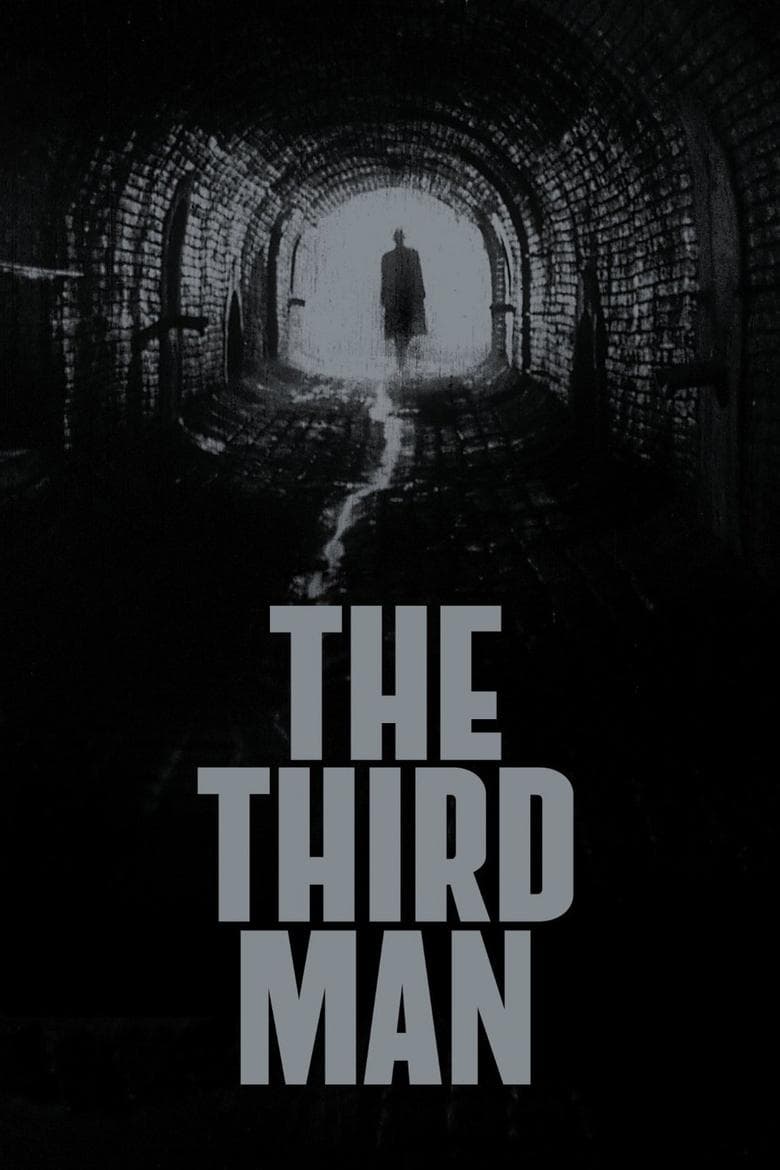
Set in the ruins of postwar Vienna, this atmospheric mystery follows American pulp writer Holly Martins as he arrives to visit his old friend Harry Lime, only to learn that Lime has apparently died in a suspicious accident. As Martins tries to make sense of conflicting accounts and the city’s fractured loyalties, he uncovers a black-market world shaped by corruption, moral compromise, and the lingering damage of war. Directed by Carol Reed, the film is celebrated for its expressionistic lighting, tilted compositions, and unforgettable use of urban space. Orson Welles’s magnetic appearance as Harry Lime and Anton Karas’s haunting zither score help make The Third Man one of the defining achievements of postwar cinema and film noir.
Watch for
- Carol Reed’s use of tilted framing, deep shadows, and nighttime streets, which turns Vienna into a psychologically unstable landscape.
- The famous delayed entrance of Harry Lime, where performance, lighting, and timing combine to create one of cinema’s most memorable reveals.
- Anton Karas’s zither score, whose jaunty strangeness gives the film an uneasy emotional texture unlike any other noir.
- The contrast between Holly Martins’s naïveté and the city’s moral ambiguity, especially as the mystery shifts from puzzle-solving to disillusionment.
Production notes
The Third Man was Carol Reed's British production set in post-WWII Vienna, with the screenplay by Graham Greene (developed from his own treatment, which was subsequently published as a novella). The film's production was substantially funded by David O. Selznick's Selznick International Pictures and Alexander Korda's London Films. Joseph Cotten played Holly Martins, the American pulp-novelist who arrives in Vienna seeking his friend Harry Lime — only to find Lime apparently deceased, only to discover later that Lime is alive and engaged in black-market racketeering. Orson Welles played Harry Lime in a performance that included the famous 'cuckoo clock' speech, which Welles himself reportedly wrote. Alida Valli played Anna Schmidt, Trevor Howard played Major Calloway, and Bernard Lee played Sergeant Paine. The film was shot on location in actual post-war Vienna — capturing the bombed city before reconstruction — and made distinctive use of canted-angle cinematography by Robert Krasker. Composer Anton Karas's zither score became one of the most distinctive pieces of film music ever composed. Production cost approximately $1.5 million.
Trivia
- Orson Welles wrote his own famous 'cuckoo clock' speech — including the lines about the Borgias producing the Italian Renaissance and the Swiss producing brotherly love and the cuckoo clock — though the speech is not in Graham Greene's original treatment; Welles's addition has become one of the most-quoted single speeches in American/British film.
- Anton Karas was reportedly discovered by Carol Reed in a Vienna café during pre-production scouting; the Austrian zither player had been performing locally with no film-music experience, and his subsequent score became one of the most distinctive pieces of film music ever composed, the 'Harry Lime Theme' becoming a worldwide hit.
- The film was shot on location in actual post-war Vienna — capturing the bombed city before reconstruction — and the distinctive visual atmosphere of rubble, shadows, and Soviet/American/British/French occupied-zone politics gave the film an unprecedented documentary realism for a fiction feature.
- Cinematographer Robert Krasker's deliberate use of canted-angle (Dutch-angle) shots became one of the most influential cinematographic choices of the late 1940s; the technique would be widely adopted by subsequent thriller and noir directors, and Krasker won the Academy Award for Best Cinematography for the work.
- The Third Man received three Academy Award nominations and won one (Best Cinematography for Krasker); it received the Grand Prix at the 1949 Cannes Film Festival — predecessor to the Palme d'Or — making it one of the few British films to win the festival's top honor during the postwar period.
Legacy
The Third Man is widely regarded as one of the greatest British films ever made — and as one of the canonical films of postwar European cinema. It received three Academy Award nominations and won one (Best Cinematography). It received the Grand Prix at the 1949 Cannes Film Festival. The British Film Institute's 2007 poll of British critics named it the greatest British film of the 20th century, ahead of David Lean's Brief Encounter (1945) and Powell and Pressburger's The Red Shoes (1948). Anton Karas's zither 'Harry Lime Theme' became one of the most distinctive pieces of film music ever composed and a worldwide hit single. The film's specific visual approach — canted angles, deep shadows, location-shot bombed-Vienna atmosphere — has been continuously studied as a template for the noir-thriller form, and its central images (especially the famous Ferris-wheel speech and the closing zither-and-Vienna-graveyard sequence) have become permanent shorthand for postwar European existential malaise. Among films that take location work seriously, The Third Man remains one of the most thoroughly realized — capturing a specific historical moment (occupied Vienna, late 1940s) that no subsequent reconstruction could match.