A Streetcar Named Desire
Vibe
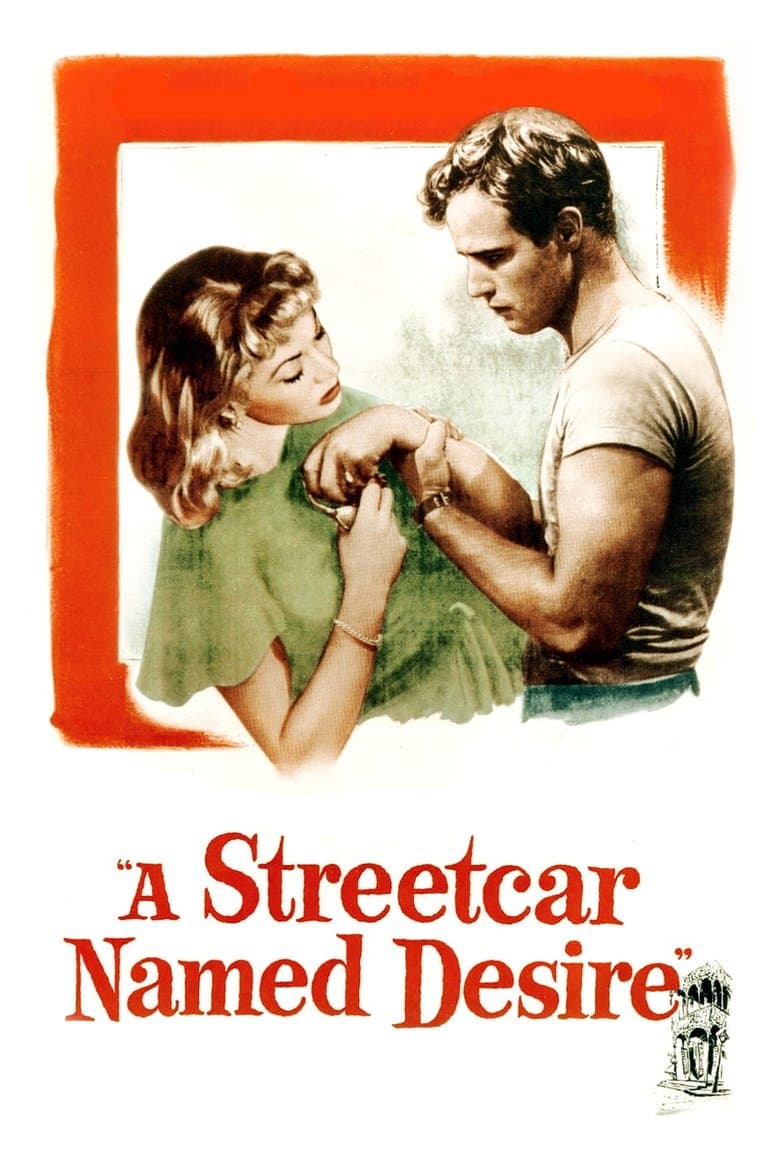
Elia Kazan’s powerful adaptation of Tennessee Williams’s play follows Blanche DuBois, a fragile Southern woman who arrives at her sister Stella’s cramped New Orleans apartment after the loss of her family home and social standing. Blanche’s carefully maintained illusions and longing for refinement collide with the blunt physicality and simmering hostility of Stella’s husband, Stanley Kowalski. As suspicion, desire, and resentment build inside the apartment’s claustrophobic walls, Blanche’s emotional world begins to fracture. Vivien Leigh gives a haunting performance of vulnerability and denial, while Marlon Brando’s Stanley brought a new rawness and realism to screen acting. A Streetcar Named Desire remains one of American cinema’s most searing portraits of power, sexuality, and psychological collapse.
Watch for
- Vivien Leigh’s performance as Blanche, especially the way charm, fragility, performance, and panic coexist in nearly every scene.
- Brando’s physical presence and vocal style, which make Stanley feel not just threatening but transformational in the history of film acting.
- How Kazan uses the apartment’s confined space to heighten tension, turning domestic interiors into a pressure cooker of humiliation and desire.
- The contrast between Blanche’s romantic self-mythology and the film’s increasingly harsh realism, which drives the story toward its devastating final breakdown.
Production notes
A Streetcar Named Desire was Elia Kazan's adaptation of Tennessee Williams's 1947 Pulitzer Prize-winning play, which Kazan had also directed on Broadway in the original 1947 production. Williams wrote the screenplay (with help from his collaborator Oscar Saul), preserving substantial material from his original stage work. The film's production was substantially shaped by the Production Code Administration's demands: the homosexual backstory of Blanche's deceased husband had to be obscured, the rape of Blanche by Stanley had to be implied rather than shown, and Stella's apparent decision to leave Stanley at the film's conclusion was added at PCA insistence. Marlon Brando reprised his Broadway role as Stanley Kowalski, with Vivien Leigh replacing Jessica Tandy as Blanche DuBois. Kim Hunter played Stella, with Karl Malden as Mitch — both also reprising their Broadway roles. Cinematographer Harry Stradling Sr. shot the film. Composer Alex North contributed the score, including the famous moody jazz-influenced opening. Production cost approximately $1.8 million.
Trivia
- Marlon Brando reprised his original 1947 Broadway role as Stanley Kowalski; Brando had been the original Broadway Stanley, and his stage performance had been so foundational that his film performance has remained the canonical interpretation of one of the most demanding roles in American theater.
- Vivien Leigh played Blanche DuBois opposite Brando, replacing Jessica Tandy from the Broadway production; Leigh had played Blanche in the London West End production, and Kazan reportedly preferred Leigh over Tandy for film purposes despite Tandy's more thorough preparation in the role.
- The Production Code Administration demanded substantial cuts from the original play's content — the homosexual backstory of Blanche's deceased husband had to be obscured, the rape of Blanche by Stanley had to be implied rather than shown, and Stella's apparent decision to leave Stanley at the film's conclusion was added at PCA insistence — though Tennessee Williams himself reluctantly approved the changes.
- The film won four Academy Awards — Best Actress (Vivien Leigh), Best Supporting Actor (Karl Malden), Best Supporting Actress (Kim Hunter), and Best Art Direction; Marlon Brando lost Best Actor to Humphrey Bogart for The African Queen, an outcome considered one of the great upsets of early-1950s Oscars.
- Marlon Brando's iconic 'STELLA!' shouted at the apartment building — one of the most-quoted lines in American cinema — was performed in the film and has been continuously parodied and referenced across decades of subsequent comedy, drama, and theatrical work.
Legacy
A Streetcar Named Desire received twelve Academy Award nominations and won four, including Best Actress (Leigh), Best Supporting Actor (Malden), and Best Supporting Actress (Hunter) — the first and so far only film to win three of the four acting categories. It was selected for the National Film Registry in 1999. Marlon Brando's performance as Stanley Kowalski has become one of the most cited launching points for method-acting style in American cinema; his approach influenced subsequent generations of actors from James Dean to Al Pacino to Brad Pitt. Vivien Leigh's performance as Blanche DuBois — fragile, deluded, sexualized, increasingly broken — has been continuously celebrated as one of the great female lead performances of the studio era. The film's specific Production Code-era cuts (the obscured homosexual backstory, the implied rape, the studio-imposed conclusion) became one of the most-discussed examples of American cinema's compromises with the censorship apparatus of the era. Tennessee Williams's central themes — Southern decay, sexual desire and violence, the cruelty of class — have made the film a continuing reference for American dramatic cinema.