Star Wars
Vibe
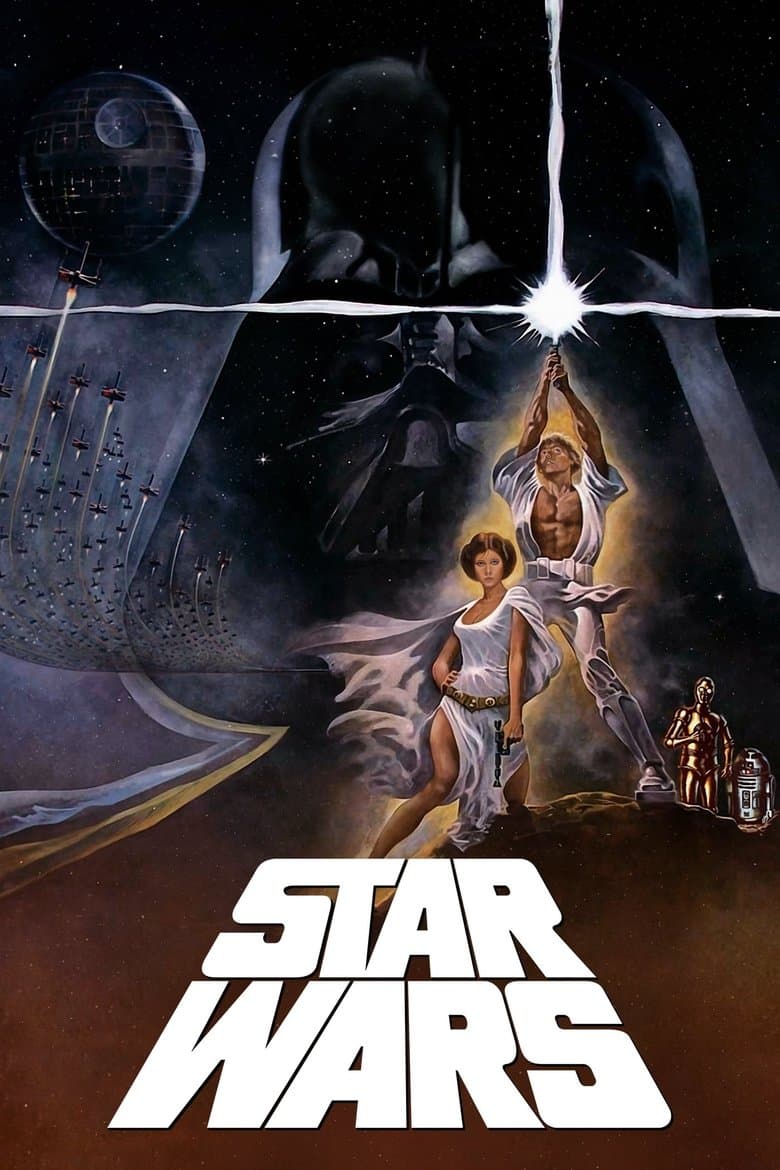
George Lucas’s Star Wars launched a new era of blockbuster filmmaking with its sweeping space adventure and mythic storytelling. The film follows Luke Skywalker, a restless farm boy who becomes drawn into a rebellion against the tyrannical Galactic Empire after meeting Jedi mentor Obi-Wan Kenobi. Alongside the daring smuggler Han Solo, Princess Leia, and a pair of loyal droids, Luke embarks on a journey that will test his courage and awaken his destiny. Blending classic adventure serials, fantasy archetypes, and groundbreaking visual effects from Industrial Light & Magic, Lucas created a richly imagined galaxy that captivated audiences worldwide. Powered by John Williams’s triumphant score, Star Wars became a cultural phenomenon and one of the most influential films in modern cinema.
Watch for
- The film’s use of classic mythic storytelling, especially Luke Skywalker’s hero’s-journey arc inspired by Joseph Campbell’s mythology studies.
- The groundbreaking miniature and motion-control visual effects that brought space battles and alien worlds to life.
- John Williams’s sweeping orchestral score, which gives the story a grand, operatic scale.
- How Lucas blends humor, action, and mythic themes to create a fast-moving adventure that feels both timeless and modern.
Production notes
Star Wars (later subtitled Episode IV: A New Hope) was George Lucas's third feature film, after THX 1138 (1971) and American Graffiti (1973). The screenplay went through multiple major revisions across two years; Lucas's original treatment had been substantially different from the final film, and the eventual narrative drew from Akira Kurosawa's The Hidden Fortress, Joseph Campbell's hero's-journey monomyth, and Saturday-matinee serial conventions of the 1930s and 1940s. 20th Century Fox agreed to finance with significant skepticism. Production took place primarily at Elstree Studios in England and on location in Tunisia. Mark Hamill played Luke Skywalker, with Harrison Ford as Han Solo, Carrie Fisher as Princess Leia, Alec Guinness as Obi-Wan Kenobi, James Earl Jones voicing Darth Vader (David Prowse in costume), Peter Cushing as Tarkin, and Anthony Daniels as C-3PO. The film required developing entirely new visual-effects approaches; ILM (Industrial Light & Magic), founded by Lucas specifically for the production, would become Hollywood's dominant visual-effects studio. John Williams composed the score with the London Symphony Orchestra. Production cost approximately $11 million.
Trivia
- George Lucas famously took a percentage of merchandising rights instead of a directing salary — a deal Twentieth Century Fox considered minor at the time but which made Lucas one of the wealthiest filmmakers in Hollywood history; the film's toy and licensing revenue eventually exceeded its theatrical gross.
- Industrial Light & Magic (ILM), the visual-effects company founded by Lucas specifically to produce Star Wars, would become Hollywood's dominant special-effects studio; subsequent ILM work has included Jurassic Park, the Indiana Jones films, the Pirates of the Caribbean films, the Marvel Cinematic Universe, and most major Hollywood blockbusters of the past four decades.
- Alec Guinness, who played Obi-Wan Kenobi, reportedly disliked the dialogue and the entire project; he later said he was 'fed up' with Star Wars fans and asked them to 'get a life.' Despite his discomfort, his performance anchored the film's mystical-mentor archetype.
- Harrison Ford was working as a carpenter when he was cast as Han Solo; he had been hired by Lucas to install doors on the set, and Lucas asked him to read lines opposite other actors auditioning, eventually casting him over the studio's preference for a more established star.
- Star Wars grossed approximately $775 million on its initial theatrical release — the highest-grossing film of all time at the moment of its 1977 release, eventually surpassed by the same franchise's Empire Strikes Back and Return of the Jedi sequels.
Legacy
Star Wars's commercial and cultural impact may exceed any single American film since Gone with the Wind. It received ten Academy Award nominations and won six (in technical categories); Best Picture went to Annie Hall, but the franchise's commercial impact at the time was already overwhelming. It was selected for the inaugural class of the National Film Registry in 1989. The film essentially created the modern blockbuster era — its summer-tentpole release pattern, its merchandising-driven economics, its franchise-based long-term commercial planning, and its visual-effects-spectacle centrality have shaped every subsequent decade of Hollywood industrial structure. The Star Wars franchise has grown to encompass eleven theatrical features, multiple television series, novels, comic books, and one of the most lucrative merchandising operations in entertainment history. Lucas's 1981 trademark of 'May the Force be with you' is now one of the most internationally recognized phrases in popular culture. Among American genre films, Star Wars remains the single most influential transformation of what mainstream cinema could be.