Snow White and the Seven Dwarfs
Vibe
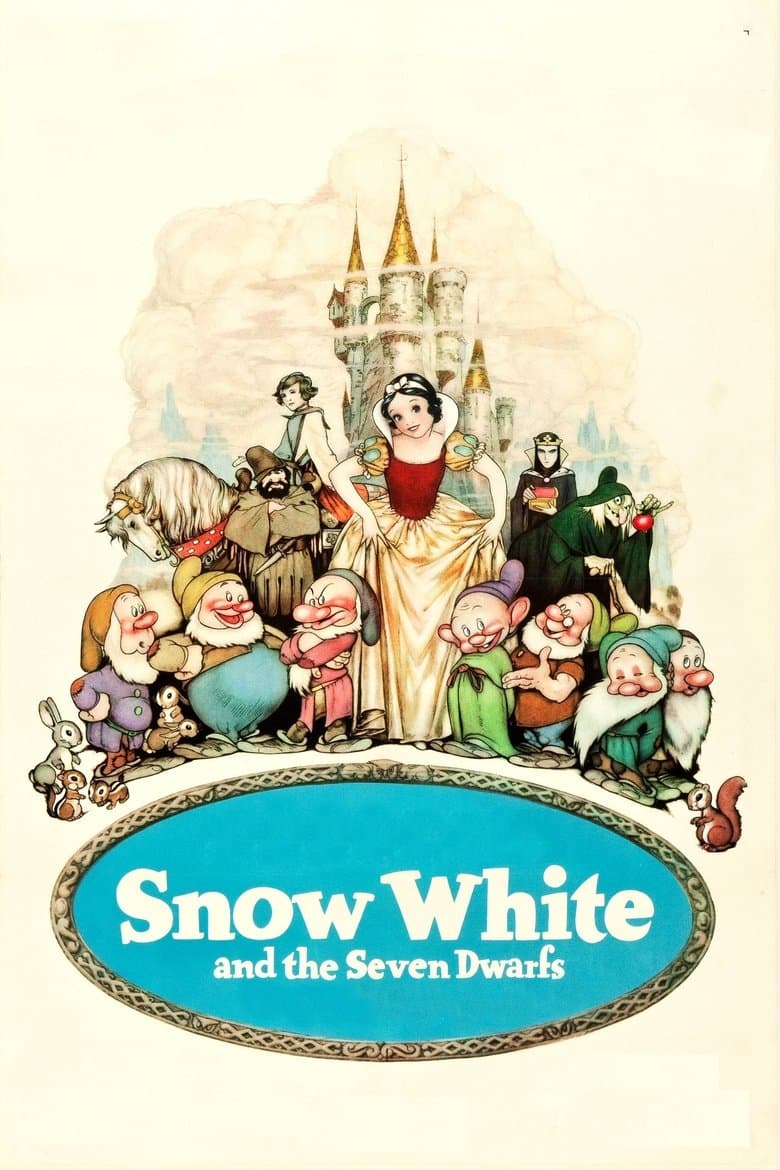
Walt Disney’s pioneering animated feature brings the classic fairy tale of Snow White to the screen with a scale and emotional richness audiences had never seen in animation. Forced to flee after her jealous stepmother, the Evil Queen, orders her death, Snow White finds refuge in the forest with seven dwarfs whose warmth and comic energy briefly shield her from danger. The Queen’s return in disguise sets the story on its path toward enchantment and terror. Through expressive character animation, vibrant color, and memorable songs, Disney proved that animation could sustain feature-length storytelling with genuine dramatic and emotional power. Snow White and the Seven Dwarfs remains the foundation of American animated feature filmmaking.
Watch for
- Recurring motifs and touchpoints (witch, dying and death, princess, becoming an adult, dwarf, poison)—notice how they show up, evolve, or get subverted scene-to-scene.
- How information is revealed (or withheld): pay attention to what you learn first, and what you only understand in hindsight.
- Performance details in close-ups—pauses, glances, and timing often do more than the lines.
- Transitions and visual rhymes: watch how the film connects scenes through matching images, sound bridges, or repeated blocking.
Production notes
Snow White and the Seven Dwarfs was Walt Disney's first feature-length animated film — the project Hollywood industry insiders nicknamed 'Disney's Folly' during its three-year production, doubting any audience would tolerate an 80-minute animated film. The screenplay by a team of writers (Ted Sears, Otto Englander, Earl Hurd, Dorothy Ann Blank, Richard Creedon, Dick Rickard, Merrill De Maris, and Webb Smith) adapted the Brothers Grimm fairy tale 'Schneewittchen.' The film required Disney to develop entirely new approaches to character animation, including the use of multiplane cameras for depth-illusion effects, rotoscoping for human characters (Snow White and the Prince were partly traced from live-action reference footage of Marge Belcher dancing), and extensive color-and-lighting research. Adriana Caselotti voiced Snow White (in a deliberately youthful soprano), with Lucille La Verne as the Queen and Witch, and Roy Atwell, Pinto Colvig, and others as the seven dwarfs. Composer Frank Churchill contributed the score. Production cost approximately $1.49 million — extraordinarily expensive for the era — and required Walt Disney to mortgage his house to complete.
Trivia
- Hollywood industry insiders nicknamed the project 'Disney's Folly' during its three-year production, doubting any audience would tolerate an 80-minute animated film; Walt Disney himself reportedly mortgaged his house and his brother Roy mortgaged the studio to complete the production after the budget overran initial estimates.
- Snow White's animation drew on extensive live-action reference work — actress Marge Belcher (later Marge Champion) was filmed dancing and performing as visual reference for Snow White's movements; the rotoscoping technique gave the character a more naturalistic motion than purely-animated characters of the era.
- Adriana Caselotti, who voiced Snow White in a deliberately youthful soprano, was 18 at the time of recording; her contract with Disney specifically prohibited her from making other vocal performances, a restriction that effectively ended her singing career — Caselotti spent much of her subsequent life regretting the deal.
- The film grossed approximately $8 million on its initial 1937 release — making it the highest-grossing film of any kind that year, and one of the highest-grossing American films of any kind to that point in cinema history; the success effectively saved Disney financially and enabled the studio's subsequent production work.
- Walt Disney received an Honorary Academy Award at the 11th Academy Awards in 1939 — one full-size statuette and seven miniature ones, presented in a dwarf-themed gag — for 'a significant screen innovation which has charmed millions and pioneered a great new entertainment field.'
Legacy
Snow White and the Seven Dwarfs occupies a foundational position in American cinema as the first feature-length animated film and the work that essentially created Disney as a cultural and commercial force. It was selected for the inaugural class of the National Film Registry in 1989, and the AFI ranks it #1 on its 'Greatest Animated Films' list. The film's commercial success on its 1937 release saved Disney financially and enabled the studio's subsequent production of the animated features that would establish it as the dominant American animation studio for the next century. Snow White's dwarf characters — Doc, Grumpy, Happy, Sleepy, Bashful, Sneezy, and Dopey — have remained among the most enduringly recognizable characters in American animation. The film's specific narrative innovations — the integration of music into character development, the use of memorable supporting characters around a central protagonist, the deliberate balance between dark and light tonal registers — became the template for the entire subsequent Disney feature-animation tradition. Among American films of the 1930s, Snow White and the Seven Dwarfs is the most thoroughly transformative — the film whose existence remade the possibilities of mainstream American cinema.