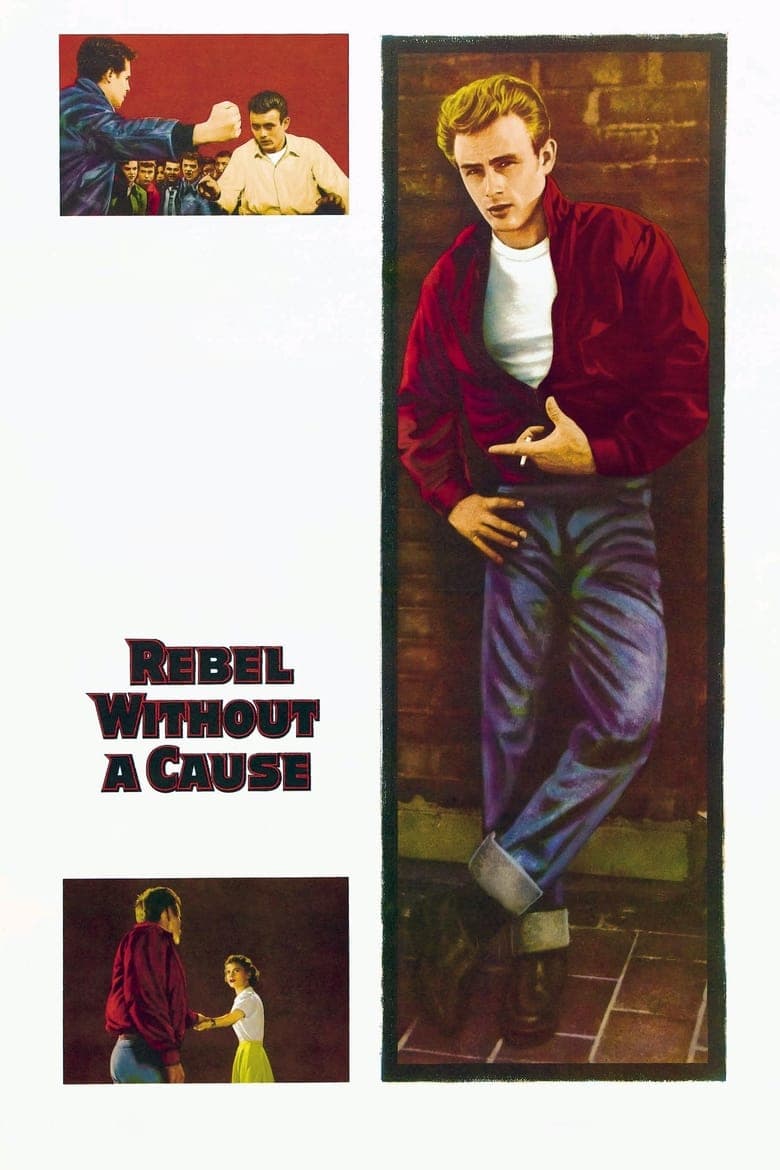
Rebel Without a Cause
Vibe
This influential drama captures the turbulence of teenage alienation in 1950s America through Jim Stark, a troubled adolescent trying to find stability after moving to a new town. James Dean gives Jim a restless mix of defiance, confusion, and vulnerability as he forms fragile bonds with fellow outsiders Judy and Plato, each searching for connection in a world of emotional neglect and social pressure. Directed by Nicholas Ray, the film treats adolescence with unusual seriousness, turning family conflict, peer violence, and loneliness into the substance of tragedy. Dean’s performance became an enduring emblem of youthful rebellion, and Rebel Without a Cause remains one of American cinema’s defining portraits of teenage angst.
Watch for
- James Dean’s physical performance, especially the way Jim’s slouched posture, sudden bursts of anger, and awkward tenderness reveal a teenager unable to regulate his emotions.
- Nicholas Ray’s use of widescreen color and nighttime settings, which turn suburban spaces, observatories, and empty streets into charged emotional landscapes.
- The dynamic among Jim, Judy, and Plato, whose search for belonging gives the film much of its tenderness as well as its sadness.
- How family scenes and peer confrontations mirror each other, showing that the film’s violence grows as much from emotional neglect at home as from adolescent bravado.
Production notes
Rebel Without a Cause was Nicholas Ray's drama about middle-class American teenage alienation, with the screenplay by Stewart Stern from a story by Ray himself. The film was Warner Bros.'s response to the contemporary commercial success of teen-themed films and the post-Brown v. Board of Education political moment. James Dean played the troubled new student Jim Stark in his second of only three completed feature films (East of Eden had been released earlier in 1955, and Giant would follow in 1956). Natalie Wood played Judy, with Sal Mineo as Plato — a role that contained substantial homoerotic subtext, ahead of its time for 1955 American cinema. The cast included Jim Backus and Ann Doran as Jim's parents and Corey Allen as the antagonist Buzz. The famous 'chicken' scene — driving stolen cars off a cliff — was shot at Griffith Observatory in Los Angeles, where the entire film's famous planetarium sequence was also filmed. James Dean died in a car accident on September 30, 1955, approximately one month before the film's October 27 theatrical release. Cinematographer Ernest Haller shot the film. Production cost approximately $1.5 million.
Trivia
- James Dean died in a car accident on September 30, 1955 — approximately one month before Rebel Without a Cause's October 27 theatrical release; Dean was 24 years old and had completed only three feature films, with Giant (1956) released posthumously the following year.
- Natalie Wood was 16 when she made Rebel Without a Cause and required California Department of Industrial Relations permits to perform; her on-set affair with director Nicholas Ray (then 43, more than twice her age) has been substantially documented in subsequent biographies and reflects the era's predatory production-set culture.
- Sal Mineo's role as Plato contained substantial homoerotic subtext that was ahead of its time for 1955 American cinema; the character is widely interpreted as the first openly gay teenager in American mainstream cinema, though the Production Code Administration required the film's homosexuality to remain implicit rather than explicit.
- All three principal cast members died young and tragically: James Dean died in a car accident in 1955 at age 24, Sal Mineo was murdered in 1976 at age 37, and Natalie Wood drowned in 1981 at age 43; the 'Rebel curse' became one of the most-discussed coincidences in Hollywood history.
- Rebel Without a Cause received three Academy Award nominations — Best Supporting Actress (Natalie Wood), Best Supporting Actor (Sal Mineo), and Best Motion Picture Story (Nicholas Ray) — and won none; James Dean would receive posthumous Best Actor nominations for East of Eden and Giant but not for this film.
Legacy
Rebel Without a Cause became one of the canonical films of American teenage alienation and the moment when American cinema began taking the inner lives of suburban-middle-class teenagers seriously as dramatic subject matter. It received three Academy Award nominations but won none. It was selected for the National Film Registry in 1990. James Dean's posthumous theatrical release (he died one month before the film opened) helped establish his permanent mythology as the archetypal mid-twentieth-century American troubled-young-male figure, alongside Marlon Brando's earlier roles in The Wild One (1953) and On the Waterfront (1954). The film's specific visual elements — Dean's red windbreaker, the planetarium sequence, the cliff-chicken-race — have become permanent shorthand for American teenage rebellion across subsequent decades. Sal Mineo's Plato has been retroactively recognized as one of the earliest and most thoroughly textured depictions of gay teenagers in mainstream American cinema. Among films of the mid-1950s teen-youth-cycle, Rebel Without a Cause stands as the most thoroughly serious and the most enduringly influential.