Rear Window
Vibe
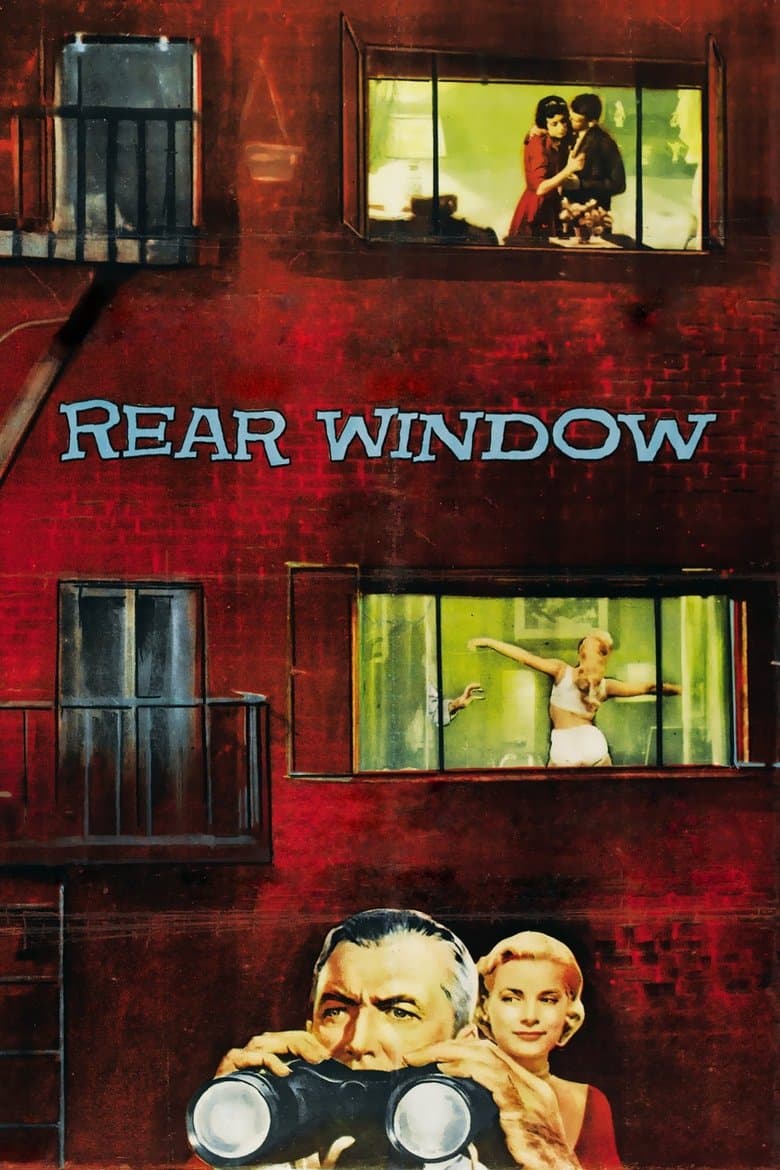
Alfred Hitchcock’s suspenseful thriller centers on L.B. “Jeff” Jefferies, a photojournalist confined to his apartment with a broken leg who passes the time by observing his neighbors through a rear window. What begins as idle curiosity gradually turns into obsession when Jeff becomes convinced that one of the residents across the courtyard has committed murder. With the help of his glamorous girlfriend Lisa Fremont and his sharp-tongued nurse Stella, he begins piecing together clues from a distance. Hitchcock transforms a single apartment complex into a brilliantly controlled world of suspense, using point of view, editing, and visual detail to draw viewers into Jeff’s uneasy gaze. Rear Window remains one of Hitchcock’s most elegant and influential thrillers.
Watch for
- How Hitchcock limits the viewer almost entirely to Jeff’s perspective, making every glance across the courtyard an act of discovery and uncertainty.
- Grace Kelly’s performance as Lisa, whose poise and glamour gradually give way to courage and active involvement in the investigation.
- The elaborate apartment courtyard set, where each neighbor’s small routine creates a living world and a network of visual clues.
- The way suspense grows through editing, reaction shots, and silence rather than overt action, especially in the film’s most dangerous late sequences.
Production notes
Rear Window was Alfred Hitchcock's adaptation of Cornell Woolrich's short story 'It Had to Be Murder,' with the screenplay by John Michael Hayes. The film's entire narrative takes place from the perspective of the protagonist's apartment courtyard window — a deliberately constrained structural choice that Hitchcock had been developing as an experiment in spatial cinema. James Stewart played the photographer L.B. 'Jeff' Jefferies, recovering from a broken leg and obsessively watching his neighbors through binoculars. Grace Kelly played his society-girlfriend Lisa Fremont — Kelly's third Hitchcock film after Dial M for Murder (1954) and the same year as her Hitchcock work on To Catch a Thief (1955). Thelma Ritter played Stella, the visiting nurse, with Wendell Corey as Detective Doyle and Raymond Burr as the suspected murderer Lars Thorwald. The elaborate courtyard set — with apartments visible from across the courtyard, all at the perspective of Stewart's character — was built at Paramount and remained one of the largest indoor sets ever constructed. Cinematographer Robert Burks shot the film in Technicolor. Composer Franz Waxman contributed the score. Production cost approximately $1 million.
Trivia
- The entire film is shot from one location — Jeffries's apartment window facing the courtyard — and the elaborate courtyard set was built at Paramount, with all the visible apartment windows representing real interior spaces with their own lighting, set design, and supporting performers visible in long shot.
- Grace Kelly's three-Hitchcock collaboration (Dial M for Murder, Rear Window, and To Catch a Thief) was substantially launched by her performance here; Hitchcock specifically wrote the part for her glamorous, controlled screen presence, and Kelly's Lisa Fremont established her as the canonical Hitchcock blonde.
- James Stewart's character is named L.B. 'Jeff' Jefferies — a deliberate joke from Hitchcock referencing Jefferson, the most-photographed Mount Rushmore face; Stewart's character's photographer profession plays into the film's central exploration of voyeurism and watching.
- The film's central thematic concern — voyeurism, the moral implications of watching others, the relationship between observer and observed — has been continuously studied as a foundational text of cinema theory, influencing the work of Brian De Palma, Wim Wenders, and the entire 'cinema-of-watching' tradition.
- Rear Window received four Academy Award nominations including Best Director (Hitchcock), Best Cinematography (Robert Burks), Best Sound, and Best Adapted Screenplay (John Michael Hayes); it won none, an outcome that has been continuously cited as one of the great snubs of mid-1950s Oscar voting.
Legacy
Rear Window is widely regarded as one of the greatest American thrillers and one of Alfred Hitchcock's two or three definitive films, alongside Vertigo (1958) and Psycho (1960). It received four Academy Award nominations and won none, but its critical reputation has only grown across decades. It was selected for the National Film Registry in 1997. The film's central thematic concern — voyeurism, the moral implications of watching others, the relationship between observer and observed — has been continuously studied as a foundational text of cinema theory. It has influenced subsequent films from Brian De Palma's Body Double (1984) to Disturbia (2007), and its central premise has been adapted across countless television episodes and theatrical works. Grace Kelly's performance as Lisa Fremont — her glamorous, controlled screen presence transformed by active engagement with the murder mystery — established her as the canonical Hitchcock blonde. Among Hitchcock's films, Rear Window stands as the most thoroughly cinematic exploration of watching as moral act — the film essentially watches itself, with the audience implicated in Jefferies's voyeurism through identification with his perspective.