Raging Bull
Vibe
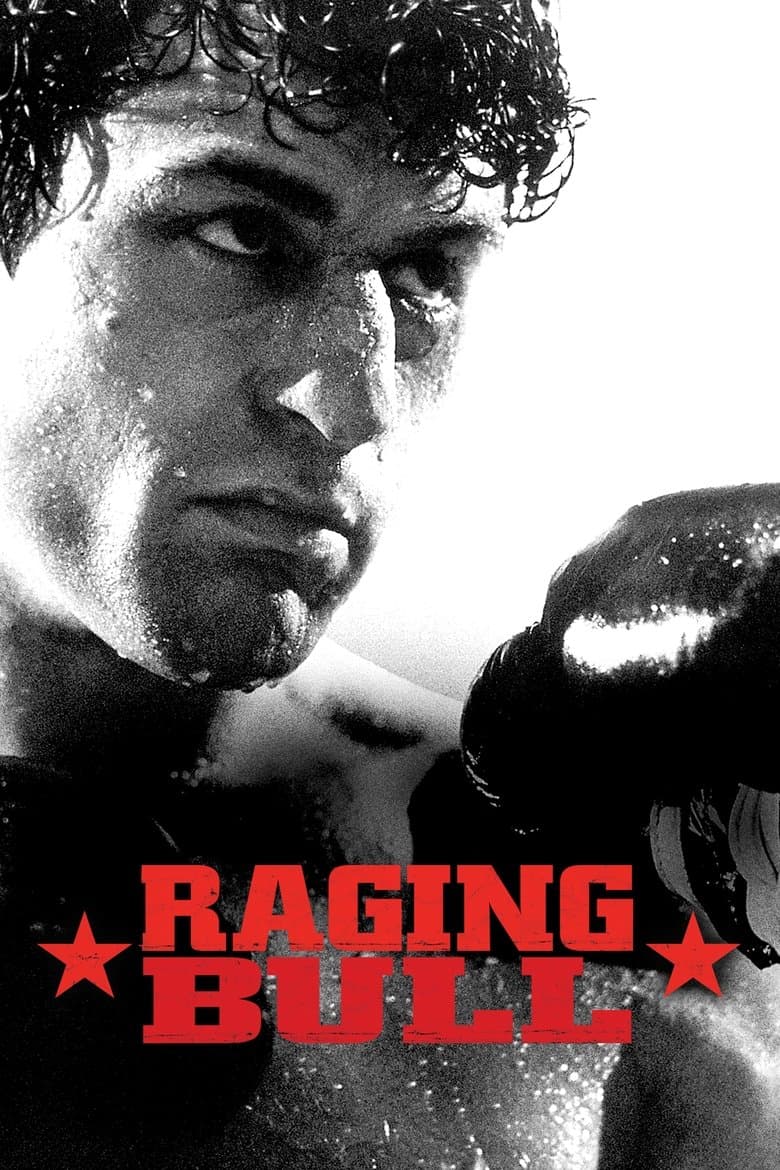
Martin Scorsese’s searing biographical drama chronicles the rise and fall of middleweight boxing champion Jake LaMotta. Robert De Niro delivers a ferocious, Oscar-winning performance as the volatile fighter whose relentless drive in the ring contrasts sharply with his destructive jealousy and paranoia outside it. As LaMotta’s career climbs toward championship glory, his relationships with his brother, his wife, and those closest to him deteriorate under the weight of his anger and insecurity. Shot in stark black-and-white, the film’s brutal boxing sequences use stylized editing and dynamic camerawork to plunge viewers into LaMotta’s inner turmoil. Both intimate character study and operatic tragedy, Raging Bull is widely regarded as one of the greatest achievements of modern American cinema.
Watch for
- The stylized boxing sequences, where slow motion, sound design, and lighting convey LaMotta’s inner rage rather than literal realism.
- De Niro’s shifting physical presence throughout the film, reflecting the character’s rise, fall, and eventual self-reflection.
- The intimate scenes between Jake and his brother Joey, which reveal how jealousy and pride gradually poison their relationship.
- The film’s haunting final moments, where LaMotta confronts his own legacy in a quiet and deeply ambiguous conclusion.
Production notes
Raging Bull was Martin Scorsese's biographical adaptation of middleweight boxer Jake LaMotta's memoir, produced after Scorsese's near-fatal 1978 cocaine overdose during the troubled production of his New York, New York musical. Robert De Niro had championed the project for years and continued pushing Scorsese to direct it during Scorsese's hospital recovery; De Niro has said that the film's production essentially saved Scorsese's life by giving him purpose. Paul Schrader and Mardik Martin wrote the screenplay. De Niro famously gained approximately 60 pounds to play LaMotta in his post-retirement period, an extraordinary physical transformation that became one of the most-discussed examples of method-acting commitment. Cinematographer Michael Chapman shot the film in deliberately stylized black-and-white. The cast included Joe Pesci as Jake's brother Joey, Cathy Moriarty as Jake's wife Vickie, and Frank Vincent as Salvy. Composer Pietro Mascagni's 'Cavalleria Rusticana' Intermezzo provides the famous opening music. Production cost approximately $18 million.
Trivia
- Robert De Niro famously gained approximately 60 pounds to play Jake LaMotta in the film's post-retirement scenes — an extraordinary physical transformation that won him the Academy Award for Best Actor and set the template for subsequent radical-physical-transformation performances.
- The film was Martin Scorsese's recovery project after his near-fatal 1978 cocaine overdose during the troubled production of New York, New York; Robert De Niro has said that pushing Scorsese to direct Raging Bull essentially saved his life by giving him creative purpose during his hospital recovery.
- The boxing sequences — among the most influential ever filmed — were choreographed by professional boxer Frankie Cain and shot using both standard cameras and modified handheld rigs; the famous slow-motion blood spray was achieved by puncturing rubber bladders attached to the actors' faces.
- Joe Pesci, who plays Jake's brother Joey, had nearly retired from acting before being cast in Raging Bull; the role launched his subsequent collaboration with Scorsese in Goodfellas (1990) and Casino (1995), and a successful decades-long career.
- Raging Bull received eight Academy Award nominations and won two — Best Actor (De Niro) and Best Film Editing (Thelma Schoonmaker, who has edited every Scorsese feature since); the film lost Best Picture to Ordinary People in one of the more contested Oscar contests of the era.
Legacy
Raging Bull is widely regarded as Martin Scorsese's masterwork and one of the greatest American films ever made — a designation that has only strengthened across decades of subsequent reassessment. It received eight Academy Award nominations and won two (Best Actor, Best Film Editing). It was selected for the National Film Registry in 1990. Roger Ebert named it the greatest film of the 1980s, and Sight & Sound's decennial critics' polls have ranked it among the greatest films ever made. Robert De Niro's Jake LaMotta — the 60-pound weight gain, the Bronx Italian-American intensity, the violent self-destruction — is regularly cited as the canonical example of method-acting commitment in American cinema; the role won De Niro his second Academy Award. The boxing sequences have been continuously studied as the most thoroughly cinematic treatment of the sport ever filmed. Among Scorsese's films, Raging Bull stands at the apex of his serious dramatic ambition — the synthesis of his Catholic moral seriousness, his collaborative partnership with De Niro, and his command of cinematic craft across what may be his most thoroughly realized film.