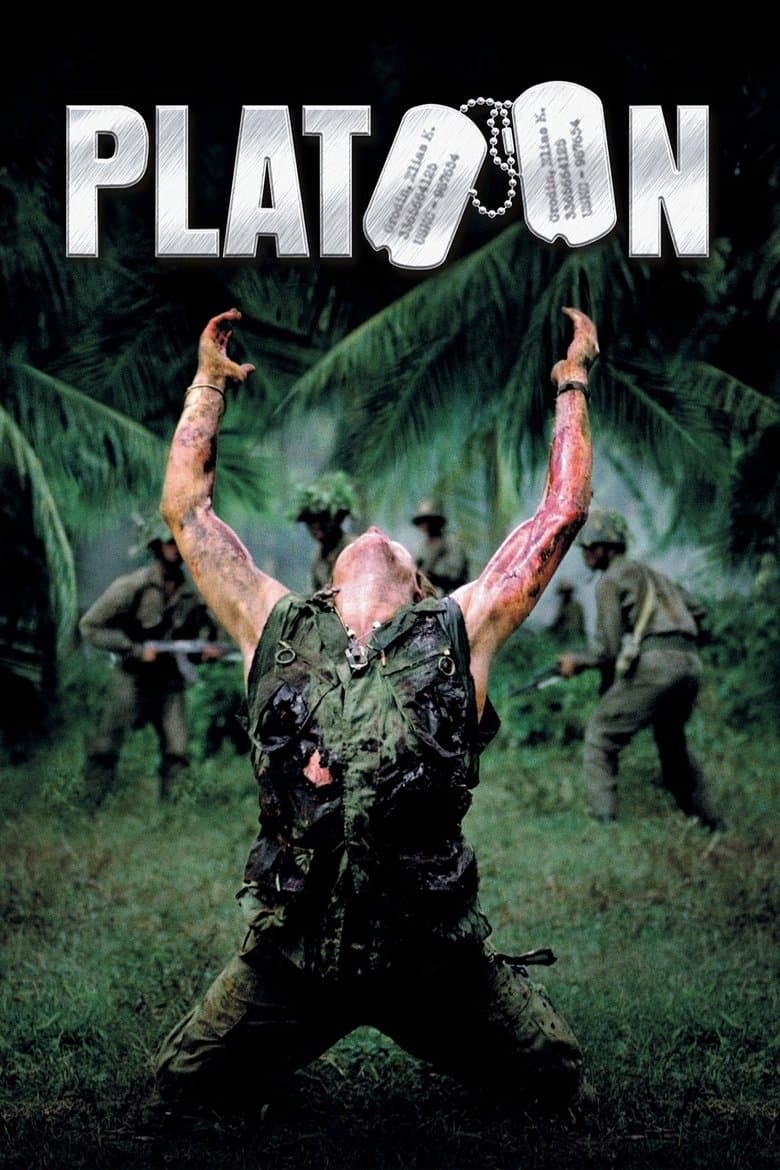
Platoon
Vibe
Oliver Stone’s Vietnam War drama follows young soldier Chris Taylor as he arrives in the jungle expecting duty and purpose, only to confront confusion, terror, and moral collapse. Caught between two sergeants—one guided by conscience, the other by brutality—Chris becomes the witness to a unit slowly unraveling under pressure, fear, and rage. Drawing on Stone’s own wartime experience, the film rejects heroic myth in favor of exhaustion, chaos, and psychological damage. Charlie Sheen, Willem Dafoe, and Tom Berenger deliver fiercely committed performances that give the conflict an intimate human scale. Platoon remains one of the most influential and emotionally searing American films about Vietnam.
Watch for
- The contrast between Sergeant Elias and Sergeant Barnes, whose opposing values turn the platoon into a battleground of morality as much as military conflict.
- How Stone uses heat, darkness, jungle noise, and disorientation to make combat feel exhausting, chaotic, and psychologically consuming.
- Willem Dafoe and Tom Berenger’s performances, which embody two radically different responses to war’s pressure and dehumanization.
- The film’s shifting perspective through Chris Taylor, whose voiceover and experience frame the story as both personal awakening and spiritual disillusionment.
Production notes
Platoon was Oliver Stone's autobiographical Vietnam War drama — substantially based on Stone's own 1967-1968 service as a U.S. Army infantryman in the Mekong Delta and the Cambodian border. Stone wrote the screenplay; he had been trying to produce the film for over a decade after his 1967-1968 service in Vietnam, with Hollywood studios uniformly rejecting it as too dark and too morally complex. The film was finally produced by Hemdale Film Corporation and Orion Pictures on an approximately $6 million budget. Charlie Sheen played the protagonist Chris Taylor, a young soldier whose moral compass is shaped by the conflict between two sergeants: Tom Berenger's morally corrupt Sergeant Barnes and Willem Dafoe's morally serious Sergeant Elias. The cast included Forest Whitaker, John C. McGinley, Kevin Dillon, Keith David, Francesco Quinn, Johnny Depp, and Sheen's father Martin Sheen in a cameo. The film was shot on location in the Philippines under deliberately punishing conditions — Stone insisted on extensive military training for the cast before production, and the shooting itself simulated genuine military-operation conditions. Cinematographer Robert Richardson shot the film. Composer Georges Delerue contributed the score (with extensive use of Samuel Barber's 'Adagio for Strings').
Trivia
- Oliver Stone had been trying to produce Platoon for over a decade after his 1967-1968 service in Vietnam as a U.S. Army infantryman; Hollywood studios uniformly rejected the screenplay as too dark and too morally complex, and the film was finally produced by Hemdale Film Corporation and Orion Pictures on an approximately $6 million budget.
- Stone insisted on extensive military training for the cast before production — the actors were sent to a two-week boot camp run by military veteran Dale Dye in the Philippine jungle, with limited food, no access to outside contact, and continuous physical exhaustion; Stone wanted the cast to experience genuine fatigue and discomfort that would translate to on-screen authenticity.
- Charlie Sheen's casting as the protagonist Chris Taylor was substantially shaped by Sheen's father Martin Sheen (who had previously starred in Apocalypse Now) — Martin Sheen recommended his son for the role, and Charlie Sheen had previously appeared in a brief role in his father's earlier film; the casting drew on the actual father-son connection to the Vietnam War cinematic tradition.
- Samuel Barber's 'Adagio for Strings' — used extensively in the film, particularly for the elegiac sequences around Sergeant Elias's death — has become permanent shorthand for cinematic grief; the music's substantial subsequent use in other films and contexts (including Michael Moore's Fahrenheit 9/11 in 2004) draws directly from Platoon's establishment of the connection.
- Platoon won four Academy Awards including Best Picture, Best Director (Stone), Best Film Editing, and Best Sound; Tom Berenger and Willem Dafoe were both nominated for Best Supporting Actor — both losing to Michael Caine for Hannah and Her Sisters — in what was widely considered one of the more contested supporting-actor contests of the 1980s.
Legacy
Platoon won four Academy Awards including Best Picture and Best Director (Oliver Stone), and grossed approximately $138 million worldwide on its $6 million budget. It was selected for the National Film Registry in 2019. The film's combat-realist approach — based substantially on Oliver Stone's own military service experience — established a new template for Vietnam War cinema, distinct from the more abstract or symbolic approaches of Apocalypse Now (1979) and The Deer Hunter (1978). Samuel Barber's 'Adagio for Strings' has become permanent shorthand for cinematic grief, with its substantial subsequent use in other films drawing directly from Platoon's establishment of the connection. Among American films about the Vietnam War, Platoon sits alongside Apocalypse Now (1979), The Deer Hunter (1978), and Full Metal Jacket (1987) as the canonical late-1970s and 1980s treatments. Oliver Stone's subsequent Vietnam-themed films — Born on the Fourth of July (1989) and Heaven & Earth (1993) — formed his self-described 'Vietnam trilogy,' though Platoon remains the most thoroughly Oscar-celebrated and the most thoroughly autobiographical of the three.