A Place in the Sun
Vibe
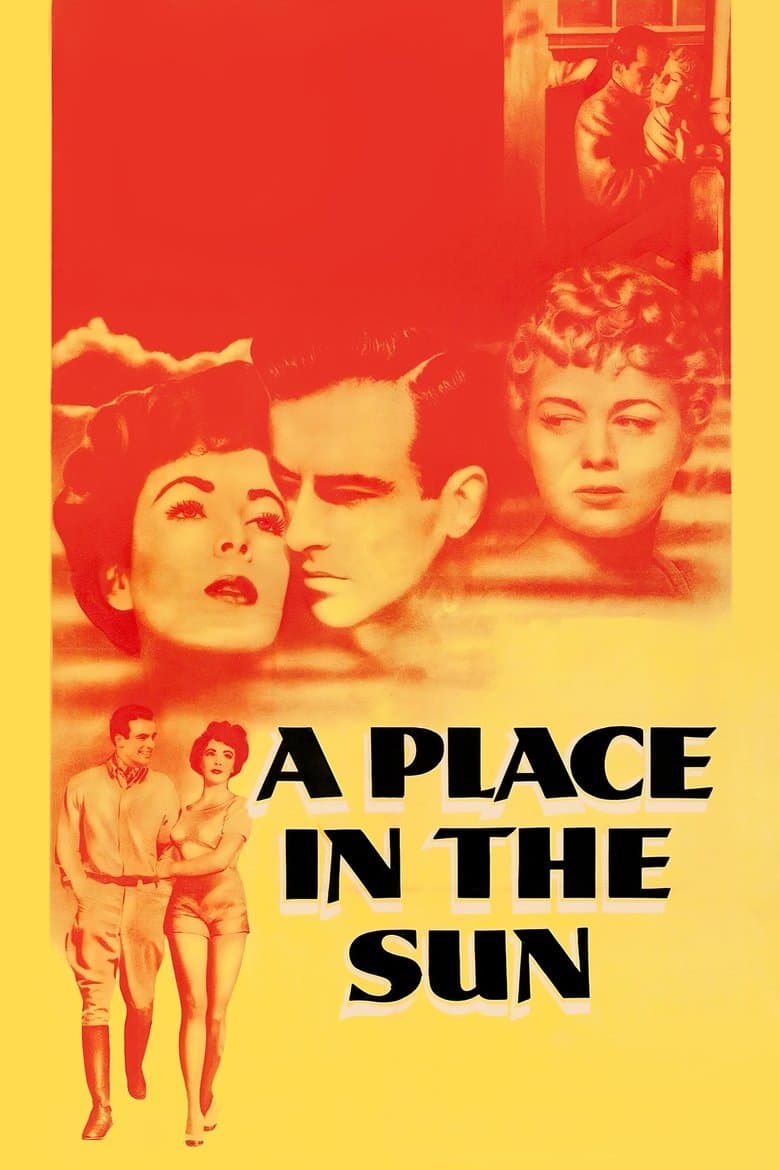
George Stevens’s dramatic adaptation of Theodore Dreiser’s novel follows George Eastman, an ambitious young factory worker whose desire for love, status, and social advancement pulls him into a devastating moral crisis. Caught between a working-class woman who depends on him and a glamorous socialite who seems to embody the life he longs for, George drifts toward choices he cannot undo. Montgomery Clift gives the character a fragile inwardness that makes his weakness as revealing as his aspiration, while Elizabeth Taylor and Shelley Winters embody two sharply different worlds of desire and consequence. Blending romantic intensity with class tragedy, A Place in the Sun remains one of the most powerful American dramas of its era.
Watch for
- Montgomery Clift’s performance, especially the way hesitation, silence, and inward tension reveal George’s weakness long before the plot reaches its crisis.
- The contrast between Shelley Winters and Elizabeth Taylor, who are presented not simply as rivals but as embodiments of different social worlds and emotional pressures.
- George Stevens’s use of close-ups, glamour lighting, and romantic framing, which makes desire feel intoxicating even as the story darkens around it.
- How the film gradually shifts from intimate romance to moral nightmare, culminating in a courtroom and conscience drama shaped as much by class and fantasy as by action.
Production notes
A Place in the Sun was George Stevens's adaptation of Theodore Dreiser's 1925 novel An American Tragedy, with the screenplay by Michael Wilson and Harry Brown. Wilson was being investigated by the House Un-American Activities Committee during production and would be blacklisted shortly after; he ultimately shared the Academy Award for Best Adapted Screenplay (despite his blacklist status, he received the award) with Harry Brown. The film starred Montgomery Clift as the upwardly-mobile factory worker George Eastman, with Elizabeth Taylor as the wealthy heiress Angela Vickers, and Shelley Winters as the pregnant working-class girlfriend Alice Tripp. The cast included Anne Revere as George's evangelical mother Hannah (in her final performance before her blacklisting prevented further film work), Raymond Burr as the prosecuting district attorney Marlowe, Keefe Brasselle as Earl Eastman, Fred Clark as the defense attorney Bellows, Walter Sande as Jansen, and Frieda Inescort as Mrs. Vickers. The film was shot extensively on location, including Lake Tahoe sequences for the boat-tragedy scenes. Cinematographer William C. Mellor shot the film. Composer Franz Waxman contributed the score. Production cost approximately $2.3 million.
Trivia
- Michael Wilson, who shared the Academy Award for Best Adapted Screenplay, was being investigated by the House Un-American Activities Committee during production and would be blacklisted shortly after; despite his blacklist status, he was permitted to receive the award — making him one of the few blacklisted Oscar winners during the immediate Hollywood blacklist era.
- Anne Revere, who played George's evangelical mother Hannah, was making her final on-screen performance before her own blacklisting prevented further film work for nearly two decades; Revere had won the Academy Award for Best Supporting Actress for National Velvet (1944) and had been a major Hollywood character actress before the political circumstances ended her career.
- Montgomery Clift's performance as the upwardly-mobile factory worker George Eastman has been continuously cited as one of the great early-1950s performances; Clift's method-acting approach and his careful integration of class-consciousness anxiety into his physical performance influenced subsequent decades of similar work.
- Elizabeth Taylor was 19 when she made A Place in the Sun and was making the transition from child star (National Velvet, Father of the Bride) to adult dramatic leading lady; her chemistry with Montgomery Clift was substantial — the two would remain close personal friends until Clift's 1966 death — and her performance opened the way to her subsequent decade of major work.
- A Place in the Sun won six Academy Awards including Best Director (Stevens), Best Adapted Screenplay (Michael Wilson and Harry Brown), Best Cinematography (William C. Mellor), Best Original Score (Franz Waxman), Best Costume Design, and Best Film Editing; it lost Best Picture to An American in Paris in one of the more contested 1951 Oscar contests.
Legacy
A Place in the Sun won six Academy Awards including Best Director (George Stevens) and Best Adapted Screenplay. It was selected for the National Film Registry in 1991. The film's depiction of class-aspiration and the moral cost of upward mobility has aged into one of the canonical American treatments of the theme — adapting Theodore Dreiser's 1925 novel An American Tragedy with substantial contemporary 1950s resonance. The film's substantial controversy around the Hollywood blacklist — screenwriter Michael Wilson's contemporaneous HUAC investigation and his post-Oscar blacklisting, supporting actress Anne Revere's own blacklisting following her final on-screen performance in this film — has become one of the canonical examples of how the blacklist era intersected with major Hollywood production. Montgomery Clift's performance has been continuously cited as one of the great early-1950s performances, and the Clift-Taylor on-screen chemistry has remained one of the most celebrated of the era. Among George Stevens's films, A Place in the Sun sits alongside Shane (1953) and Giant (1956) as the canonical works of his epic-prestige period, with A Place in the Sun representing his most thoroughly intimate dramatic mode.