Patton
Vibe
This sweeping biographical drama traces the World War II career of General George S. Patton, a brilliant battlefield commander whose tactical genius is matched by a volatile ego and an often disastrous gift for spectacle. Admired for his audacity and feared for his severity, Patton emerges as both a military visionary and a man increasingly at odds with the institutions he serves. George C. Scott’s towering performance captures the general’s intelligence, vanity, theatricality, and inner contradictions with unusual force. Blending large-scale combat with a probing character study of leadership and ambition, Patton remains one of cinema’s most compelling portraits of wartime command.
Watch for
- George C. Scott’s performance, especially the way Patton shifts from grand public confidence to flashes of pettiness, fury, and private vulnerability.
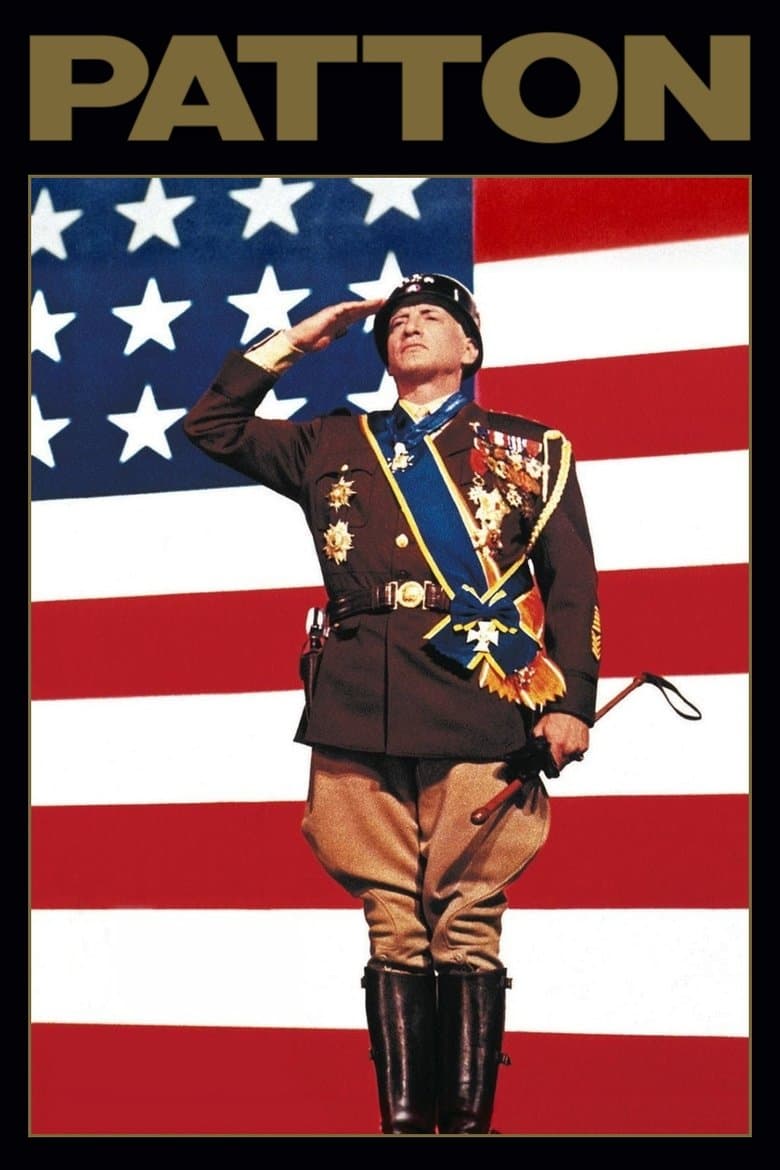
- The famous opening speech before the giant American flag, which immediately frames Patton as both military icon and self-created myth.
- How Franklin J. Schaffner stages battle scenes to reveal not only strategy and scale but Patton’s appetite for momentum, control, and theatrical command.
- The tension between Patton’s instinctive brilliance and the political realities around him, which gradually turns the film from triumphal portrait into something more conflicted and revealing.
Production notes
Patton was Franklin J. Schaffner's biographical war drama about American General George S. Patton's command across the European theater during World War II. The screenplay was credited to Francis Ford Coppola and Edmund H. North — the Coppola screenplay was an early major credit for the director who would within two years be making The Godfather. The film was Twentieth Century-Fox's prestige war production, with substantial location work in Spain, Morocco, and England. George C. Scott played the title role in a performance widely considered the most thorough channeling of an actual American military figure in cinema history. The cast included Karl Malden as General Omar Bradley, Stephen Young as Captain Charles Codman, Michael Bates as British Field Marshal Bernard Montgomery, Karl Michael Vogler as German Field Marshal Erwin Rommel, James Edwards as Sgt. William Meeks, and Frank Latimore as Lt. Colonel Henry Davenport. The famous opening sequence — Patton's address to the audience against an enormous American flag — has remained one of the most influential film openings in any American cinema. Cinematographer Fred Koenekamp shot the film. Composer Jerry Goldsmith contributed the score. Production cost approximately $12.6 million.
Trivia
- George C. Scott famously refused to accept his Best Actor Academy Award for Patton, becoming the first actor in Oscar history to refuse the award; Scott had previously stated his opposition to the Academy's competitive-acting awards as 'a meat parade,' and his rejection of the Patton Oscar became one of the most public acts of awards-show defiance in Hollywood history.
- Francis Ford Coppola's screenplay was an early major credit for the director who would within two years be making The Godfather; Coppola won the Academy Award for Best Original Screenplay for Patton — his first Oscar — and the win established his Hollywood credibility leading directly to the Godfather project.
- The famous opening sequence — Patton's address to the audience against an enormous American flag — has remained one of the most influential film openings in any American cinema; the sequence was reportedly shot in one take of approximately seven minutes, with George C. Scott delivering the entire monologue without prompting.
- Karl Malden's role as General Omar Bradley reportedly required substantial historical-figure research; Malden interviewed the actual General Omar Bradley (then in retirement) before filming, drawing on Bradley's accounts of his Patton command relationship to shape the performance.
- Patton won seven Academy Awards including Best Picture, Best Director (Schaffner), Best Actor (Scott, refused), Best Original Screenplay (Coppola), Best Film Editing, Best Sound, and Best Art Direction; the win was a substantial commercial and critical success for Twentieth Century-Fox during one of the studio's more difficult financial periods.
Legacy
Patton won seven Academy Awards including Best Picture, Best Director (Franklin J. Schaffner), and Best Actor (George C. Scott, refused). It was selected for the National Film Registry in 2003. The famous opening sequence — Patton's address to the audience against an enormous American flag — has been continuously celebrated as one of the most influential film openings in any American cinema and has been continuously referenced and parodied across decades of subsequent media. George C. Scott's performance has been widely considered the most thorough channeling of an actual American military figure in cinema history. Francis Ford Coppola's Oscar-winning screenplay was the first of his Academy Award wins — his subsequent work on the Godfather films would extend the run — and the screenplay established him as a major Hollywood writer leading directly to the Godfather project. The film's depiction of Patton — the morally complicated genius-general whose talent and personal flaws are equally amplified by war — established a template for subsequent biographical-military cinema. Among American biographical-war films of the postwar era, Patton remains the canonical text.