One Flew Over the Cuckoo's Nest
Vibe
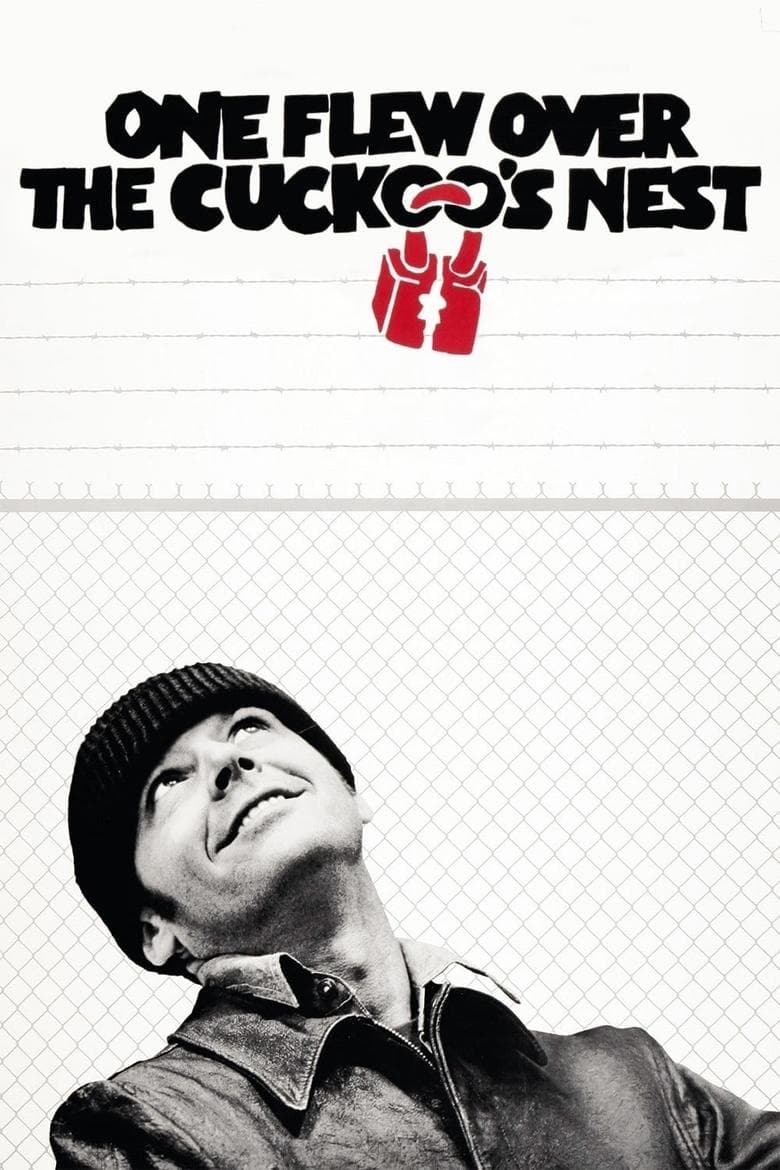
Miloš Forman’s powerful drama unfolds inside a psychiatric hospital where rebellious new patient Randle McMurphy challenges the rigid authority of head nurse Mildred Ratched. McMurphy’s defiant humor and disregard for rules inspire the other patients to rediscover their individuality and sense of dignity, gradually turning the ward into a battleground between personal freedom and institutional control. Jack Nicholson delivers a magnetic performance as the charismatic McMurphy, while Louise Fletcher’s coldly controlled Nurse Ratched stands as one of cinema’s most unforgettable antagonists. Adapted from Ken Kesey’s novel, the film blends humor, tragedy, and sharp social critique. Its emotional power and cultural impact helped it sweep the Academy Awards’ “Big Five,” cementing its place as a landmark of 1970s American cinema.
Watch for
- Jack Nicholson’s energetic performance as McMurphy, whose humor and defiance gradually inspire the other patients.
- Louise Fletcher’s chilling portrayal of Nurse Ratched, whose calm authority masks an iron grip over the ward.
- The ensemble cast of patients, whose small moments of growth and rebellion reveal the film’s deeper emotional stakes.
- The film’s powerful final act, where the cost of challenging institutional power becomes heartbreakingly clear.
Production notes
One Flew Over the Cuckoo's Nest was Miloš Forman's adaptation of Ken Kesey's 1962 novel, produced by Saul Zaentz and Michael Douglas (whose father, Kirk Douglas, had owned the rights since the early 1960s but had been unable to find studio financing for what was considered uncommercial subject matter). Lawrence Hauben and Bo Goldman wrote the screenplay. Jack Nicholson played Randle McMurphy in a performance widely considered his career masterwork; Louise Fletcher played the tyrannical Nurse Ratched, with Will Sampson as Chief Bromden, William Redfield as Harding, Christopher Lloyd in his film debut as Taber, and Brad Dourif (in his film debut) as Billy Bibbit. The film was shot at Oregon State Hospital in Salem — a real psychiatric facility — using actual patients alongside the professional cast. Cinematographer Haskell Wexler was credited with the production but reportedly had a contentious relationship with Forman that affected attribution. Composer Jack Nitzsche contributed the score. Production cost approximately $4.4 million.
Trivia
- Ken Kesey, the source novel's author, refused to see the film and rejected its $25,000 royalty advance; he objected to the elimination of the novel's first-person Chief Bromden narration, which had been central to the book's structure, and he never reconciled with the production.
- Production took place at Oregon State Hospital in Salem — a real psychiatric facility — and used actual patients alongside the professional cast as ward extras; the production reportedly affected the cast deeply, with Nicholson and Brad Dourif particularly shaken by the experience.
- Christopher Lloyd, William Redfield, Brad Dourif, and Vincent Schiavelli all made their feature film debuts in the film; Lloyd would go on to Back to the Future and Taxi, Dourif to Lord of the Rings and Chucky, and Schiavelli to Ghost and Buffy the Vampire Slayer.
- The film became only the second in Academy Award history to sweep the 'Big Five' awards — Best Picture, Best Director (Forman), Best Actor (Nicholson), Best Actress (Fletcher), and Best Adapted Screenplay; the previous sweep had been It Happened One Night in 1934, and the achievement would not be matched again until The Silence of the Lambs in 1991.
- Louise Fletcher's portrayal of Nurse Ratched was so effective that Fletcher reportedly received hate mail for years afterward; the character has remained one of the most iconic villains in American cinema, ranked #5 on the AFI's list of greatest film villains.
Legacy
One Flew Over the Cuckoo's Nest swept the Academy Awards' 'Big Five' — Best Picture, Best Director (Forman), Best Actor (Nicholson), Best Actress (Fletcher), and Best Adapted Screenplay — only the second film to do so (after It Happened One Night in 1934), and the only film to do so for forty-six years until The Silence of the Lambs matched it in 1991. It was selected for the National Film Registry in 1993. The film's depiction of psychiatric institutions, electroconvulsive therapy, and involuntary commitment contributed substantially to public conversations about mental-health institutionalization that culminated in the 1980s-era deinstitutionalization movement. Nurse Ratched became one of the canonical villains in American film, with Louise Fletcher's performance anchoring decades of subsequent media engagement with institutional cruelty. Jack Nicholson's McMurphy is widely considered his career masterwork, and the film established the template for his subsequent rebel-hero performances. Among 1970s American cinema, the film stands alongside Chinatown, The Godfather, and Taxi Driver as the high-water marks of the era's serious dramatic ambition.