North by Northwest
Vibe
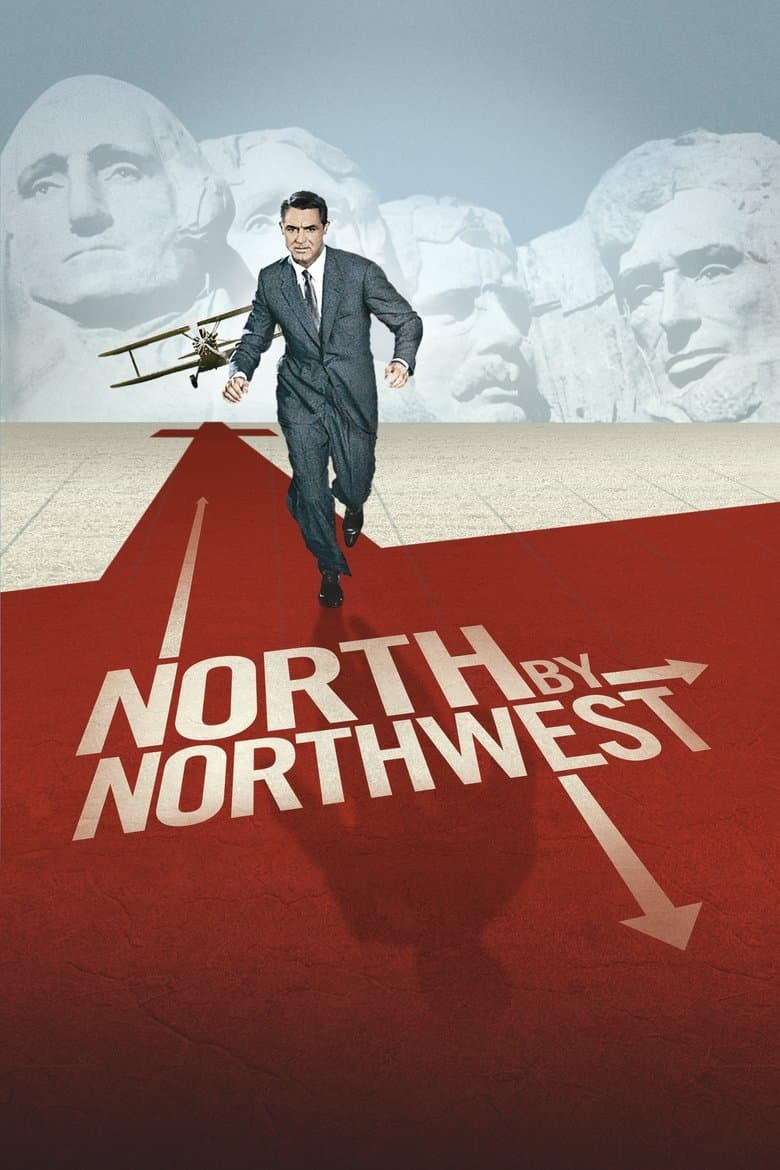
Alfred Hitchcock’s dazzling chase thriller follows Roger Thornhill, a Madison Avenue executive who is mistaken for a government operative and thrust into a deadly world of espionage, deception, and pursuit. What begins as a case of mistaken identity expands into a sleek cross-country adventure, carrying Thornhill from New York to the open plains and finally to Mount Rushmore itself. Along the way, he is drawn to the enigmatic Eve Kendall, whose charm and secrecy deepen the film’s atmosphere of uncertainty and seduction. Cary Grant’s effortless wit and sophistication anchor the film, while Hitchcock’s masterly control of pace, space, and suspense turns each sequence into a model of cinematic precision. Blending romance, danger, humor, and spectacle, North by Northwest remains one of the defining achievements of the classic Hollywood thriller.
Watch for
- Cary Grant’s performance, which uses timing, composure, and dry humor to make Thornhill’s escalating panic both believable and irresistibly entertaining.
- Hitchcock’s use of space, especially the contrast between crowded interiors and exposed landscapes in the United Nations, crop-duster, and Mount Rushmore sequences.
- Eva Marie Saint’s layered turn as Eve Kendall, whose poise, flirtation, and ambiguity continually shift the emotional and narrative balance of the film.
- Bernard Herrmann’s propulsive score and the film’s crisp visual construction, which give the action its elegance, momentum, and unmistakable sense of style.
Production notes
North by Northwest was Alfred Hitchcock's MGM thriller, with the screenplay by Ernest Lehman — who had specifically asked Hitchcock 'I want to do the Hitchcock picture to end all Hitchcock pictures' and developed the project around that ambition. Cary Grant played the advertising executive Roger O. Thornhill, in his fourth and final Hitchcock film after Suspicion (1941), Notorious (1946), and To Catch a Thief (1955). Eva Marie Saint played the morally ambiguous spy Eve Kendall, with James Mason as the villain Phillip Vandamm, Martin Landau (in his film debut) as Vandamm's deputy Leonard, Leo G. Carroll as 'The Professor,' and Jessie Royce Landis as Roger's mother Clara Thornhill. The film's most famous sequences — the Mount Rushmore climax (achieved primarily through matte painting and studio sets, since the National Park Service prohibited actual on-location work), the cropduster-attack sequence in an Indiana cornfield (entirely studio-built), and the Chicago LaSalle Street Station sequences — were all extensively planned through Hitchcock's signature shot-by-shot storyboarding. Cinematographer Robert Burks shot the film in VistaVision. Composer Bernard Herrmann contributed the iconic score. Production cost approximately $4 million.
Trivia
- The cropduster-attack sequence — Cary Grant being chased through an Indiana cornfield by a low-flying biplane — was deliberately constructed as the inverse of typical thriller suspense; Hitchcock noted that danger in cinema is usually associated with darkness and confined space, while the cropduster sequence happens in broad daylight in open landscape, making the threat all the more disorienting.
- The Mount Rushmore climax was shot primarily through matte painting and studio sets — the National Park Service prohibited actual on-location filming on the monument itself, considering it disrespectful to the presidential heads — and Hitchcock had to construct elaborate scaled replicas for the principal photography.
- Eva Marie Saint had previously won the Academy Award for Best Supporting Actress for her debut in On the Waterfront (1954); North by Northwest was her transition from method-acting dramatic work to glamorous Hitchcock-blonde romantic-thriller heroine, a transition handled with notable elegance.
- Martin Landau's film debut was as Vandamm's hostile deputy Leonard; the role launched his subsequent six-decade career, including his Academy Award win for Tim Burton's Ed Wood (1994) thirty-five years after this debut.
- Bernard Herrmann's score for North by Northwest is regularly cited as one of the great American film scores; the kinetic main theme, with its dissonant strings and percussive momentum, became one of the most influential pieces of thriller music ever composed.
Legacy
North by Northwest is widely regarded as the apex of Alfred Hitchcock's commercial-thriller filmmaking — a film that synthesized the techniques of his entire career into a single perfectly constructed adventure. It received three Academy Award nominations (Best Original Screenplay, Best Art Direction, and Best Film Editing) and won none, an outcome that has aged into one of the most-discussed snubs of late-1950s Oscar voting. It was selected for the National Film Registry in 1995. The cropduster sequence is one of the most-studied set pieces in any thriller film, regularly cited in film schools and quoted across decades of subsequent action and suspense work. The Mount Rushmore climax has become permanent visual shorthand for thriller cinema, parodied and referenced across decades of American comedy and action films. Cary Grant's Roger Thornhill — the urbane advertising executive thrown into espionage chaos — established the 'wrong man caught in spy plot' template that would shape subsequent thrillers from The 39 Steps to the entire James Bond and Jason Bourne franchises. Among Hitchcock's films, North by Northwest is regularly cited as the most thoroughly entertaining synthesis of his complete craft.