My Fair Lady
Vibe
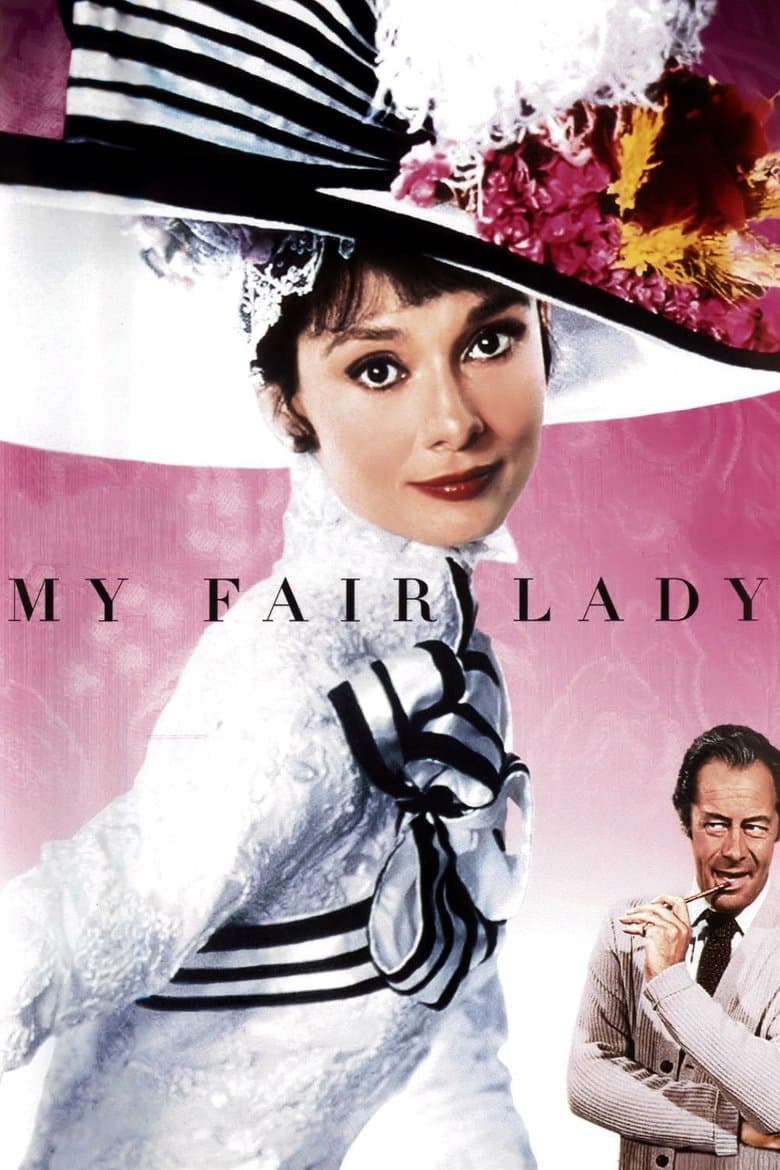
George Cukor’s elegant musical adaptation of Pygmalion follows phonetics professor Henry Higgins, who wagers that he can transform Eliza Doolittle, a Cockney flower seller, into a lady fit for high society simply by changing the way she speaks. As Eliza masters language, posture, and social ritual, the experiment grows into something more revealing, exposing the rigid codes of class as well as the limits of Higgins’s own self-awareness. Audrey Hepburn brings grace and emotional warmth to Eliza, while Rex Harrison’s brisk, talk-sung performance gives Higgins his brilliant arrogance. With its lavish design, memorable songs, and enduring wit, My Fair Lady remains one of the most celebrated movie musicals ever made.
Watch for
- Rex Harrison’s distinctive performance style, which turns Higgins’s dialogue into rhythmic musical expression and gives the character both comic brilliance and emotional blindness.
- How Eliza’s transformation is conveyed not just through costume and speech, but through shifts in confidence, posture, and presence.
- The film’s lavish production design and costume work, which turn drawing rooms, racecourses, and ballrooms into visual expressions of social hierarchy.
- The tension beneath the elegance, especially in scenes where the musical’s charm gives way to sharper questions about control, independence, and what Eliza’s transformation is really for.
Production notes
My Fair Lady was George Cukor's lavish adaptation of the 1956 Lerner and Loewe Broadway musical (based on George Bernard Shaw's 1913 play Pygmalion). The film was Warner Bros.'s prestige musical production with substantial casting controversy: Julie Andrews had originated the role of Eliza Doolittle on Broadway but was passed over for the film in favor of Audrey Hepburn, who was more commercially established. Andrews's loss became one of the most-discussed casting decisions of the 1960s — and ironically, Andrews won the 1964 Best Actress Academy Award for Mary Poppins (released the same year) while Hepburn was not even nominated for My Fair Lady. The screenplay was credited to Alan Jay Lerner, who had also written the Broadway book and lyrics. Rex Harrison reprised his Broadway role as Professor Henry Higgins, with Hepburn as Eliza Doolittle (her singing dubbed by Marni Nixon), Stanley Holloway as Alfred P. Doolittle, Wilfrid Hyde-White as Colonel Pickering, Theodore Bikel as Zoltan Karpathy, and Jeremy Brett as Freddy Eynsford-Hill. Cinematographer Harry Stradling Sr. shot the film. Composer André Previn conducted the score. Production cost approximately $17 million.
Trivia
- Julie Andrews had originated the role of Eliza Doolittle on Broadway but was passed over for the film in favor of Audrey Hepburn — who was more commercially established at the time; ironically, Andrews won the 1964 Best Actress Academy Award for Mary Poppins (released the same year) while Hepburn was not even nominated for My Fair Lady, vindication that Andrews substantially appreciated.
- Audrey Hepburn's singing was dubbed by Marni Nixon — the same off-screen vocal performer who had dubbed Natalie Wood in West Side Story (1961) and Deborah Kerr in The King and I (1956); Hepburn had wanted to sing the role herself and reportedly recorded many tracks, but Warner Bros. used Nixon's dubbing for the final film.
- Rex Harrison's distinctive talk-singing approach to his musical numbers — speaking lines on pitch rather than singing them traditionally — became one of the most influential musical-theater performance approaches of the postwar era; Harrison's technique influenced subsequent decades of similar work, from Richard Burton's Camelot performance to Rex Harrison's own subsequent musical work.
- Cecil Beaton designed both the costumes and the production design — extending the famous Ascot Gavotte sequence's elaborate black-and-white visual approach that Beaton had developed for the original Broadway production; Beaton won two Academy Awards for the film (Best Art Direction and Best Costume Design), and his visual approach has been continuously referenced across decades of subsequent musical-theater design.
- My Fair Lady won eight Academy Awards including Best Picture, Best Director (Cukor), Best Actor (Rex Harrison), Best Cinematography, Best Art Direction (Beaton), Best Costume Design (Beaton), Best Sound, and Best Adaptation Score; it remains one of the most thoroughly Oscar-celebrated musical films in Hollywood history.
Legacy
My Fair Lady won eight Academy Awards including Best Picture, Best Director (George Cukor), and Best Actor (Rex Harrison). It was selected for the National Film Registry in 2018. The film's casting controversy — Julie Andrews's loss to Audrey Hepburn followed by Andrews's Mary Poppins Oscar win for the same year — became one of the most-discussed casting decisions of the 1960s, and the parallel-careers-of-Andrews-and-Hepburn has been continuously studied as a case study in Hollywood casting politics. The film's Lerner and Loewe songs — 'I Could Have Danced All Night,' 'On the Street Where You Live,' 'Get Me to the Church on Time,' 'I've Grown Accustomed to Her Face' — have become some of the most-performed pieces in American musical theater repertoire, recorded across countless artists and contexts. Among American film musicals of the 1960s, My Fair Lady sits alongside The Sound of Music (1965) and West Side Story (1961) as the high-water marks of the form, though My Fair Lady's specific approach to integrating Shaw's social-class commentary with Broadway-musical conventions remains uniquely successful — making it one of the most thoroughly intelligent musical-comedy syntheses in any cinema.