Mutiny on the Bounty
Vibe
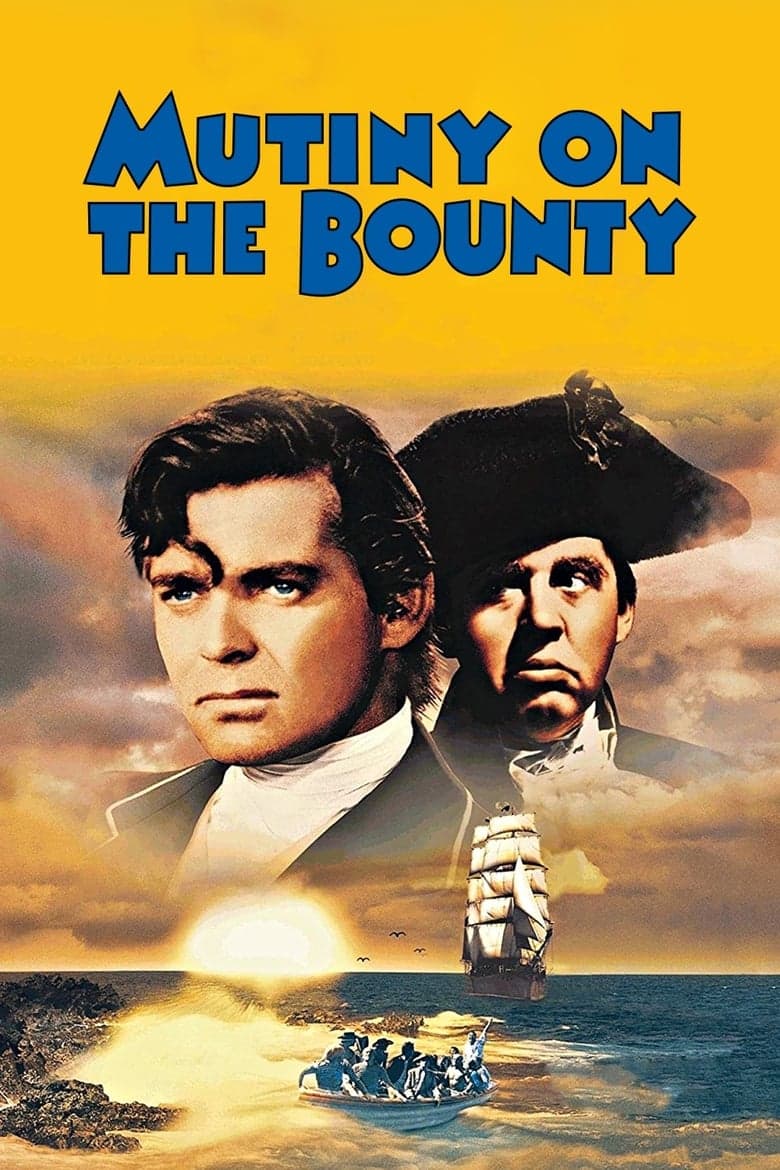
This classic adventure drama dramatizes the famous eighteenth-century uprising aboard HMS Bounty, where the cruelty of Captain William Bligh pushes his crew toward open rebellion. As Bligh’s rigid discipline and humiliating punishments grow increasingly unbearable, first officer Fletcher Christian emerges as the man willing to defy him. The conflict between the two turns the voyage into a gripping struggle over authority, justice, and survival at sea. Clark Gable brings charisma and moral conviction to Christian, while Charles Laughton gives Bligh a chilling mix of arrogance, obsession, and severity. With its grand seafaring spectacle and sharp human conflict, Mutiny on the Bounty remains one of Hollywood’s most enduring adventure films.
Watch for
- Charles Laughton’s performance as Captain Bligh, especially the way his clipped authority and cold fury make cruelty feel methodical rather than explosive.
- The contrast between Gable’s natural ease and Laughton’s rigid intensity, which gives the film’s power struggle its emotional charge from the very beginning.
- How shipboard routines, punishments, and cramped spaces create a mounting sense of tension long before the mutiny itself erupts.
- The film’s use of the sea and the ship as both adventure setting and moral pressure cooker, where questions of loyalty, fear, and command become impossible to avoid.
Production notes
Mutiny on the Bounty was Frank Lloyd's MGM adaptation of Charles Nordhoff and James Norman Hall's 1932 novel — the second-published volume of their Bounty trilogy, dramatizing the actual 1789 mutiny aboard the British naval ship HMS Bounty. The screenplay was credited to Talbot Jennings, Jules Furthman, and Carey Wilson, drawing extensively on the source novel as well as additional historical sources. Clark Gable played the mutiny leader Fletcher Christian, with Charles Laughton as the brutal Captain William Bligh — a performance that has remained the canonical Hollywood villain portrayal of historical authority figures. Franchot Tone played the midshipman Roger Byam, with Herbert Mundin, Donald Crisp, Movita Castaneda as Tehani, and Mamo Clark as Maimiti. The film was shot extensively on location in Tahiti — at the actual South Pacific island where the historical Bounty mutiny had occurred — and was one of the most expensive Hollywood productions to that point. Cinematographer Arthur Edeson shot the film. Composer Herbert Stothart contributed the score. Production cost approximately $1.9 million.
Trivia
- Mutiny on the Bounty is the only film in Academy history to receive three Best Actor nominations in a single year — Clark Gable, Charles Laughton, and Franchot Tone all received Best Actor nominations for the same film, an outcome that contributed to the subsequent introduction of the Best Supporting Actor and Actress categories the following year (1936).
- Charles Laughton's performance as Captain William Bligh has remained the canonical Hollywood villain portrayal of historical authority figures; Laughton was 36 when he made the film and had been working in major Hollywood roles for several years, but his Bligh established him as the dominant character actor of the late-1930s and 1940s.
- The film was shot extensively on location in Tahiti — at the actual South Pacific island where the historical Bounty mutiny had occurred — and was one of the most expensive Hollywood productions to that point; the location work required transport of approximately 200 cast and crew members across nearly six months of production.
- Mutiny on the Bounty won the Academy Award for Best Picture, defeating Captain Blood, Top Hat, and other 1935 contenders; it was the third major MGM Best Picture win in five years (after The Big House in 1930 and Grand Hotel in 1932), establishing the studio as the dominant prestige-feature producer of the early 1930s.
- The 1962 Lewis Milestone-directed remake starring Marlon Brando as Fletcher Christian was a substantial commercial failure that contributed to MGM's late-period financial difficulties; the production had been notoriously chaotic, with Brando's behavior reportedly contributing to substantial schedule and budget overruns, and the film's box-office failure helped end the era of major-budget historical epics.
Legacy
Mutiny on the Bounty won the Academy Award for Best Picture, defeating Captain Blood, Top Hat, and other 1935 contenders. It received eight total nominations and won one (Best Picture). It was selected for the National Film Registry in 2006. The film established the historical-naval-adventure template that would shape subsequent decades of similar productions, with direct lineage to Master and Commander: The Far Side of the World (2003) and the Pirates of the Caribbean franchise. Charles Laughton's Captain Bligh has remained the canonical Hollywood villain portrayal of historical authority figures, embedded in popular consciousness through decades of subsequent reference. The 1962 Lewis Milestone-directed remake starring Marlon Brando as Fletcher Christian was a substantial commercial failure; the 1984 Roger Donaldson-directed version starring Mel Gibson and Anthony Hopkins as the leads was also unsuccessful at matching the original's cultural reach. Among Hollywood naval-historical adventures of the 1930s, Mutiny on the Bounty stands as the most thoroughly successful and the most enduringly influential — a film whose commercial and critical legacy has substantially outlived its subsequent remakes.